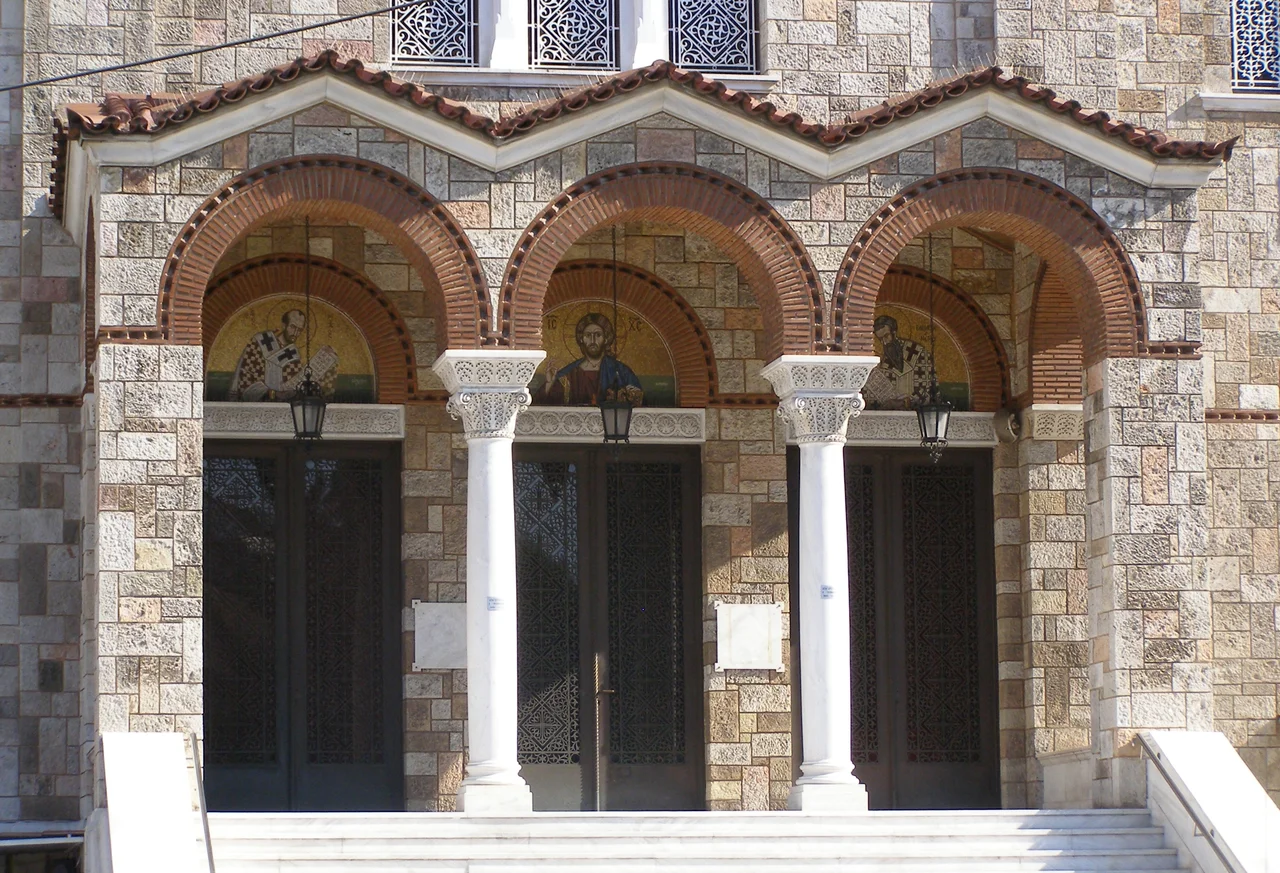

Hagia Triada Cathedral, Piraeus
On January 11, 1944, Allied bombers struck Piraeus. Among the buildings destroyed was the church of the Holy Trinity — Hagia Triada — which had stood in the city since 1845. It was not empty when the bombs fell. People had taken shelter inside the church, as people do in war, and some of them died there. That the church was demolished not by an occupying enemy but by Allied aircraft targeting the harbor is one of the less comfortable facts of the Second World War in Greece. What stands in its place today is the current Hagia Triada Cathedral, whose construction began in 1956 and which was inaugurated in 1964 before reaching full completion in 1979 — the largest church in Piraeus and the metropolitan seat of Greek Orthodoxy in the city.
Built in the First Years of Freedom
Construction of the original Hagia Triada began in 1839, just a few years after Greece secured independence from the Ottoman Empire. It was a time of national institution-building, and Piraeus was being reimagined as the new Greek state's primary port — a city rising quickly from a small settlement to a major maritime hub. The church, completed in 1845 and decorated with murals by 1844, was part of that founding energy. The Holy Trinity was not simply a neighborhood church; it served as the spiritual center of what would become one of the Mediterranean's busiest ports. For nearly a century, it stood at the heart of Piraeus life — through wars, waves of migration, industrial expansion, and the convulsions of the early twentieth century.
The Bombing and the Loss
By 1944, Greece was under Axis occupation and Piraeus harbor was a strategic target. Allied forces were bombing German supply lines and port infrastructure throughout occupied Europe. On January 11, the raid on Piraeus destroyed the original Hagia Triada. The people who had sought refuge inside the church were killed. The destruction of a church full of sheltering civilians — even as an unintended consequence of a militarily justified strike — sits uneasily in any account of the war. Piraeus mourned the loss of both its people and its century-old cathedral. The ruins remained until the postwar decades, when the community eventually turned to rebuilding.
The Cathedral That Stands Today
The current Hagia Triada Cathedral was begun in 1956, inaugurated on May 17, 1964, and fully completed in 1979, rising on the same ground as its predecessor. It is a substantial building — the largest church in its community — with a portico, a dome, and an iconostasis that visitors still photograph for its gilded artistry. The architectural language is the broad Byzantine-influenced Greek Orthodox idiom: whitewashed walls, measured proportions, interior light that falls differently at different hours. The cathedral functions as the metropolitan seat of the Holy Metropolis of Piraeus, meaning it is the formal ecclesiastical headquarters for Greek Orthodoxy throughout the greater Piraeus region. Services here carry institutional weight that smaller neighborhood churches do not.
Orthodoxy in a Port City
Piraeus is a working city — cargo ships, ferry terminals, the constant movement of people and goods through the largest port in Greece. Against that backdrop, Hagia Triada has served as an anchor of continuity. Greek Orthodoxy is deeply embedded in public life here: feast days, memorial services, the marking of births and deaths, the rhythms of the liturgical year woven into the rhythms of the city. The cathedral's calendar intersects with civic life in ways that are difficult to separate. The Icon of the Raising of Lazarus, noted by visitors to the church, is one of several artworks that give the interior its particular character — the church is not a museum, but it holds things worth lingering over.
A Site Layered with Time
Standing outside Hagia Triada today, you are on ground that has held a church for nearly two centuries, in a city that has experienced independence, invasion, occupation, liberation, refugee waves, and rapid modernization. The current building — begun in 1956 and completed in 1979 — is the newest chapter in a longer story. Greece is not always comfortable with its wartime complexities — the collaboration, the resistance, the Allied damage, the civil war that followed liberation — and memorials tend to emphasize certain things over others. Hagia Triada simply stands, rebuilt, in use, welcoming visitors and worshippers who may or may not know what happened on this site in January 1944. The church offers no dramatic interpretation. It just continues to exist, which is its own form of witness.
From the Air
Hagia Triada Cathedral sits in central Piraeus at approximately 37.944°N, 23.645°E, close to the city's main commercial and civic core. From the air, Piraeus is distinguished by its peninsular geography extending into the Saronic Gulf, surrounded on three sides by water. The cathedral's dome is visible among the dense urban fabric from low altitudes. The nearest major airport is Athens International Eleftherios Venizelos (LGAV), about 25 km to the east-northeast. Flying in from the coast, Piraeus's multiple harbor basins serve as clear orientation points; Hagia Triada lies slightly inland from the main waterfront, north of the central port.
Nearby Stories
- Parnitha 3.4 km away
- Kea (island) 7.3 km away
- Sanctuary of Apollo Maleatas 11 km away
- Sousaki Volcano 12 km away
- Battle of Leuctra 14 km away
- Great Sand Beach 18 km away
- Agios Georgios (island) 23 km away
- Skyros 84 km away