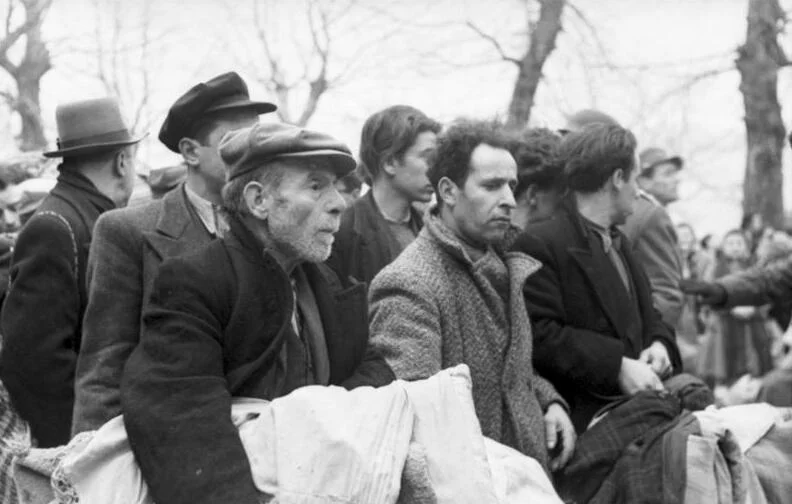

Haidari Concentration Camp
The prisoners gave it the name themselves. They called it the "Bastille of Greece" - a fortress for the politically dangerous, a place from which few expected to walk out unchanged, and from which many never walked out at all. Haidari sits on the western edge of Athens, on the grounds of an unfinished army barracks, and for one year, from September 1943 to September 1944, it was the largest and most feared concentration camp in occupied Greece. Some 21,000 people passed through its blocks: Greek resistance fighters, Italian prisoners of war, and Greek Jews held briefly before deportation north. About 2,000 were executed here. The rest were sent on - to forced labour in Germany, or, in the case of the Jews, to Auschwitz.
How It Began
For most of the occupation, southern Greece lay under Italian control, and the regime in the camps was comparatively lax. When the first political prisoners arrived at Haidari in early September 1943 - 600 people sent up from Larissa, including 243 communists who had already been jailed since before the war under the Metaxas dictatorship - they could still receive visits and letters, and were not forced to labour. That mercy lasted barely a week. Italy surrendered to the Allies on 8 September, and on 10 September the Germans took over the camp. The SS imposed a far harsher order: prisoners confined to their rooms, visits cut to once a month, and a regime of fear deliberately maintained.
The Men Who Ran It
One commandant casts the longest shadow. Paul Radomski, an early Nazi Party member, had run the Syrets camp near Kiev with a terror so brutal that even fellow SS officers recoiled; his own file called him "primitive." An eyewitness, Constantine Vatikiotis, arrested in October 1943, later described Radomski personally shooting a Jewish prisoner named Levy in front of the assembled inmates, supposedly for an escape attempt on the day of his arrest. The killing was a message, calculated to keep everyone in constant fear of their lives. Vatikiotis estimated that 2,000 people were executed during the months he spent there. Radomski's successor, Karl Fischer, traded open brutality for a quieter cruelty: a web of informants and spies planted among the prisoners themselves.
The Day Two Hundred Were Taken
The single act for which Haidari is most remembered came on May Day, 1944. After ELAS partisans ambushed and killed the German general Franz Krech in the southern Peloponnese, the occupiers chose 200 communist prisoners from Haidari and shot them at the Kaisariani rifle range on 1 May. Reprisal killing on this scale was not exceptional in those months - through the spring and summer of 1944 the Germans swept Athens with mass arrests and raids, and the camp's population swelled to several thousand. But the May Day 200 became a symbol. They had been singled out, named on a list, and marched out to die for the act of partisans they had never met. Survivors said many of them faced the firing squad singing.
The Jews of Haidari
The Germans had already deported the Jews of Thessaloniki in 1943, but the communities of the formerly Italian zone were left untouched until the spring of 1944. The first Jewish prisoners reached Haidari in December 1943, held apart in the basement of Block 3. Then, in late March, the machinery of deportation closed in everywhere at once. On 23 March, between 700 and 1,000 Jews of Athens were rounded up and brought here; days later came 614 more from Epirus and western Greece, among them families who had carried foreign passports they believed would protect them. Haidari was the funnel. Almost all of those deported from the old Italian zone were murdered within days of reaching Auschwitz-Birkenau in April 1944.
What the Place Became
For decades after the war, Haidari was deliberately forgotten. The camp had become bound up with the memory of the executed communists, and after the Left's defeat in the Greek Civil War, public commemoration of its role in the resistance was suppressed. The site remained a working army base, off limits to mourners and historians alike. Only in the 1980s, with the rise of the socialist PASOK government and new laws recognising the resistance and pursuing national reconciliation, were the gates finally opened for annual remembrance. Block 15, where so many were held, is now a declared national monument; it even appears in the emblem of the Haidari municipality. The people who survived return there still, standing before the same walls.
From the Air
Haidari lies at 38.017°N, 23.65°E, in the western suburbs of Athens, roughly 8 km west of the Acropolis and below the slopes of Mount Aigaleo. The nearest major airport is Athens International (LGAV), about 30 km to the east. From the air the dense low rooftops of western Athens give little hint of the site; the preserved Block 15 and its memorial grounds form a small island of green within the suburb. Best appreciated on the ground, where the surviving blocks can be walked and read.
Nearby Stories
- Great Sand Beach 5 km away
- Battle of Delium 7.7 km away
- Tower of Aliartos 9 km away
- HMHS Britannic 10 km away
- Saronic Gulf 15 km away
- Sousaki Volcano 17 km away
- Sanctuary of Apollo Maleatas 24 km away
- Skyros 66 km away