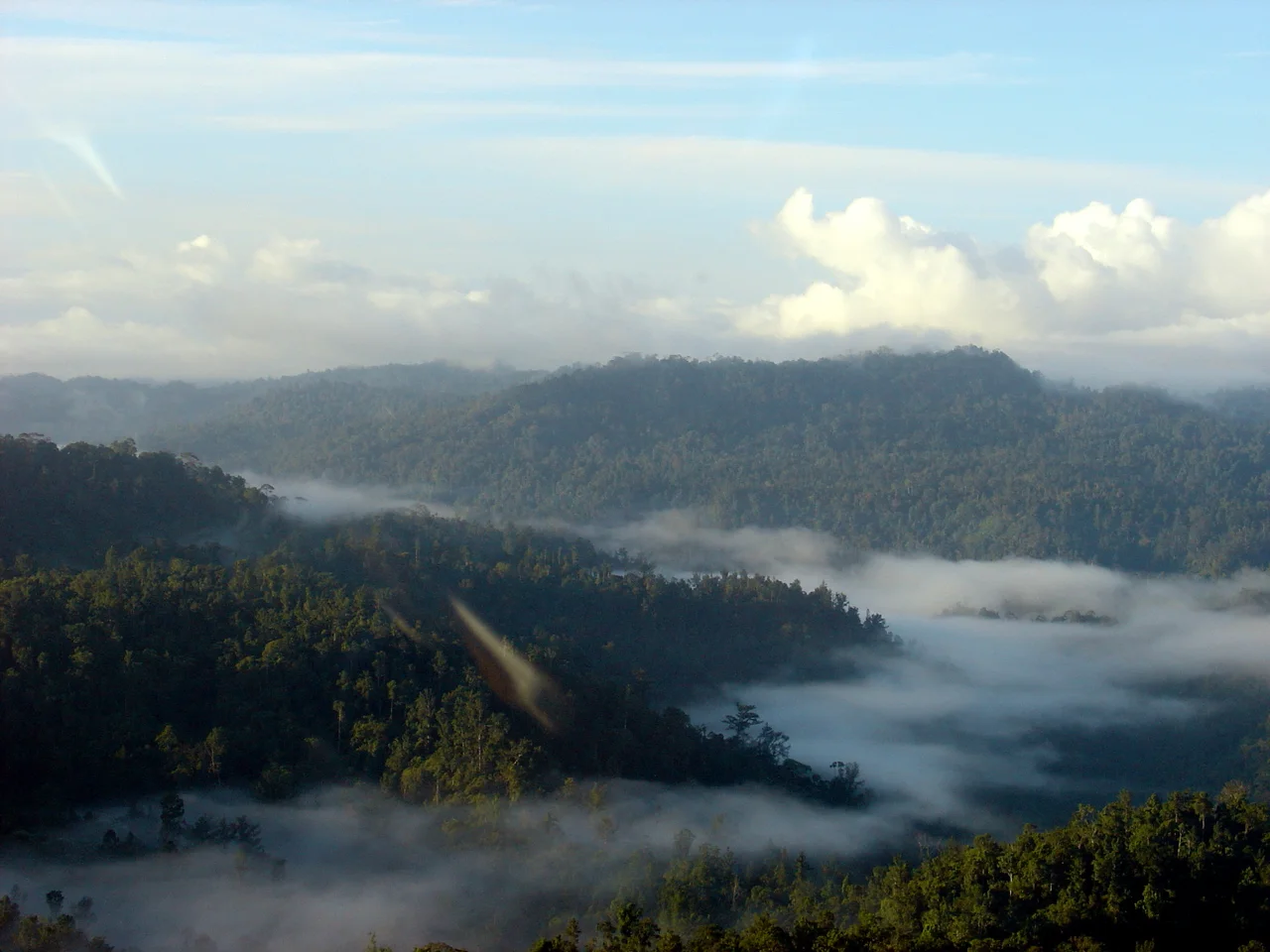

Halmahera Rain Forests
The world's largest bee was lost for 123 years. Wallace's giant bee, Megachile pluto, with a wingspan of six centimeters and jaws like a stag beetle, was first collected by Alfred Russel Wallace in 1858 during his explorations of the northern Maluku Islands. It was not seen again by scientists until 1981 — 123 years later — and even then only briefly. This elusive insect lives in the Halmahera rain forests, a tropical ecoregion that sprawls across Halmahera and its neighboring islands in eastern Indonesia, a place where evolution has been running its own experiment for millions of years, producing creatures found nowhere else on Earth.
The Crossroads of Two Worlds
The Halmahera rain forests occupy a biological borderland. The islands that make up this ecoregion, Halmahera, Bacan, Morotai, the Obi Islands, Ternate, Tidore, Gebe, and many smaller islets, are part of Wallacea, the transitional zone between the Asian and Australasian biological realms. These islands were never connected to either continent, not during the lowest sea levels of the ice ages, not at any point in their geological history. The eastern boundary of the ecoregion follows Lydekker's Line, which separates the Wallacean islands from the Australian-New Guinea continental shelf. Isolated by deep ocean trenches, the animals and plants here evolved in a mixing zone: marsupials that trace their ancestry to Australasia share the forest canopy with species whose nearest relatives live in Southeast Asia.
The Spice Trees
Two trees native to this ecoregion transformed world history. Syzygium aromaticum produces the aromatic flower buds known as cloves, while Myristica fragrans yields both nutmeg and mace from its seeds. For centuries, these were the most valuable commodities on Earth per unit of weight, driving Portuguese, Spanish, Dutch, and British empires to fight wars over a few small volcanic islands. Both trees are still widely cultivated across the ecoregion. The recently discovered palm Jailoloa halmaherensis, found only on Halmahera, suggests that the forests still hold botanical surprises. The main plant communities are tropical lowland evergreen and semi-evergreen rain forest, cloaking the mountainous volcanic terrain up to the slopes of active peaks like Mount Gamkonora, Halmahera's highest point at 1,560 meters.
Creatures of Isolation
Thirty-eight mammal species inhabit the ecoregion, seven of them found nowhere else. The endemics include four species of cuscus, arboreal marsupials with dense fur and prehensile tails whose ancestors rafted across ocean gaps from Australasia. The ornate cuscus, Rothschild's cuscus, the Gebe cuscus, and the blue-eyed cuscus each evolved on separate islands or island groups, diverging in isolation. The masked flying fox, the Obi mosaic-tailed rat, and the Moluccan prehensile-tailed rat round out the endemic mammals. But birds are the real headline: 223 species, 23 of them endemic. Four endemic birds are the sole representatives of their entire genera, including the invisible rail, a flightless bird so secretive that it earned its name from decades of eluding researchers, and two birds of paradise: the Halmahera paradise-crow and the standardwing bird-of-paradise, the latter being what Wallace himself called his greatest prize.
A Forest Under Pressure
A 2017 assessment found that only 8 percent of the ecoregion, roughly 2,052 square kilometers, lies within protected areas. The largest is Aketajawe-Lolobata National Park on Halmahera, covering 1,673 square kilometers of lowland and montane forest. The relatively good news is that almost two-thirds of the unprotected area remains forested. The bad news is that nickel mining, logging, and agricultural conversion are accelerating. The Weda Bay Industrial Park on Halmahera hosts one of the world's largest nickel operations, and Indonesia's 2022 ban on exporting unprocessed nickel ore means the processing now happens on the island, multiplying the industrial footprint. For the invisible rail hiding in the forest, for the giant bee nesting in termite mounds in lowland trees, the question is whether protection can keep pace with extraction.
From the Air
The Halmahera rain forests ecoregion is centered around 0.60N, 127.87E, covering Halmahera and its surrounding islands. From the air, the forest canopy is a dense unbroken green stretching across mountainous volcanic terrain. Mount Gamkonora (1,560 m) on Halmahera is the highest visible peak. The Aketajawe-Lolobata National Park occupies the central-eastern portion of Halmahera. The nearest major airports are Sultan Babullah Airport (WAMN) on Ternate and Kuabang Kao Airport (WAMK) on Halmahera. Best viewed at 15,000-25,000 feet to appreciate the scale of forest cover across the spider-shaped island of Halmahera.
Nearby Stories
- Makian 47 km away
- Aketajawe-Lolobata National Park 61 km away
- The Ocean's Hidden Crossroads 95 km away
- USS Shark (SS-174) 97 km away
- Morotai Island 158 km away
- The Sea That Swallows Itself 223 km away
- Japanese Submarine Ro-41 235 km away
- Bitung 248 km away