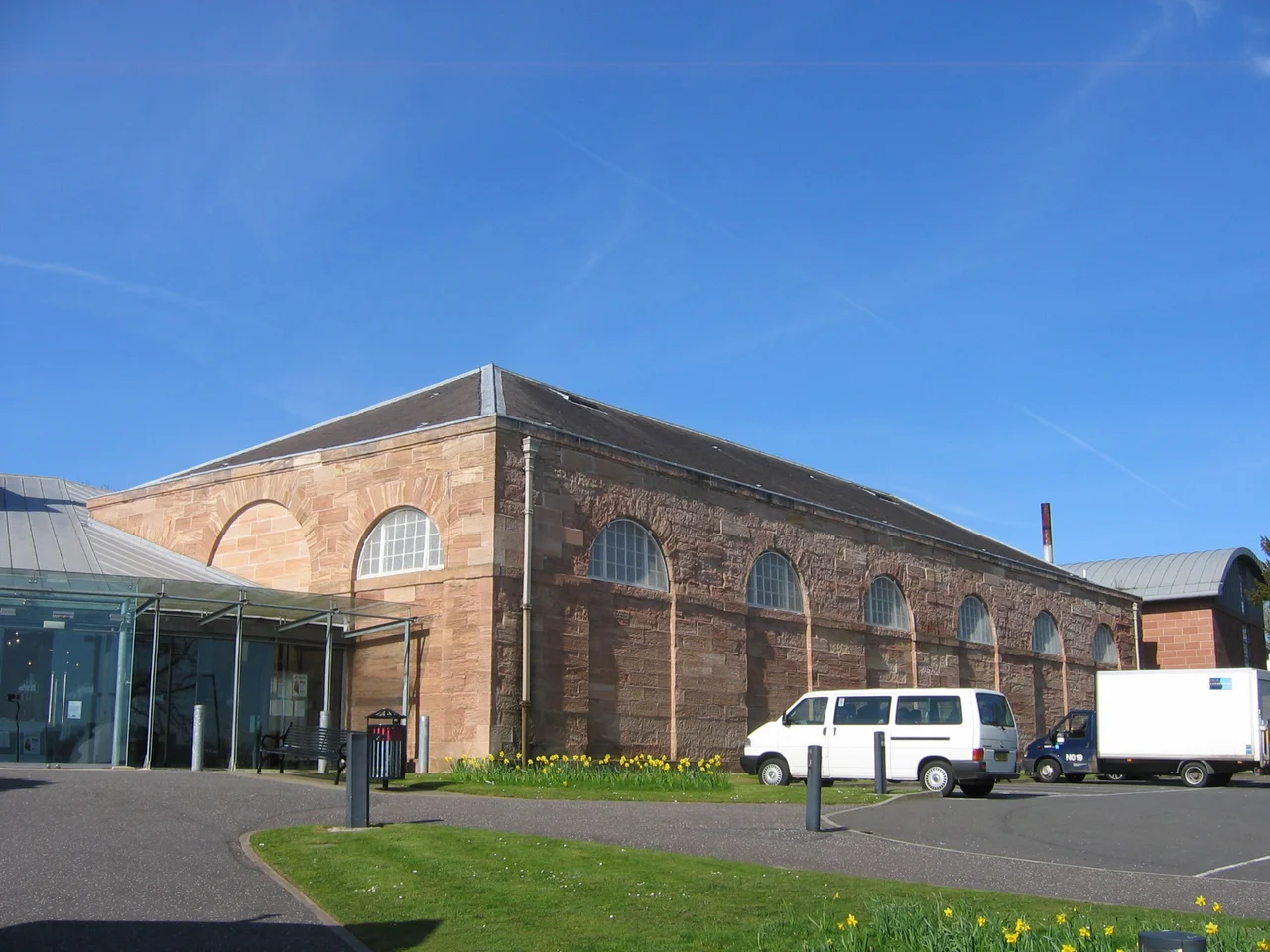

Hamilton Low Parks Museum
The Riding School was built in 1837 for a duke who already had Rubens on his walls and an Egyptian sarcophagus in his entrance hall. By the 1920s the palace those horses served had been sold off in pieces, the largest art auction in British history scattering its contents across the museums of the world. The Riding School survived. So did a townhouse from 1696, built for the Duchess of Hamilton's lawyer. Today those two buildings stand together as the Low Parks Museum, a small institution holding what remains of one of the largest private fortunes Scotland ever assembled.
Two Buildings, One Story
The older of the two is Portland, built in 1696 by the architect James Smith for David Crawford, secretary and lawyer to Anne Hamilton, 3rd Duchess of Hamilton. It sat at the foot of the Hietoun, close to the precincts of the palace it served. Hamilton has lost much of its old fabric across three centuries, but Portland endures and is now thought to be the oldest building in the town. Next to it stands the Duke's Riding School, completed for the 10th Duke in 1842 when his stables court had become inadequate for his ambitions. Both buildings outlived the palace they served. After Hamilton Palace was demolished in the 1920s, the Riding School passed through use as a gymnasium and boxing ring before becoming the regimental museum of the Cameronians in 1983. In 1993 the two buildings were linked into a single museum, both now Category A listed for their national importance.
The Lion of the Covenant
The Cameronians collection is the heart of the museum. The regiment took its name from Richard Cameron, the field preacher killed at Airds Moss in 1680, and from its founding on 14 May 1689 it was the only regiment in the British military with a religious origin. Every original recruit was a Covenanter. The displays include the Bluidy Banner carried by Covenanting forces at the Battle of Bothwell Bridge in 1679, along with over a thousand medals earned by soldiers and officers across nearly three centuries of service, seven of them Victoria Crosses. The regiment was disbanded on 14 May 1968, refusing amalgamation rather than lose its name. Two hundred and seventy-nine years had passed since its founding day.
A Palace Remembered
One gallery is given over to Hamilton Palace itself, demolished between 1921 and 1932 and considered one of the largest single losses to Scottish heritage. The display gathers what could be saved: a floor-to-ceiling mirror, photographs taken in the palace's final years, fragments of the world the Hamiltons spent two centuries building. The same gallery turns to the coal mining that paid for the palace and eventually undermined it, and to the Blantyre Mining Disaster of 1877. A firedamp explosion that morning killed 207 miners. It remains the worst mining disaster in Scottish history, and the museum's small exhibit on it sits among the relics of the family whose collieries lay nearby.
Looms and Clydesdales
Before steel and coal, Lanarkshire ran on weaving and horses. The Textile gallery holds one of the original weavers' looms once found in every cottage in every town across the area, alongside the story of Hamilton's distinctive lacemaking industry, introduced by Duchess Elizabeth in 1752. The agricultural display is built around the Clydesdale, the broad, feather-footed draft horse bred locally for hauling coal carts and ploughing the heavy clay soils of the Clyde valley. Period dramatisations and living history demonstrations bring the displays to life, including At Home with the Duke and Duchess, in which professional actors take on the roles of Anne and the 10th Duke.
Visiting Today
The museum sits inside Strathclyde Country Park, in the old Low Parks where the palace once stood. Admission is free. The Hamilton Mausoleum stands a few minutes away across the grass, and tours of that other surviving fragment can be booked at the museum desk. Together the three sites give visitors the most complete picture available of what Hamilton was before the palace came down: a ducal seat, a Covenanting heartland, a weaving and mining town that built its modest fortunes alongside one of the largest private fortunes in Britain.
From the Air
Located at 55.7795 N, 4.0354 W in Hamilton, South Lanarkshire, Scotland. The museum sits within Strathclyde Country Park between Hamilton and Motherwell. Best viewed from 2,000-3,000 ft. Glasgow Airport (EGPF) lies about 14 nm northwest; Edinburgh Airport (EGPH) about 35 nm east. The M74 motorway runs directly past the park's eastern edge, a useful navigation reference along the Clyde valley.
Nearby Stories
- HMS Gannet 3.6 km away
- Luss 5.3 km away
- Oliver Castle 6.8 km away
- Battle of Bannockburn 6.9 km away
- Beith 7.9 km away
- Pentland Hills 7.9 km away
- Lochleven Castle 16 km away
- Cumnock 17 km away