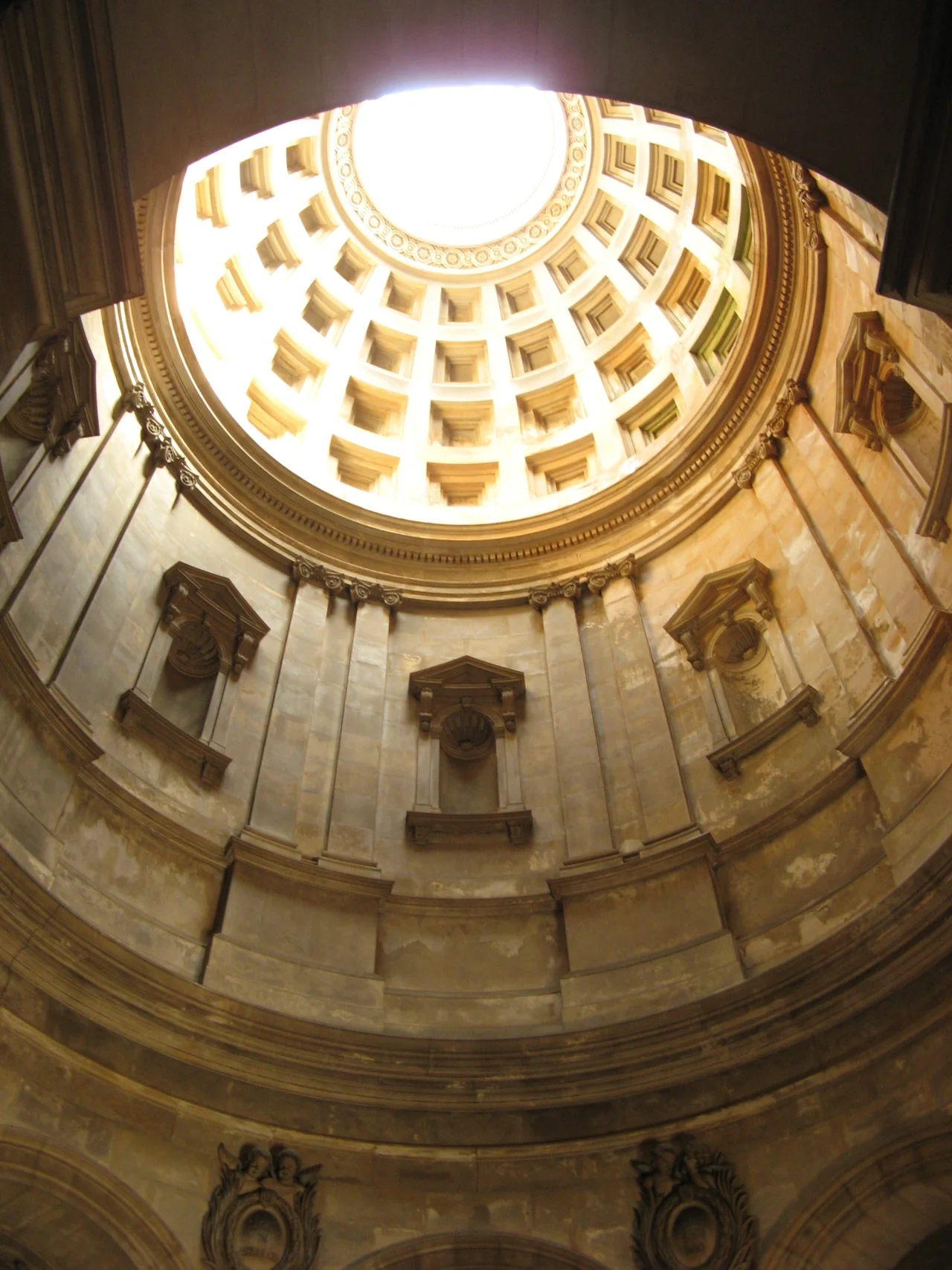

Hamilton Mausoleum
Clap your hands inside the dome and the sound takes fifteen seconds to die. For decades the Hamilton Mausoleum held the record for the longest echo of any man-made structure on Earth, a fact discovered almost by accident in a building meant for absolute stillness. The 10th Duke of Hamilton built it as his final resting place. He was interred inside an Egyptian sarcophagus from the Ptolemaic period, laid on a slab of black marble in the main chapel, with two stone lions flanking the grand stairs at the eastern entrance, one asleep and one awake. None of it kept him there. By 1921 the Clyde was flooding the vault, the palace next door was being torn down for the coal beneath it, and the dukes were being moved out.
The Great Design
Alexander, 10th Duke of Hamilton, did nothing by halves. Already enlarging Hamilton Palace into the grandest country house in Britain, he turned his attention to the family burial vault, which sat in the dilapidated aisle of the old collegiate church. Construction began in 1840 to designs by David Hamilton, with David Bryce and the sculptor Alexander Handyside Ritchie completing the work in 1858, five years after the duke's death. The result rose 123 feet of panelled masonry to a Roman dome, set some 650 feet north of the palace it complemented. Today the mausoleum stands alone in Strathclyde Country Park, the solitary surviving witness to the colossal scale of what once filled the Low Parks.
The Echo
Nobody designed the echo. It came from the geometry: a high stone dome, hard surfaces, a long path for sound to travel and return. A single sharp noise can take roughly fifteen seconds to decay inside the chapel, longer than almost anywhere else humans have built. For years that reverberation was considered the world's longest, until 2014 when measurements at the Inchindown oil storage tanks in the Scottish Highlands recorded a longer figure, classed strictly as a reverberation rather than an echo. The mausoleum still holds its place in acoustic history, and visitors who join the guided tours quickly understand that the building, intended for silence, became famous for sound.
The Dukes Move Out
By the early 1920s, the River Clyde was undermining the building. Subsidence from coal mining and flooding from the river had affected the structure to the point that the 17 members of the House of Hamilton interred there could no longer rest in peace. In April 1921, with the consent of the family, the trustees of the 12th Duke petitioned Hamilton Sheriff Court for permission to remove the remains. The 11th and 12th dukes were reburied on the Isle of Arran. The other 15, including the 10th Duke himself, were moved to ground purchased in Hamilton's Bent Cemetery. The Egyptian sarcophagus stayed. So did the lions, the marble slab, the dome. Only the dead were taken away.
Rescue and Restoration
For most of the twentieth century, the mausoleum simply endured: locked up, occasionally toured, slowly weathering. In May 2021 a major restoration began, supported by charitable donations that pushed the budget close to £500,000. Stonework was repaired, the dome stabilised, the long-neglected interior brought back from decades of damp and decay. The two flanking lions still keep their watch at the eastern stairs, one drowsing, one alert, just as the sculptor placed them more than a century and a half ago. Together with the nearby Low Parks Museum and the trace of the old Great Avenue running south to Chatelherault, the mausoleum is now one of the few physical things left of the ducal Hamilton, an empty stone bell still ringing in the open ground where a palace used to be.
From the Air
Located at 55.7833 N, 4.0316 W in Strathclyde Country Park, Hamilton, South Lanarkshire. The domed mausoleum stands roughly 123 ft tall and is visible against the open ground of the former palace site. Best viewed from 1,500-2,500 ft. Glasgow Airport (EGPF) lies about 14 nm northwest, Edinburgh Airport (EGPH) about 35 nm east. The M74 motorway runs along the eastern boundary of the park.
Nearby Stories
- HMS Gannet 3.6 km away
- Luss 5.3 km away
- Oliver Castle 6.8 km away
- Battle of Bannockburn 6.9 km away
- Beith 7.9 km away
- Pentland Hills 7.9 km away
- Lochleven Castle 16 km away
- Cumnock 17 km away