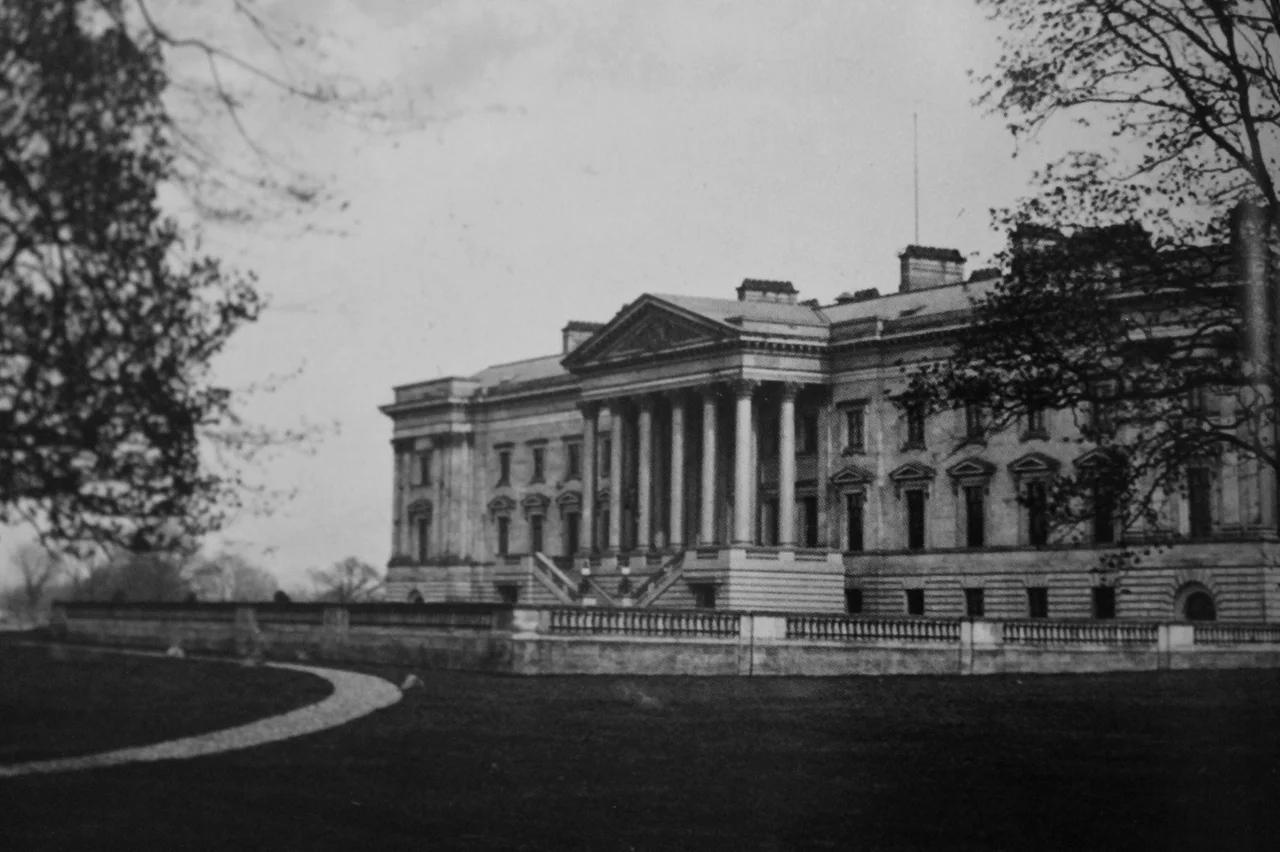

Hamilton Palace
When the 12th Duke of Hamilton died at Algiers in 1895, he owned 157,000 acres, a steam yacht called Thistle and debts of £1.5 million. Among his instructions to his trustees was the option, if they thought it advisable, to entirely displenish and dismantle the palace and remove the building. They eventually did. Between 1882 and 1932 the largest non-royal house in Britain was emptied, sold off in two enormous auctions at Christie's, then knocked down so the coal seam beneath it could be worked. Today the site is a bowling green, a car park and the long ghost of a tree-lined avenue running three miles south through a country park.
The Great Design
There had been a Hamilton building on the site since the 14th century. The earliest reference to a castle at Hamilton appears in a charter of 1445, when James Hamilton was created first Lord Hamilton. When the palace finally came down in the 1920s, demolition crews found defensive walls in the north-west quarter still thick enough to mark the medieval core. The transformation began with Anne, 3rd Duchess of Hamilton, and her husband William, who between 1684 and 1701 commissioned what the family called The Great Design: a U-plan Baroque country house wrapped around an open south-facing courtyard. James, 5th Duke, planned more in the 1730s with William Adam preparing the drawings, but the duke died young and only the interiors of the east wing were finished.
The 10th Duke's Vision
Alexander, 10th Duke of Hamilton, inherited in 1819 with a coalfield under his feet and a wife who had inherited the Beckford art collection. He spent both freely. Between 1824 and 1832 the Glasgow architect David Hamilton enlarged the north front into something extraordinary: a 15-bayed three-storey facade adorned with six 25-foot Corinthian columns. Behind it rose new state rooms with names that read like an inventory of ambition - the Egyptian Hall, the Tribune, the State Dining Room, the Music Room, the Hamilton Library, the Beckford Library. The walls held one of the finest private collections in Scotland: Rubens, Titian, Van Dyck, Velazquez, Poussin, David, Botticini, Signorelli. A double staircase of Irish black marble. Two bronze Atlantes in the Entrance Hall. An Egyptian sarcophagus from the Ptolemaic period, holding the duke himself.
A House for Royalty
The new palace drew the people it was built to impress. In 1831 Marie Therese of France, the surviving daughter of Louis XVI and Marie Antoinette, visited. The Count of Chambord came in 1843 for the marriage of the future 11th Duke to Princess Marie Amelie of Baden. In 1851 the mother of Queen Victoria stayed at the palace. In 1860 the French empress Eugenie made a visit so anticipated that crowds gathered in the park to catch a glimpse of her, and a grand ball was thrown in her honour. In January 1878 the Prince of Wales, Napoleon Prince Imperial, and Rudolf of Austria came for game shooting in the High Parks, finishing with a ball for 400. The palace was, briefly, one of the great social addresses in Britain.
The Sales
It did not last. The 12th Duke disliked Hamilton, lived chiefly at Brodick Castle and Easton Park in Suffolk, and ran up enormous debts on horse racing and sailing. To fund them, in 1882 he was forced to sell the Beckford and Hamilton libraries and the art collection. The Hamilton Palace Sale ran at Christie's from 17 June to 20 July 1882, dispersing 2,213 lots, including paintings by Durer, Rembrandt, Rubens, Velazquez and Van Dyck. Combined with the libraries, the proceeds reached £786,847. A second sale in November 1919 sold off what was left of the contents: tapestries, jewellery, more Rubens, Van Dyck, Reynolds, Romney, Raeburn. By 1921 the palace itself was sold for £7,500 to an Edinburgh demolition contractor, William D. Lillico, who found it so solidly built that the work ran for over a decade. The last sections came down in 1932.
What Remains
Pieces of Hamilton Palace are scattered now across the museums of the world. The black marble chimneypiece and wall from the Old State Drawing Room sit in the National Museum of Scotland. The Dining Room, in its entirety, is at the Museum of Fine Arts in Boston. The Egyptian sarcophagus of Pabasa, which once stood in the Egyptian Hall, was presented to Kelvingrove Art Gallery in Glasgow in 1922. Velazquez's Philip IV in Brown and Silver hangs in the National Gallery in London. A Louis XIV armoire sold in 1882 is now at the Louvre. The site itself is a bowling pavilion and car park inside Strathclyde Country Park. The mausoleum still stands a few hundred metres north. The Great Avenue, once a three-mile tree-lined sightline running south to Chatelherault, can still be walked, and from the hunting lodge at the far end you can look back across the Low Parks and see exactly where the palace used to be.
From the Air
Located at 55.78 N, 4.0315 W within Strathclyde Country Park, between Hamilton and Motherwell. The site is now bowling greens and car park; the surviving Hamilton Mausoleum stands about 200 m north. Best viewed from 2,000-3,000 ft. Glasgow Airport (EGPF) is about 14 nm northwest; Edinburgh Airport (EGPH) about 35 nm east. The M74 motorway runs directly past the park's eastern edge along the Clyde valley.
Nearby Stories
- HMS Gannet 3.6 km away
- Luss 5.3 km away
- Oliver Castle 6.8 km away
- Battle of Bannockburn 6.9 km away
- Beith 7.9 km away
- Pentland Hills 7.9 km away
- Lochleven Castle 16 km away
- Cumnock 17 km away