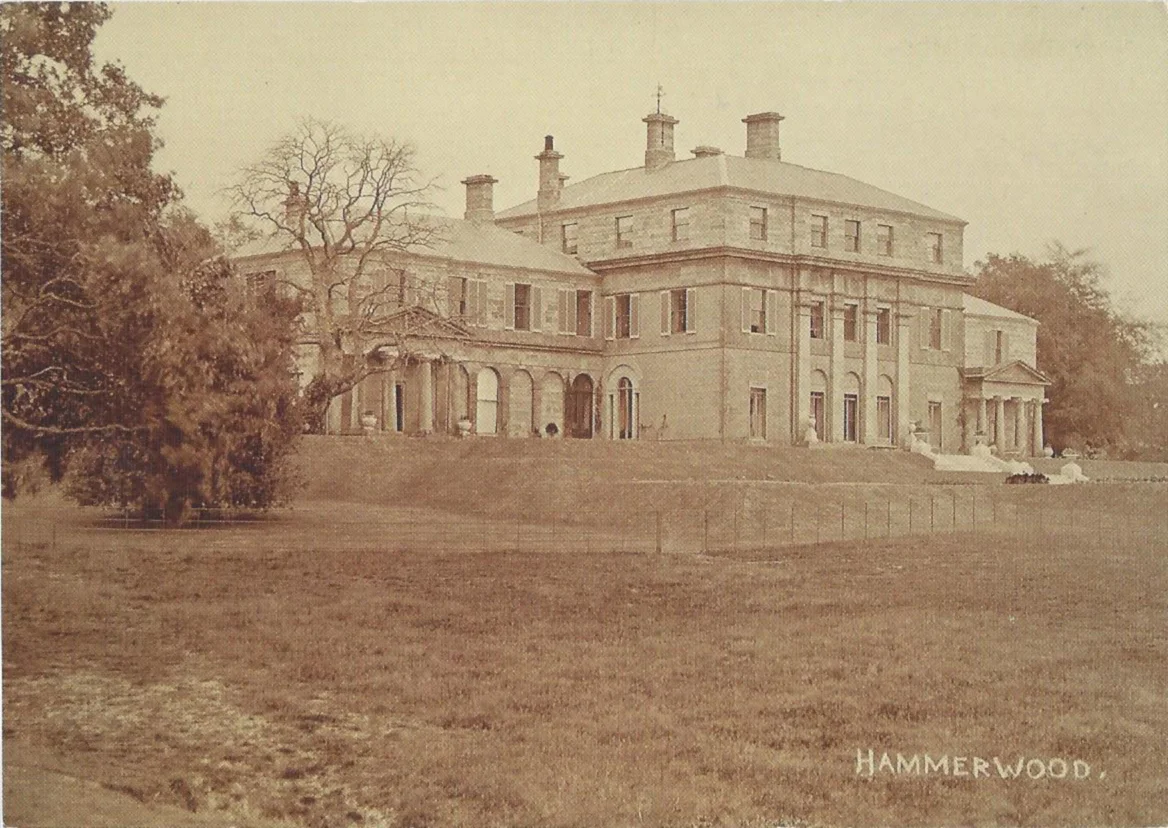

Hammerwood Park
Benjamin Henry Latrobe was 28 years old in 1792 when he designed his first complete building. It was a Greek Revival country house in East Sussex, built for John Sperling on a 2,000-acre estate in the High Weald. A few years later Latrobe emigrated to the new United States, became the second Architect of the Capitol under Thomas Jefferson, and is now remembered as the father of American architecture. Hammerwood Park, his English debut, was forgotten. By 1976 it had been bought and abandoned by Led Zeppelin, had three tonnes of roof lead stripped by vandals, and was boarded up. In 1982 a 21-year-old recent physics graduate named David Pinnegar bought it and started repairing the roof himself. The story of what has happened to Hammerwood since is one of the more remarkable rescues in English country house history.
An Architect on His Way to Washington
Latrobe was English-born, German-educated and steeped in the latest archaeological publications on Greek architecture when John Sperling commissioned him in 1792. Hammerwood Park - completed in 1795 - was a deliberate exercise in Doric purity, with porticos drawn directly from the temples of Paestum and Coade-stone plaques in the porticos transcribing scenes from the Borghese Vase. The house is severe by Georgian standards, almost archaeological. Latrobe sailed for Virginia in 1795. Within a decade he was in Washington, finishing the south wing of the United States Capitol, designing Baltimore's Roman Catholic cathedral, and shaping what would become the American Greek Revival. Hammerwood is the only surviving complete English work of an architect who reshaped the public buildings of a young republic.
Owners, Then Owners' Owners
After Sperling the house passed through several owners. The Reverend John Dorrien-Magens added the wings in 1832. Oswald Augustus Smith took over later and ran a 2,000-acre estate, installing gas lighting and funding a remarkable amount of local infrastructure: a village school for 100 children in 1873, a vicarage in 1875, St Stephen's Church Hammerwood in 1880 to the design of E. P. Loftus Brock for 7,431 pounds, the rebuilding of St Peter's Church Holtye in 1892 in memory of his late wife Rose Sophia Vansittart, the Countess of Thanet's almshouses in 1893, and a new building for the Queen Victoria Hospital in East Grinstead at the end of the century. Hammerwood's village population peaked at 438 in 1891; many of the cottages still standing east of Ashurst Wood were built as tied housing for estate workers.
Wars, Death Duties, Decline
The Reverend George Ferris Whidborne bought Hammerwood shortly before Oswald Smith's death in 1902 and the family lived there from 1901 to 1921. The First World War took the eldest Whidborne son in 1915; all three sons were awarded the Military Cross at different times. After 1919, when a Tunbridge Wells prep school called St Andrew's burned down, it relocated temporarily to Hammerwood while new premises were prepared. Then death duties hit. In 1918 Margaret Whidborne sold 843 acres - nearly half the estate. Three years later another 1,300 acres went, the house was sold, the contents auctioned, and two floors of servants' quarters demolished. The remnant - house and 329 acres - was bought in 1921 by Lt. Col. Stephen Hungerford Pollen, a British Army officer who had served as ADC to two Viceroys of India. The Pollens were the first residents to have mains electricity and water.
Led Zeppelin's Recording Studio That Never Was
In 1973 Led Zeppelin bought Hammerwood at auction. Their plan was to convert the house into a recording studio with flats above. Footage from the film *The Song Remains the Same* was shot here. The plans did not progress. Three tonnes of lead were stripped from the roof by vandals, compromising the roof in fourteen places. Thousands of gallons of water poured into the house. Ceilings collapsed. By 1976 Hammerwood was boarded up; by 1978 it was on the market. In 1982, David Pinnegar - then a 21-year-old recent physics graduate - bought it. The restoration that followed was, for years, the largest private restoration project in Europe. Pinnegar funded almost all of it from visitor entrance fees, supplemented by a modest grant from English Heritage; private ownership locked the house out of most heritage funding streams. By 1989 he had spent over 140,000 pounds. Simon Jenkins, writing in *England's Thousand Best Houses* in 2003, described him as 'one of those eccentrics without whom half the houses in England would have vanished.'
A Helicopter, a Frieze, a Hand-Over
The Great Storm of 1987 caused significant new damage. In 1988 No. 656 Squadron of the Army Air Corps delivered new lead to the roof by Westland Lynx helicopter, an operation covered by the BBC children's programme *Blue Peter*. A rare D. Brucciani and Co. cast of the Parthenon frieze was donated in 1984 and is displayed in the old kitchens, now called the Elgin Room. Pinnegar opened Hammerwood to the public from 1983. The house has hosted Cheryl Cole, Victoria Beckham, the Darkness, fashion shoots for Prada and Tim Walker, and film locations including the 2010 *London Boulevard* with Colin Farrell and Keira Knightley. Annual concerts are still played on instruments tuned to the unequal temperaments used by Classical and Romantic composers. In 2024 Hammerwood passed to David's son Edward Pinnegar, born in 1996, and his wife Sophie. Restoration continues, room by room. The house remains private and lived-in, and tours are offered through the season.
From the Air
Hammerwood Park sits at approximately 51.13 degrees north, 0.06 degrees east, on the High Weald in East Sussex. It is about 3 miles east of East Grinstead and 22 miles south of London. London Gatwick (EGKK) is roughly 10 miles to the northwest. From altitude, look for the pale stone block of the main house, the long approach drive, and the surrounding parkland on the ridge above the rolling fields of the Weald. The Ashdown Forest heath is visible to the south.
Nearby Stories
- Lullingstone Castle 3.6 km away
- Belle Tout Lighthouse 7.5 km away
- Oatlands Palace 8.7 km away
- Queenborough Castle 10 km away
- The Mermaid Inn, Rye 13 km away
- Surrey 22 km away
- Fratton Park 50 km away
- Battle of Boulogne 65 km away