,_Commonwealth_Games,_Glasgow_2014.jpg)
Hampden Park
On 17 April 1937, an official 149,415 people pressed through the turnstiles at Hampden Park to watch Scotland play England. The unofficial figure was at least 20,000 higher - a small army that bunked the gates or squeezed through them, packing the terraces until they were physically dangerous. The crowd that afternoon set a European attendance record for an international football match that has stood for almost 90 years and will probably stand forever. A week later, another 147,365 squeezed in to watch the Scottish Cup Final between Celtic and Aberdeen. The world record for a club match. These numbers describe a stadium that was, for nearly half a century after its 1903 opening, simply the largest sports venue on Earth.
Three Hampdens
Queen's Park, the oldest club in Scottish football, first played at a venue called Hampden Park on 25 October 1873. The ground was overlooked by a terrace named after John Hampden, the Englishman who fought for the Parliamentarians in the English Civil War. A lawn bowling club at the junction of Queen's Drive and Cathcart Road now marks the spot. The second Hampden Park opened in October 1884; its ground today is Cathkin Park, where the ruins of terraces still show through the grass. The third and current Hampden opened on 31 October 1903, designed by architect James Miller with terracing shaped by the great stadium engineer Archibald Leitch. From the beginning it was vast. The first Old Firm Cup Final in 1904 drew 64,672 people, a Scottish record. The 1906 Scotland v England match drew 102,741. The terraces grew through the 1920s and 30s, reaching a theoretical capacity of 183,388 - though the SFA was only permitted to issue 150,000 tickets.
When 130,000 Came to See Real Madrid
Hampden hosted the 1960 European Cup Final between Real Madrid and Eintracht Frankfurt. Real won 7-3 in front of 127,621 people - a crowd figure for a European Cup Final that no other stadium has come close to matching. The Spanish side were at the height of their first golden age, with Alfredo Di Stefano and Ferenc Puskas scoring across the ninety minutes in a match still cited as the most influential single game in continental club football. Other great nights followed. In 1970, Celtic moved their European Cup semi-final against Leeds United from Celtic Park to Hampden because the bigger ground could hold more people. A crowd of 136,505 saw them beat the English champions 2-1. That figure remains the record attendance for any match in UEFA competition. The 2002 UEFA Champions League Final saw Real Madrid win again, with Zinedine Zidane scoring a left-foot volley that still surfaces on "greatest goals ever" lists.
Smaller, Safer, Still Hampden
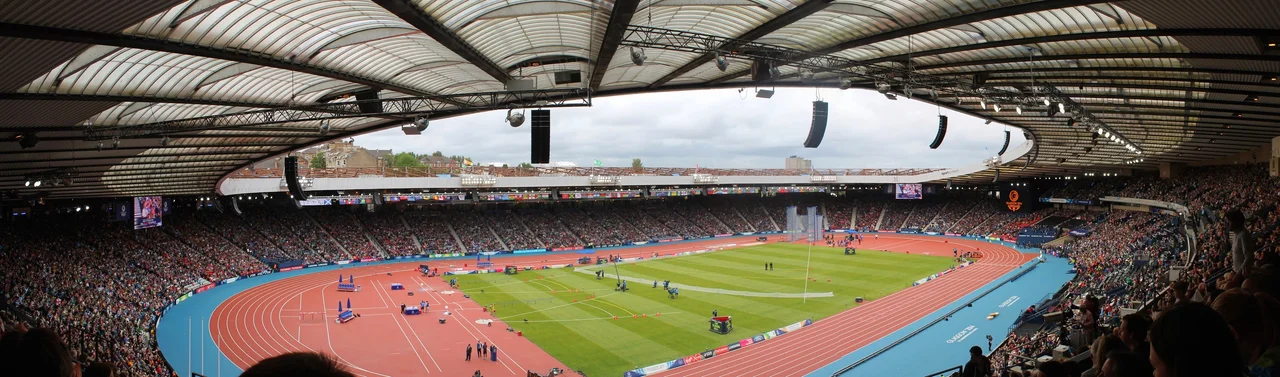
The Burnden Park disaster in Bolton in 1946 prompted Hampden's first official capacity cut, down to 135,000. The Ibrox disaster of 1971, in which 66 people died on Stairway 13, prompted a much deeper reckoning with stadium safety across Britain. Hampden's vast bowl-shaped terracing was steadily reduced. By 1977, the official capacity was 81,000. Redevelopment began in 1981, demolishing the North Stand and concreting the terraces. The final phase started in November 1997 with £59 million of National Lottery funding. The South Stand was rebuilt, the stadium reopened for the 1999 Scottish Cup Final, and Hampden became an all-seater with a capacity now around 51,000 - a fraction of its old self, but configured for the safety the 20th century had spent decades learning to demand. In 2014 it temporarily became an athletics stadium for the Commonwealth Games, hosting the closing ceremony. In December 2025, naming rights were sold for the first time and the ground officially became Barclays Hampden.
Hampden Roar
The crowd noise had its own name. The Hampden Roar was a real acoustic phenomenon, audible across south Glasgow when Scotland scored a goal that mattered. A 2018 study measured peak noise during an Old Firm match at 115 decibels after a goal - roughly the volume of a chainsaw at a metre's distance, except produced by tens of thousands of human voices. Glaswegians use the phrase "What's the Hampden?" to mean "What's the score?" or just "What's going on?" The East and West stands are commonly called the Celtic and Rangers ends because of how often those clubs play here in cup finals. Beyond football, Hampden has been an athletics venue (Eric Liddell won the 100, 220 and 440-yard dashes here in 1925), a tennis exhibition court (Suzanne Lenglen in 1927), an American football field for NFL Europe, a speedway track, a boxing arena where Mike Tyson stopped Lou Savarese in 38 seconds in 2000, and a concert venue for the Rolling Stones, Bruce Springsteen, U2, Beyonce, and Ed Sheeran (the first artist to play here three times on a single tour).
From the Air
Hampden Park sits at 55.8259 N, 4.2520 W in the Mount Florida area of Glasgow's south side, about 2 miles south of the city centre. From the air the stadium's oval bowl is unmistakable, particularly when contrasted with the neighbouring residential streets of Mount Florida and Cathcart. Glasgow International Airport (EGPF) is 7 nautical miles west-north-west, and Glasgow Prestwick (EGPK) is 24 nautical miles south-west. Mount Florida and King's Park railway stations both serve the stadium via the Cathcart Circle Lines from Glasgow Central. Recommended viewing altitude: 3,000-5,000 feet to see the stadium in context with Glasgow's southside grid and the Clyde to the north.
Nearby Stories
- Mauchline 3.6 km away
- Shotts 4.2 km away
- HMS Ulysses (1917) 7.7 km away
- Rothesay Castle 8.8 km away
- Inchcailloch 10 km away
- Strachur 14 km away
- Battle of Dollar 16 km away
- Crawford Castle 16 km away