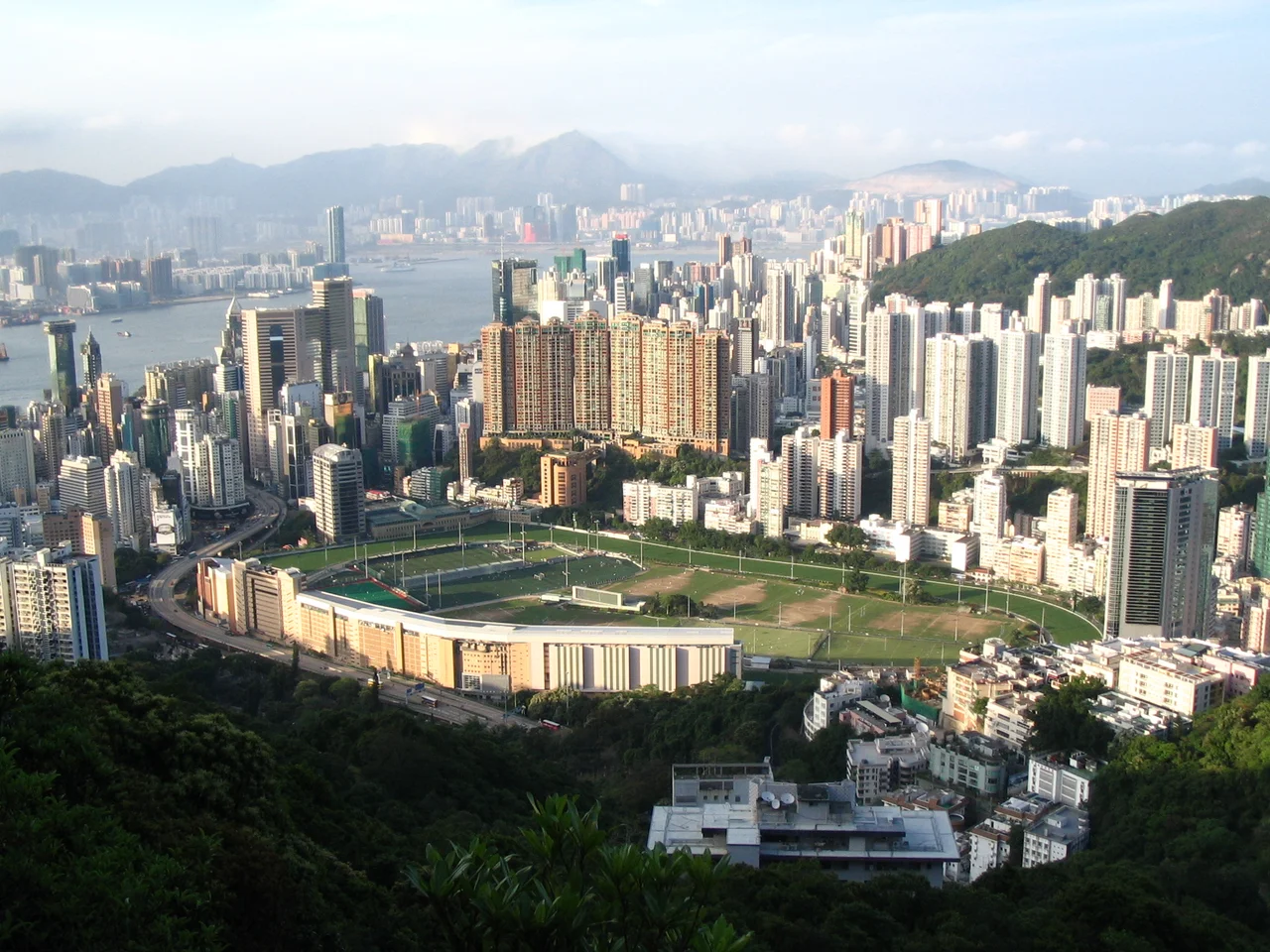

Happy Valley, Hong Kong
The name is a lie, or at least a euphemism. In the early years of British settlement, this valley — then called Wong Nai Chung, meaning yellow mud stream — was a place where people came to be buried. The British Army set a camp here in 1840 and then abandoned it when soldiers began dying from what was then an unknown fever, later understood to be malaria. The valley's marshy ground, its proximity to standing water, its reputation as unhealthy: all of it made the place a burial ground. "Happy Valley" was the common colonial-era euphemism for a cemetery. The name stuck to the neighbourhood instead.
From Paddy Fields to the Racecourse
The rice paddies that the Wong Nai Chung river once nourished survived the early colonial years, fed by water draining from the surrounding hills. Then in 1846 the British saw something else in the valley's terrain: flat land, surrounded by hills, ideal for horses. The paddy fields were cleared. The racecourse was built. The Wong Nai Chung river was redirected into the Bowrington Canal — known locally as Ngo Keng Kan — as part of wider land reclamation in Wan Chai. That canal is now buried under Canal Road. Where farmers once grew rice, crowds now gather on Wednesday evenings for race nights that draw 8,000 to 12,000 spectators. The Happy Valley Racecourse, opened in 1846, is one of the two tracks operated by the Hong Kong Jockey Club, and its floodlit nights have become one of Hong Kong's most distinctive urban experiences.
February 26, 1918
On that afternoon, a temporary grandstand at the racecourse collapsed during a race meeting. The collapse knocked over food stalls and set bamboo matting ablaze. The fire spread quickly through the crowded temporary structures. At least 670 people died in what became one of the worst disasters in Hong Kong's colonial history; the Hong Kong Telegraph reported 576 confirmed deaths by the following day, with the final official toll reaching 670. Most of the people who died were Chinese. Many bodies were unrecognizable and were buried in the nearby So Kon Po area, now the site of Hong Kong Stadium. A Chinese-styled memorial — the Race Course Fire Memorial — was built in the adjacent Chinese cemetery, behind what is now the stadium's east stand. The Hong Kong Jockey Club's race nights resumed after the war, in 1947. The memorial still stands.
December 1941, Blue Pool Road
On December 22, 1941, the Japanese Imperial Army entered the valley from the hills to the east and fought their way toward Blue Pool Road. What followed on that street was one of the war's worst episodes in Hong Kong: civilians were bayoneted in what became known as the Blue Pool Road Massacre. Civilians and soldiers captured in the area were held in a house on Blue Pool Road under conditions witnesses described as a 'black hole.' Japanese forces then pushed south and west to Wong Nai Chung Gap, taking control of the high ground that divided the island. Areas around Leighton Hill and Morrison Hill were contested for longer. The battle was eventually decided, and the occupation began. Blue Pool Road today is a quiet residential address lined with apartment buildings. The name carries no visible marker of what happened there.
The Valley Now
Happy Valley today is an upper-income residential neighbourhood and a sporting hub, bisected by the oval of the racecourse. Six cemeteries run along its southern edge — Jewish, Hindu, Parsee, the main Hong Kong Cemetery, St. Michael's Catholic Cemetery, and a Muslim cemetery — a legacy of the valley's original identity that feels incongruous among the apartment towers and sports clubs. The Hong Kong Racing Museum sits at the racecourse. Valley RFC, Craigengower Cricket Club, and Hong Kong FC all have grounds here. The trams that first extended to Happy Valley in 1904 still run their single terminus loop. On race nights, the stadium lights illuminate surrounding buildings like daylight, and the traffic on Wong Nai Chung Road backs up for blocks. The euphemism that named this place has been completely overtaken by what the place became.
From the Air
Happy Valley sits at approximately 22.27°N, 114.18°E on Hong Kong Island, in the Wan Chai District. From the air at 1,500–2,500 feet, the Happy Valley Racecourse oval is one of the most recognizable features on Hong Kong Island — a green ellipse surrounded tightly by high-rise residential towers, clearly visible against the urban fabric. Victoria Peak rises to the west and southwest. The Causeway Bay waterfront and Victoria Harbour are visible to the north. Hong Kong International Airport (VHHH) lies approximately 25 km to the west. The racecourse's floodlight towers are distinctive landmarks in low-altitude navigation around the eastern part of Hong Kong Island.
Nearby Stories
- Lok Ma Chau Loop 2.3 km away
- Portas do Cerco 2.3 km away
- Kweilin Incident 17 km away
- Wanshan Archipelago Campaign 34 km away
- Nanxiong Formation 115 km away
- Battle of Nanpeng Island 148 km away
- Heyuan 169 km away
- Cape Maobitou 632 km away