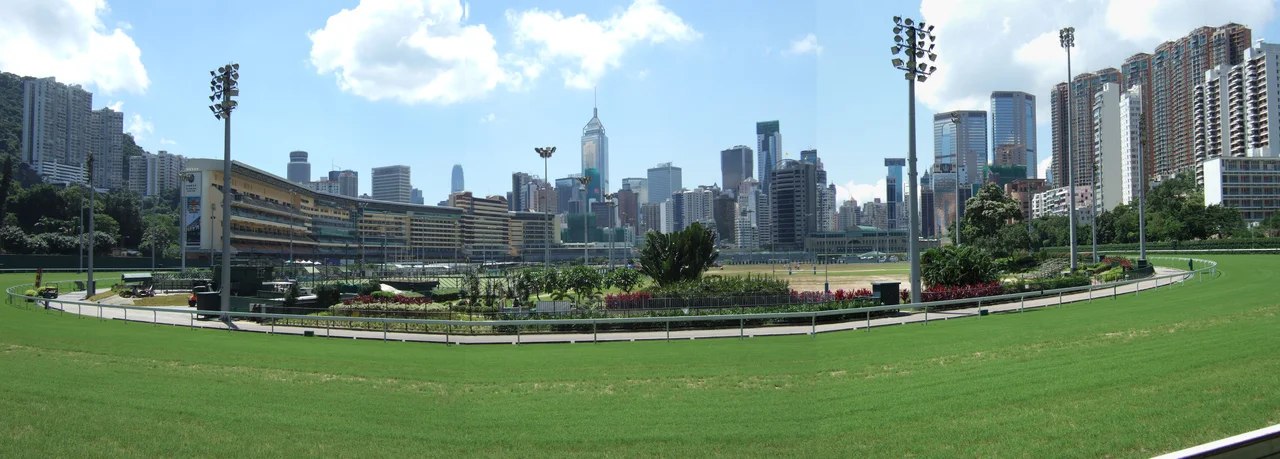

Happy Valley Racecourse
Wednesday night at Happy Valley feels like nowhere else on Earth. The horses thunder past under a blaze of floodlights, surrounded on every side by towers of glass and concrete that rise so close you feel the city pressing in. Fifty-five thousand people can fit into this oval — and on the best nights, it seems like all of them have come. Horse racing arrived in Hong Kong with the British colonizers, but Happy Valley Racecourse long ago ceased to be a colonial institution. It became something more: a shared ritual, a communal heartbeat, one of the defining experiences of Hong Kong life.
Draining the Swamp
The story begins with mud. When British administrators looked for a place to hold horse races after arriving in Hong Kong in the early 1840s, they faced a geographic problem: the island was almost entirely hills. There was exactly one patch of flat land suitable for a racecourse — a swampy valley that the surrounding villages used for growing rice. The government prohibited rice cultivation there, drained the marshland, and in December 1846 the first race was run. Happy Valley, as the district came to be called, grew up around the track. The colonial planners got their racecourse. The displaced farmers got new circumstances they had not asked for. In that transaction, early and defining, a pattern was set: the racecourse shaped the neighborhood as much as the neighborhood shaped the racecourse.
The Shadow of 1918
No account of Happy Valley Racecourse can avoid the date of 26 February 1918. Derby Day that year drew one of the largest crowds the track had ever seen. A temporary bamboo grandstand, erected to handle the overflow, collapsed during the races. It knocked over food stalls with open flames; the bamboo matting ignited; the fire spread before anyone could contain it. Six hundred and fourteen people died — most of them Chinese residents who had, over the years, come to love the sport as deeply as any British colonist. It remains one of the deadliest fires in Hong Kong's history, and one of the worst stadium disasters anywhere in the world. A memorial stands at the site today. The racecourse rebuilt and the races resumed, because Hong Kong does not easily stop, but the event left a permanent mark on the place and on the collective memory of the city.
Wednesday Nights and the World
The modern racecourse bears little resemblance to the colonial-era grounds. Seven-storey grandstands now rim the oval, capable of holding 55,000 spectators. Races in Happy Valley take place predominantly on Wednesday evenings — a deliberate scheduling choice that turns a weeknight into an occasion, a break in the working week that the city has built a whole social culture around. The Hong Kong Jockey Club, which operates both Happy Valley and the newer Sha Tin Racecourse in the New Territories, is one of Hong Kong's largest employers and charitable organizations. Gate receipts fund hospitals, schools, and community projects across the territory. Betting on horses in Hong Kong is not merely entertainment; it is, in a very literal sense, civic infrastructure.
Inside the Oval
What visitors often don't expect is what occupies the center of the track. The infield at Happy Valley is not empty: it contains eleven football pitches, hockey fields, and rugby grounds managed by the government's Leisure and Cultural Services Department. Schoolchildren practice there on weekday afternoons while race preparations happen on the track around them. The Hong Kong Racing Museum, housed on the second floor of the Happy Valley Stand since 1996, traces the full arc of the sport's history in the territory — from the original mudflat to the present day. One of its more striking exhibits is the skeleton of Silver Lining, a three-time Hong Kong Champion. The galleries are small but dense with stories, each one a thread in the larger fabric of what this place has meant to the city across nearly two centuries.
From the Air
Happy Valley Racecourse sits at 22.27°N, 114.18°E in a natural valley on Hong Kong Island, its oval unmistakable from altitude — a green ellipse hemmed in by apartment towers that rise on every hillside. At 1,500–3,000 feet, the contrast between the turf track and the surrounding urban density is striking. Hong Kong International Airport (VHHH) on Lantau Island lies approximately 25 nautical miles to the west. The Causeway Bay waterfront and Victoria Harbour are visible to the north; the hills of Wan Chai Gap rise steeply behind the southern stands.
Nearby Stories
- Lok Ma Chau Loop 2.3 km away
- Portas do Cerco 2.3 km away
- Kweilin Incident 17 km away
- Wanshan Archipelago Campaign 34 km away
- Nanxiong Formation 115 km away
- Battle of Nanpeng Island 148 km away
- Heyuan 169 km away
- Cape Maobitou 632 km away