
Harwich
On 11 November 1918, while crowds celebrated the Armistice in London, the surrendered submarines of the Imperial German Navy steamed one by one into Harwich harbour and stopped. Their crews handed over their boats, their codes, and their charts to the Royal Navy. The U-boat war - the slow strangulation that had nearly defeated Britain - ended in this small Essex port at the mouth of the Stour and the Orwell. Three centuries earlier, a Harwich-born sea captain named Christopher Jones had loaded 102 passengers onto a 100-foot ship called the Mayflower and sailed for Virginia. The harbour has been collecting that kind of history since 1318.
Military Settlement
The name Harwich comes from Old English here-wic, military settlement. The town sits on a peninsula at the mouth of the joined estuaries of the Stour and Orwell, between the Thames and the Humber - one of the safest natural harbours on the east coast. It received its first borough charter in 1318 and a recorded charter in 1604. In 1339, during the Hundred Years' War, French forces under Antonio Doria attempted to raid the town. In 1652 the Admiralty established a Royal Naval Dockyard here. In 1665 a pair of lighthouses went up on the Town Green as leading lights for the harbour entrance. In 1688 William of Orange chose Harwich as his planned landing point for the Glorious Revolution - but contrary winds forced his fleet south to Torbay instead.
The Mayflower Captain
Christopher Jones was born in Harwich around 1570, the son of a mariner. He grew up in a town whose entire economic life was the sea. By 1611 he was part-owner of a 180-ton merchant ship called the Mayflower, registered with Harwich as her home port. In 1620 he agreed to carry a group of separatist Puritans across the Atlantic. The voyage took 66 days. Sixteen passengers and crew died, the ship was driven north of her intended Virginia destination, and the colony she founded at Plymouth survived against odds. Jones died two years later, at 52, and is buried in Rotherhithe. Harwich also produced Christopher Newport, captain of the 1607 expedition that founded Jamestown - meaning two of the most consequential Atlantic crossings in English history were captained by men from this single Essex port.
Fortifications and Phrases
Harwich's strategic position meant near-constant fortification. The Harwich Redoubt, a circular Napoleonic-era fort, still stands. Beacon Hill Battery and Bath Side Battery covered the harbour approaches. From 1793 to 1815 the town was a Post Office Station for diplomatic mail to Europe and a launching point for British expeditions to Holland. The dockyard built HMS Conqueror, the 74-gun ship that captured Admiral Villeneuve at Trafalgar. In the First World War it was home to Commodore Tyrwhitt's Harwich Force light cruisers and destroyers, the German U-boat surrender, and an active British submarine flotilla. In the Second World War it assembled fleets for Dutch and Dunkirk evacuations and for D-Day follow-up. The London and North Eastern Railway's posters made the phrase "Harwich for the Continent" famous; it still appears on road signs.
Architecture in Miniature
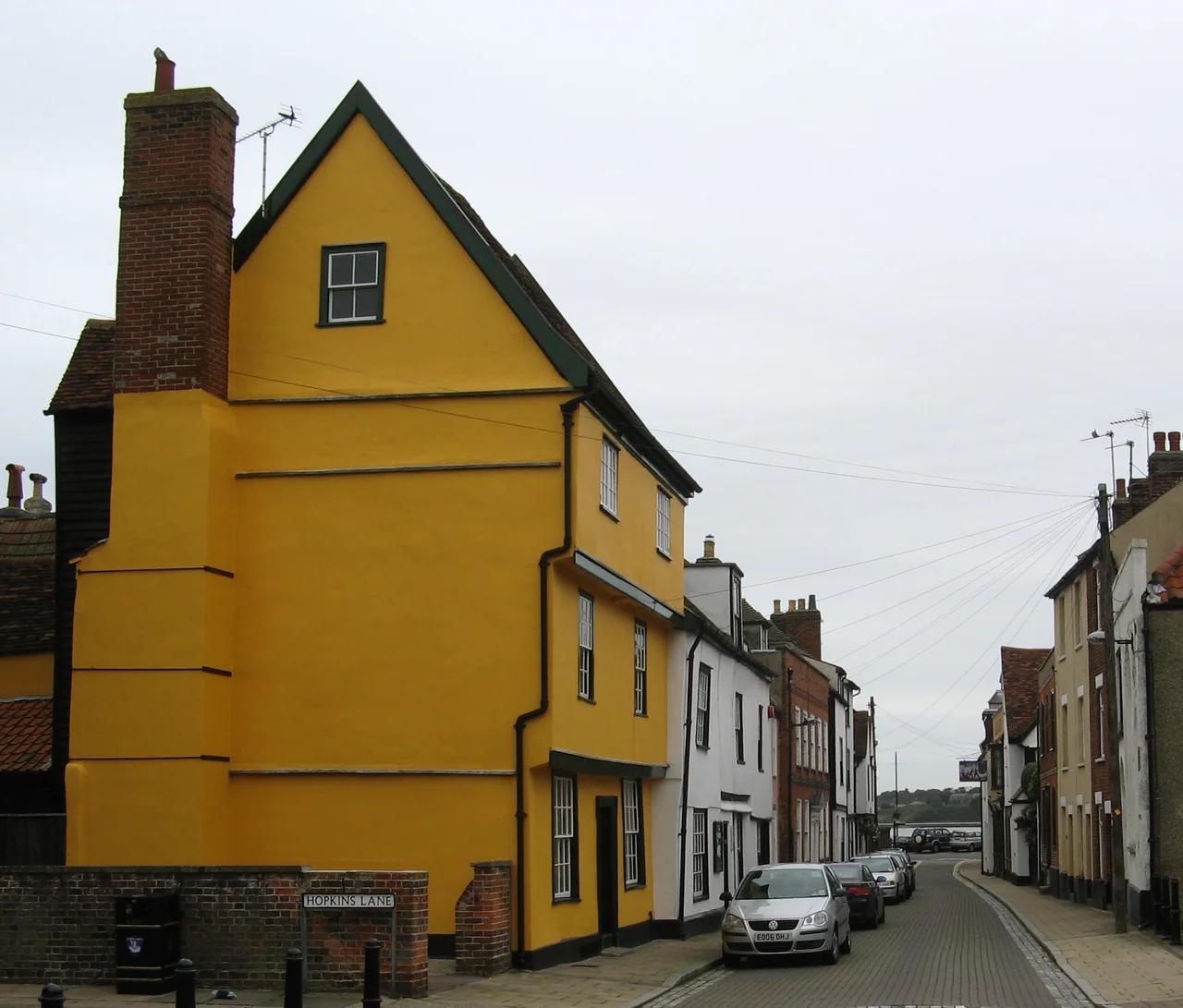
Despite the harbour's outsized importance, the old town is tiny and intact - a single conservation area covering nearly the whole medieval street plan, with thoroughfares connected by narrow alleys. Many medieval buildings hide behind 18th-century facades. The sailmaker's house on Kings Head Street, built around 1600, is unique. The 1769 Harwich Guildhall is the only Grade I listed building in town. The 1820-1822 parish church of St Nicholas was designed by M G Thompson of Dedham. The Treadwheel Crane, a 17th-century wooden crane operated by men walking inside great wheels, stands open to the weather. The Electric Palace Cinema of 1911 is one of the oldest purpose-built cinemas in Britain still operating, with its original ornamental frontage and projection room intact. The High Lighthouse of 1818 still rises behind the quay.
The Continent, Still
The Royal Navy is gone from Harwich, but ferries to the Hook of Holland still run from Harwich International Port at Parkeston, a mile up the Stour from the old town. Trinity House, the lighthouse authority, runs many of its operations from here. The Mayflower railway line carries passengers to three stations in the town. A train ferry from Harwich to Zeebrugge ran from 1924 to 1987 with the wartime gap; the linkspan and the rails leading across the road into the harbour are still there. Each October the town hosts the Harwich International Shanty Festival, one of the largest in Britain. Christopher Jones would have understood. The harbour still defines the place.
From the Air
Harwich lies at 51.94 N, 1.29 E on the south side of the combined Stour and Orwell estuaries. From altitude, the harbour appears as a large protected anchorage with Harwich peninsula on the south side, Felixstowe and its container port on the north side. Look for the high-tech Trinity House office, the Harwich Redoubt, and the lighthouses. Nearest airports: RAF Wattisham (EGUW) 20 miles west, Stansted (EGSS) 50 miles west, Cambridge (EGSC) 65 miles west, Southend (EGMC) 35 miles south. The Mayflower railway line and the Hook of Holland ferry route both terminate here.
Nearby Stories
- Ickworth House 3.6 km away
- Framlingham 7.9 km away
- Castle Hedingham 8.6 km away
- Battle of Assandun 8.6 km away
- Margate Surfboat 33 km away
- 1382 Dover Straits Earthquake 41 km away
- Four Days' Battle 48 km away
- Battle of Lowestoft 85 km away