
Hatfield Forest
The botanist Oliver Rackham, who knew more about English trees than almost anyone, called Hatfield Forest 'almost certainly unique in England and possibly in the world.' His reason was simple: it is the only place where every element of a medieval royal hunting forest still survives intact. The deer are here. The coppice woods are here. The pollarded oaks - some over 1,200 years old - are here. The grazing cattle, the wood-pasture plains, the scrub, the timber trees, the grassland and the fen. Step through the gate three miles east of Bishop's Stortford and you step back into the Middle Ages, with almost no effort of the imagination required.
What a Royal Forest Means
The word 'forest' is misleading. In medieval English law a forest was not necessarily wooded - it was simply land under Forest Law, where deer and the game beasts of the chase were reserved for the king. Hatfield was established as a royal forest sometime between 1086 and 1225, after fallow deer were introduced and the Norman kings extended their hunting rights across great swathes of England. The Forest of Essex once covered much of the county; Epping Forest, Hainault Forest and Writtle Forest were all parts of it. Most of the others have been ploughed, enclosed, built over or grubbed up. Hatfield's 403 hectares were not. The land has never been ploughed - one of the largest unploughed areas in Essex - and the management practices that have shaped it for centuries are still being carried out today, mostly by the same techniques.
Coppice, Pollard, Standard
There are three ways to manage a tree for human use without killing it. Coppicing cuts it down to a stump and lets it regrow as multiple shoots, protected from grazing animals by ditches and banks - good for firewood, fences, thatching spars. Pollarding cuts it higher up, above the browse height of deer or cattle, so the regrowth is out of reach and you can graze livestock between the trees - good for wood-pasture. And standards are simply left to grow to full size, harvested eventually for timber for buildings and ships. All three systems run side by side at Hatfield, which is why Thomas Hardy could describe the same techniques in The Woodlanders. The forest contains over 800 ancient trees, mostly oak and hornbeam, with some hawthorn, hazel and field maple. The most famous, the Doodle Oak, last bore green leaves in 1858 and its site is marked in the north of the forest - a tree that may have been a thousand years old when it died.
From the de Bohuns to a Deathbed
The chain of ownership reads like a Plantagenet family tree. In 1238 Henry III gave the forest to Isobel of Huntingdon, who married into the Bruce family. Robert the Bruce held it until Edward I confiscated his English lands in 1306. Edward II handed it to the de Bohuns. They held it through the fourteenth century, eventually gaining the right to the deer themselves. In 1521 the third Duke of Buckingham was beheaded by Henry VIII and the forest reverted to the Crown. Edward VI granted it to Richard Rich - the same Tudor lawyer who quarried Hadleigh Castle - and through Lord Morley and the Barringtons it passed in 1729 to the Houblon family, whose ancestor John Houblon had been the first Governor of the Bank of England in 1694. The Houblons may have consulted Capability Brown when they created the lake and planted exotic trees, and in 1759 the seventeen-year-old Laetitia Houblon decorated a small picnic house with shells from Britain and the tropics. The Shell House still stands. In 1923 the conservationist Edward North Buxton bought the forest from his deathbed and gave it to the National Trust.
Beetles, Bats, and Eight Hundred Birds
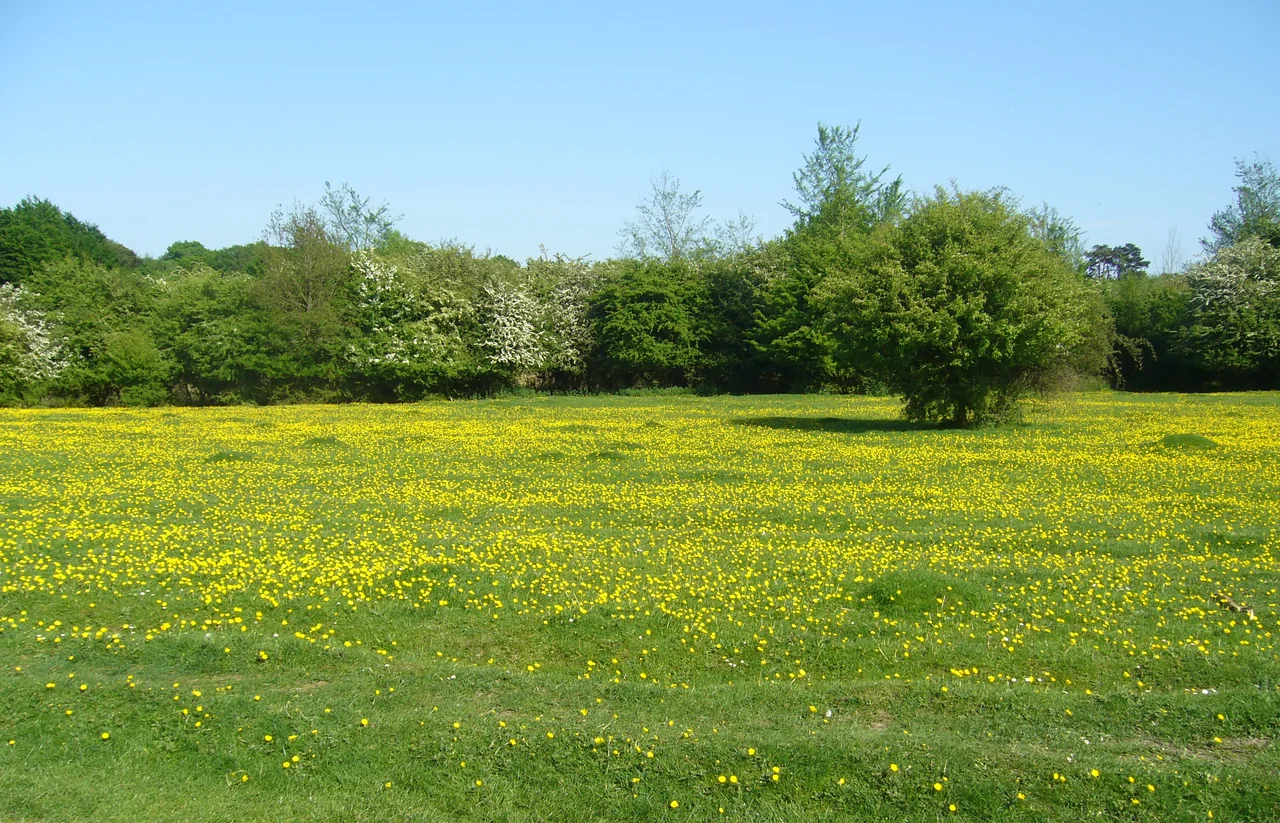
Pristine medieval landscapes produce pristine medieval ecologies. Hatfield is in the top ten sites in the UK for saproxylic beetles - the specialist insects that depend on decaying ancient wood. Ten species of bats hunt over the plains at dusk. A 2008 census found 58 bird species in a single May day - jays and green woodpeckers in the woods, mute swans and great crested grebes on the lake, kingfishers and grey herons by the streams, buzzards increasingly common above. Fallow deer move quietly through the wood-pasture. Two herds of Red Poll cattle, the traditional Essex breed, graze the plains. The conservation grazing is supplemented by Beulah Speckled Face, Wiltshire Horn and Manx Loaghtan sheep. Over 400 plant species have been recorded - bee orchids, common spotted orchids, herb robert, perforate St John's wort. In May and June the buttercups fill whole fields. Over 600 species of fungi push through the leaf litter in autumn.
The Edge of Stansted
Hatfield Forest sits awkwardly close to the runways of London Stansted Airport, three miles east of Bishop's Stortford. The proximity has cost it twice. On 20 October 1987, a Cessna 421B crashed into the forest minutes after taking off from Stansted, killing the pilot and five passengers. On 22 December 1999, Korean Air Cargo Flight 8509 - a Boeing 747-200F - went down just outside the forest after taking off from Stansted, killing all four crew on board and narrowly missing the houses below. Parts of the forest were used during the Second World War to hide munitions for the Stansted airfield; the remains of those wartime huts are still visible alongside the entry roads. The Iron Age earthworks at Portingbury Hills lie north of the main paths, never excavated to anyone's satisfaction. Underneath them - and underneath Hatfield generally - lie the deeper layers of an English landscape continuously used and continuously inhabited for at least three thousand years.
From the Air
Hatfield Forest sits at 51.8577 degrees North, 0.2291 East, about 3 miles east of Bishop's Stortford in northwest Essex. Best viewed at 1,500 to 3,000 feet. The forest is a large oval of mature woodland with the artificial Decoy Lake at its centre, set in the open arable farmland of the Stort valley. London Stansted (EGSS) lies just 3 nautical miles east-southeast - the airfield's approaches pass directly over or alongside the forest. The M11 motorway runs along the western edge. Watch traffic carefully in this airspace; Stansted is class D up to the surface.
Nearby Stories
- Cambridge Museum of Technology 2.3 km away
- Hunt family murders 3.5 km away
- St Edmundsbury Cathedral 4.2 km away
- Kelvedon Hatch Secret Nuclear Bunker 5.6 km away
- River Lea 8.4 km away
- Gainsborough's House 11 km away
- Prittlewell Royal Anglo-Saxon Burial 14 km away
- Wellingborough 25 km away