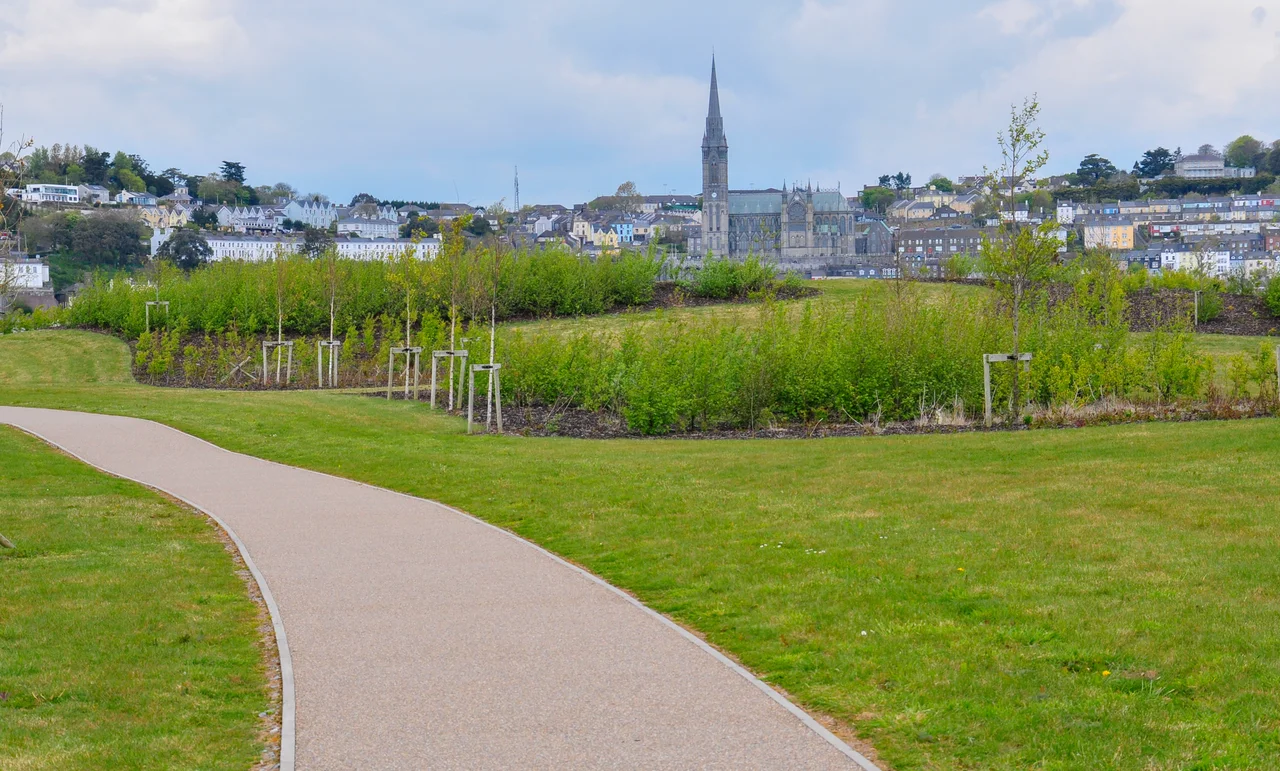

Haulbowline
The world's first yacht club was founded on this island in 1720, more than a century before the Royal Yacht Squadron at Cowes. Today the same 80-acre lump of rock in Cork Harbour holds the headquarters of the Irish Naval Service, with grey patrol vessels tied alongside Georgian storehouses built when the British Empire was rebuilding from the Napoleonic Wars. Between those two facts lies a strange third: for sixty-two years, half the island was an enormous slag heap. Irish Steel poured chromium 6 and radioactive waste into the eastern foreshore from 1939 until 2001. Erin Brockovich came over from California to look at it. The recent transformation back into parkland was so expensive that the Irish Examiner asked, in print, whether anyone should be allowed to walk on it yet.
Eels and Foxes
The name probably comes from Old Norse, ál-boling - 'eel dwelling,' the place where conger eels lived. Seventeenth and eighteenth-century spellings end in '-ing,' suggesting a Norse root that nautical English later smoothed into the modern form. The Irish-language name is more imaginative: Inis Sionnach, 'island of the foxes.' Whatever lived here when the Norse passed through, the strategic geography always mattered more than the wildlife. Haulbowline sits in deep water near the centre of one of the world's largest natural harbours - the kind of place that warlords notice. The first fortifications went up in 1602, and in 1603 the Cork city fathers were accused of trying to demolish them; William Meade, the Recorder of Cork, was charged with treason for his role and only narrowly escaped execution.
The Cork Water Club
In 1720 a group of Cork gentlemen began meeting on Haulbowline to sail together. They called themselves the Cork Water Club, and they made up rules of conduct, dress and racing that survive. The club later evolved into the Royal Cork Yacht Club, which is still active today and claims with some justification to be the oldest yacht club in the world. The clubhouse moved off the island over the centuries, but the founding moment was here - on an island that the British Army would shortly take over for entirely different purposes.
Ordnance and Victualling
In 1806, when the British Army shifted its presence to nearby Spike Island, Haulbowline was divided up - 14 acres went to the Royal Navy and 8 to the Board of Ordnance. A great stone wall split the island. On the western side an Ordnance Yard was built, a Martello tower for defence, and on neighbouring Rocky Island a pair of magazines designed to hold 25,000 barrels of gunpowder. East of the wall, between 1807 and 1824, came the Victualling Yard - six enormous Storehouses, a rainwater tank under a quadrangular cooperage, a mast and boat store, and rows of cottages for workers and officers. Three of the storehouses ringed a quay on the north shore; three more lined what was then the eastern edge. Several still stand. One was burned out in March 2008, leaving only its walls.
Irish Steel
In 1939 a new tenant moved onto the eastern half of the island, on the site of the old 1869 Dockyard. Irish Steel - later Irish Ispat - made steel here for sixty-two years. The waste went onto the foreshore. By the time the plant closed in 2001 it had added 22 acres of slag to the island, growing Haulbowline from roughly 60 acres to over 80. The slag contained Chromium 6 and traces of radioactivity. Erin Brockovich - whose name had become synonymous with chromium contamination after the California groundwater case made famous by the Julia Roberts film - travelled to Cork and called publicly for government action. A 2006 plan to redevelop the site as apartments and a marina collapsed when the Celtic Tiger economy did, in 2008.
Naval Service Today
The western half of the island is now the home of the Irish Naval Service - headquarters, training facilities, ship berths, and the Naval College. The whole campus sits largely within the footprint of the old Royal Navy Ordnance Yard. In September 2014 Minister for Defence Simon Coveney announced a €50 million upgrade with new quays for larger patrol vessels and a runway for UAV operations. The football pitch on the eastern side was reclaimed from Irish Steel land in the 1980s. The cleanup of the eastern 'East Tip' began in 2014 with a budget of €40 million, eventually rising to at least €61 million. Some park works opened by 2018 but reports questioned whether it was safe enough to use. The handover of the parkland to Cork County Council, planned for May 2019, was repeatedly deferred. The island has spent four hundred years being something useful, and is still figuring out how to be just a park.
From the Air
Haulbowline sits at 51.842 degrees N, 8.300 degrees W in the middle of lower Cork Harbour, connected to the mainland at Ringaskiddy by a road bridge since 1966. The island is unmistakable from the air: a roughly bean-shaped landmass with naval grey patrol vessels alongside, with Spike Island just to the southeast, Cobh and Great Island to the north, and the National Maritime College of Ireland on the mainland at Ringaskiddy directly west. Cork Airport (EICK) is 12 km northwest. Best viewed from 2,000 to 5,000 feet; the western Ordnance Yard layout and the cleaner-looking eastern parkland are clearly distinguishable in good light.
Nearby Stories
- Walter Siepmann 6.3 km away
- Gaeltacht na nDéise 11 km away
- Fermoy 12 km away
- Canovee 14 km away
- Rathcoole Ambush 16 km away
- SS Folia (1907) 20 km away
- Cloghan Castle, Lough Hyne 35 km away
- SM U-27 91 km away