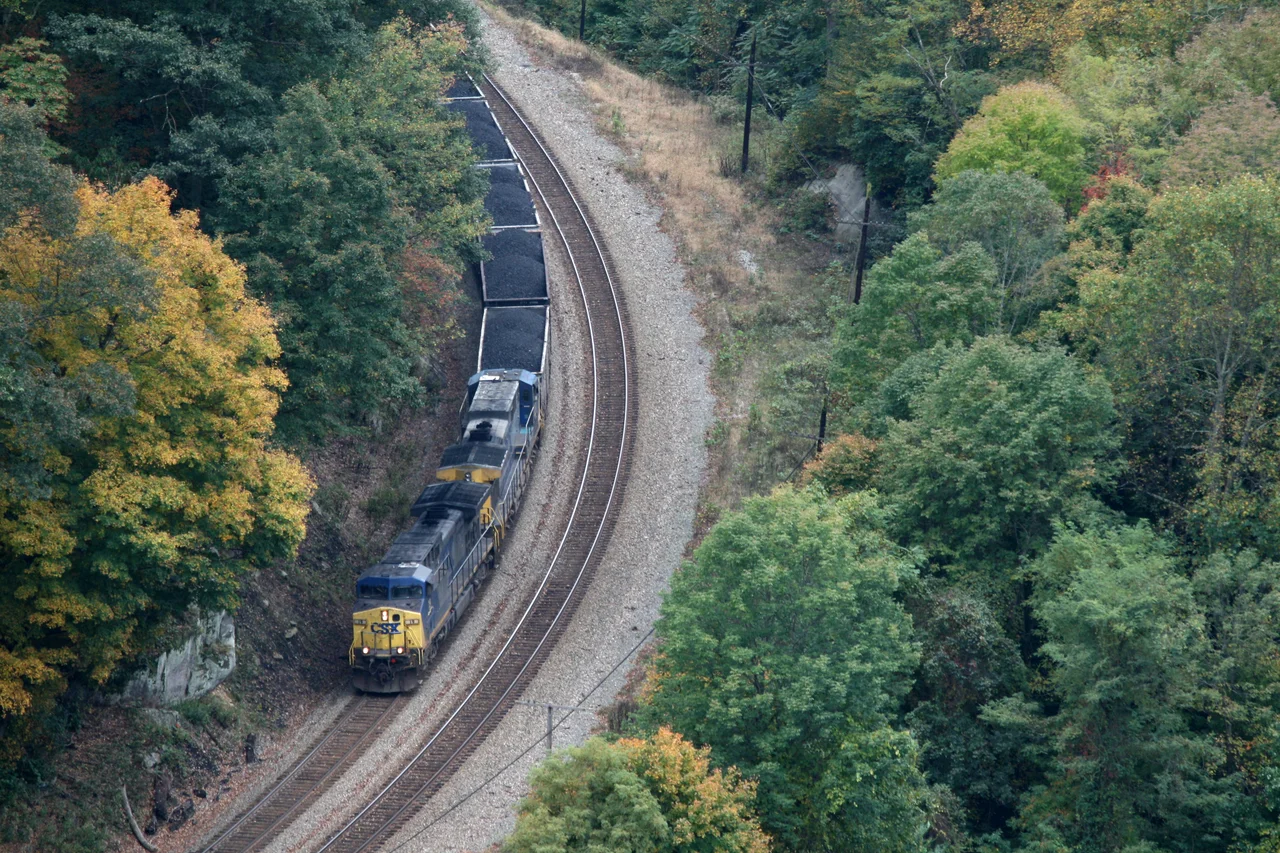

Hawks Nest State Park
Stand at the overlook at Hawks Nest State Park and you are looking down 750 feet into one of the most beautiful canyons in the eastern United States. The New River curves through the gorge below. The forest climbs the opposite ridge in waves of hardwood. The view is exactly the kind of thing the New Deal built American state parks to celebrate. But there is something else under that ridge, something the brochures handle carefully: the Hawks Nest Tunnel, a three-mile bore drilled through Gauley Mountain between 1930 and 1935 to divert the river to a hydroelectric plant. The men who dug it - most of them Black, most of them migrant - died by the hundreds from silicosis. Their graves are scattered across these hills. The view is real. So is the cost of getting to it.
The Overlook and the Lodge
The original visitor building at Hawks Nest, now a gift shop and museum, was built by the Civilian Conservation Corps as a New Deal project in the mid-1930s - around the same time the tunnel was being completed underneath the park. The CCC-era stonework and design have aged into the landscape so completely that they look like part of the cliff. The modern park lodge, a low-slung modernist structure with 31 rooms, was completed in 1967 to a design by The Architects Collaborative, the firm Walter Gropius helped found. It sits about a mile east of the overlook along US Route 60, closer to the center of the village of Ansted. From its windows, guests look across one of the most photographed segments of the Appalachian range.
The Tunnel Disaster
Between 1930 and 1935, the Rinehart and Dennis Company - contracted by Union Carbide's New Kanawha Power Company - bored a three-mile tunnel under Gauley Mountain to divert water from the New River to a downstream hydroelectric plant. The rock they drilled through was nearly pure silica - which the company knew, because they had it tested for industrial use. They did not provide their workers with respiratory protection. Most of the workers were Black men recruited from the Deep South during the Depression, when work of any kind was scarce. They drilled dry, breathing silica dust that lodged in their lungs and caused acute silicosis. Estimates of the death toll vary - the company recorded 109; later research has put the number at 700 or more, possibly over 1,000. Many of the dead were buried in unmarked graves in the surrounding hills, where descendants are still locating them today. The Hawks Nest Tunnel disaster is among the worst industrial catastrophes in American history.
The Park as It Is
The state park that grew up on the rim above the tunnel offers more than the overlook. Hiking trails wind through 370 acres of hardwood forest. The Hawks Nest Rail Trail, 1.8 miles of converted rail bed, follows an old industrial track. A swimming pool and picnic area serve summer visitors. The aerial tram that once carried guests from the lodge down to the New River shore has been dismantled, and is awaiting either restoration or a permanent retirement. The River Nature Center near the bottom of the gorge offers programs about the ecology of the gorge. WVU's Center for Excellence in Disabilities surveyed the park for accessibility in 2005 and found the lodge and facilities generally accessible, though stairway lighting needed work.
Two Stories on One Ridge
The official park brochures focus on the view, and the view is genuinely spectacular - the New River cutting north toward the Gauley confluence, the gorge falling away beneath your feet, the dark spruce on the far ridge in October. The harder story is the one that lives under the ridge, in the tunnel, in the lungs of the men who built it. Recent years have brought more honest acknowledgment - a historical marker, oral history projects, descendants' organizations, new academic research naming the dead. A visit to Hawks Nest works as both a beauty stop and a place to think about who pays for hydroelectric power and at what cost. The overlook does not separate the two. From the same boardwalk you can see the bend in the river that the tunnel diverts and the green of the Appalachian forest that took back the spoil piles. Both are real. Both belong to the place.
From the Air
Hawks Nest State Park sits at 38.12 N, 81.13 W, on the rim of the New River Gorge in Fayette County, West Virginia, just outside the village of Ansted along US Route 60. Recommended viewing altitude is 3,000 to 5,000 feet AGL. The overlook is on the north side of the gorge; the gondola line is visible from the air, descending toward the river. Nearest airports are Raleigh County Memorial (KBKW) in Beckley about 25 miles south and Yeager (KCRW) in Charleston about 30 miles west-northwest.
Nearby Stories
- West Virginia State Capitol 4.7 km away
- Greenbrier County, West Virginia 13 km away
- Beckley, West Virginia 13 km away
- Clay, West Virginia 16 km away
- The Greenbrier 18 km away
- Webster Sycamore 26 km away
- Kanawha State Forest 26 km away
- Welch, West Virginia 40 km away