
Hawkshead
Walk into Hawkshead from the road and the first thing you notice is what isn't there: traffic. Cars are kept on the edge of the village. The centre is a warren of small alleys, overhanging gables, and four little squares that connect in ways you only half understand on your first walk. Wordsworth, who came here as a boy of nine to attend the grammar school, called it timeless in The Prelude. He wasn't being lazy. Hawkshead really has been here, in roughly this shape, since the monks of Furness Abbey ran the place in the Middle Ages.
Wool, Wills, and a Royal Charter
The village sits in a small valley north of Esthwaite Water, neatly between Windermere to the east and Coniston Water to the west. Until the Dissolution of the Monasteries in 1537, the township belonged to Furness Abbey - the nearby hamlet of Colthouse takes its name from the abbey's stables. After the dissolution, Hawkshead reinvented itself as a market town built on wool. King James I granted its first market charter in 1608. By then it had been a parish in its own right for thirty years, having separated from Dalton-in-Furness in 1578. In 1585, Archbishop Edwin Sandys of York successfully petitioned Queen Elizabeth I for a charter to found Hawkshead Grammar School. That school, plain and well-lit, would change the village's place in literary history a century and a half later.
A Boy Called William
William Wordsworth arrived at Hawkshead Grammar School in 1779, aged nine, sent up from Cockermouth after the death of his mother. He boarded for several years with Ann Tyson in the village. The boy who wandered the fells, fished the becks, and climbed birds' nests at dusk later poured those years into the autobiographical sections of The Prelude. The school is now a museum. You can still see a desk into which a much younger Wordsworth carved his initials. Wordsworth attended Hawkshead Grammar before the Lake Poets existed as a movement and before his fame; the village's claim is that it helped form him before anyone knew who he was going to be.
Beatrix Potter, Reluctantly Famous
A century after Wordsworth, the village picked up another writer - though Beatrix Potter herself lived a short distance away at Hill Top in Near Sawrey, not in Hawkshead itself. Her husband, William Heelis, was a Hawkshead solicitor. His old office, now owned by the National Trust, was the Beatrix Potter Gallery until 2022; it reopened in 2025 as Tabitha Twitchit's Bookshop, a second-hand bookshop named after one of Potter's characters. Potter's original illustrations are now held primarily at Hill Top, her former home in Near Sawrey. Much of the land in and around the village - hedgerows, walls, lanes, the surrounding farms - is also owned by the Trust, which holds it under the joint title "Hawkshead and Claife." That ownership is part of why the village looks more or less as it did a hundred and fifty years ago: someone has decided, on a national scale, that it should.
Daily Life Inside the Postcard
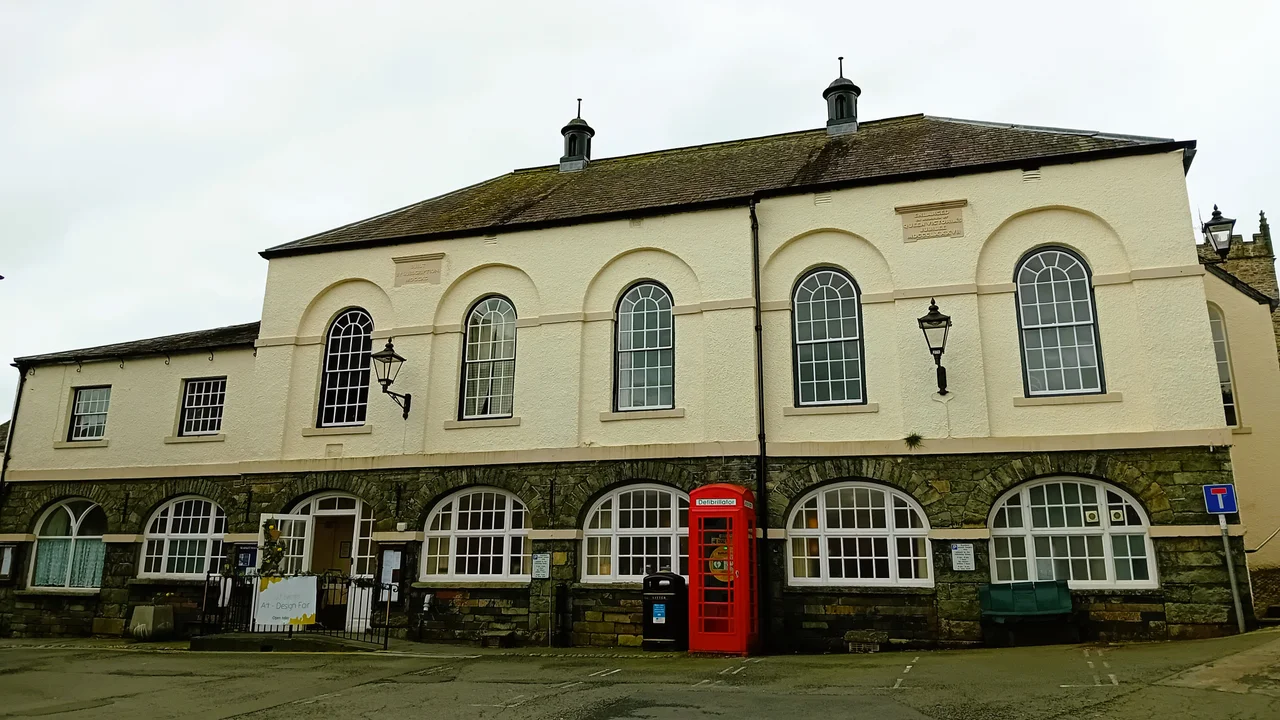
Hawkshead has roughly five hundred residents, one primary school, and four public houses. The 1790 Market Hall in the centre is where the parish council meets. The 14th-century parish church of St Michael and All Angels stands on a small rise just outside the warren, rebuilt in the 16th century, with the village laid out below it. Two small hamlets - Hawkshead Hill, 1.2 miles north-west, and Outgate, a similar distance north - belong to the same civil parish. After the Lake District National Park was formed in 1951, tourism grew steadily. Today most of the working economy comes from visitors, but there are still working farms on the surrounding fells, sheep on the hillsides, and the same overhanging gables Wordsworth knew. The temptation, walking through, is to read this as a museum piece. It isn't. It is a village that has stayed a village by being treated, for a very long time, as if it mattered.
From the Air
Hawkshead sits at 54.38 N, 3.00 W in the South Lakeland heart of the Lake District National Park, nestled between Coniston Water (about 3 km west) and Windermere (about 3 km east). From altitude the village itself is small; look for Esthwaite Water immediately to its south as a marker. The Coniston Fells rise west and the Claife Heights east. Nearest airfield is Walney Island (EGNL), about 30 km south-south-west on the Furness coast; Carlisle Lake District (EGNC) lies about 60 km north. Recommended viewing altitude 2,500-4,000 ft AGL. Hill cloud forms quickly on the surrounding fells, and the valley itself often holds mist on still autumn mornings.
Nearby Stories
- Morecambe Bay 4.1 km away
- Caldbeck 8 km away
- Pendragon Castle 8.1 km away
- Egremont Castle 8.5 km away
- Upper Teesdale 13 km away
- Solway Firth 13 km away
- Malham Cove 21 km away
- Santon Railway Station 70 km away