
Hazlitt Theatre
Carved into the pediment above Earl Street, framed by a moulded cornice, sits a small circular panel: a sheaf of corn surrounded by the words "The Corn Exchange." The building stopped being a corn exchange more than a century ago. The sheaf survived because nobody had the heart to chisel it off - and because the Late Victorian collapse of British agriculture happened so gradually that, by the time anyone admitted the trade was finished, the new tenants liked the carving too much to lose it.
The Surveyor's Colonnade
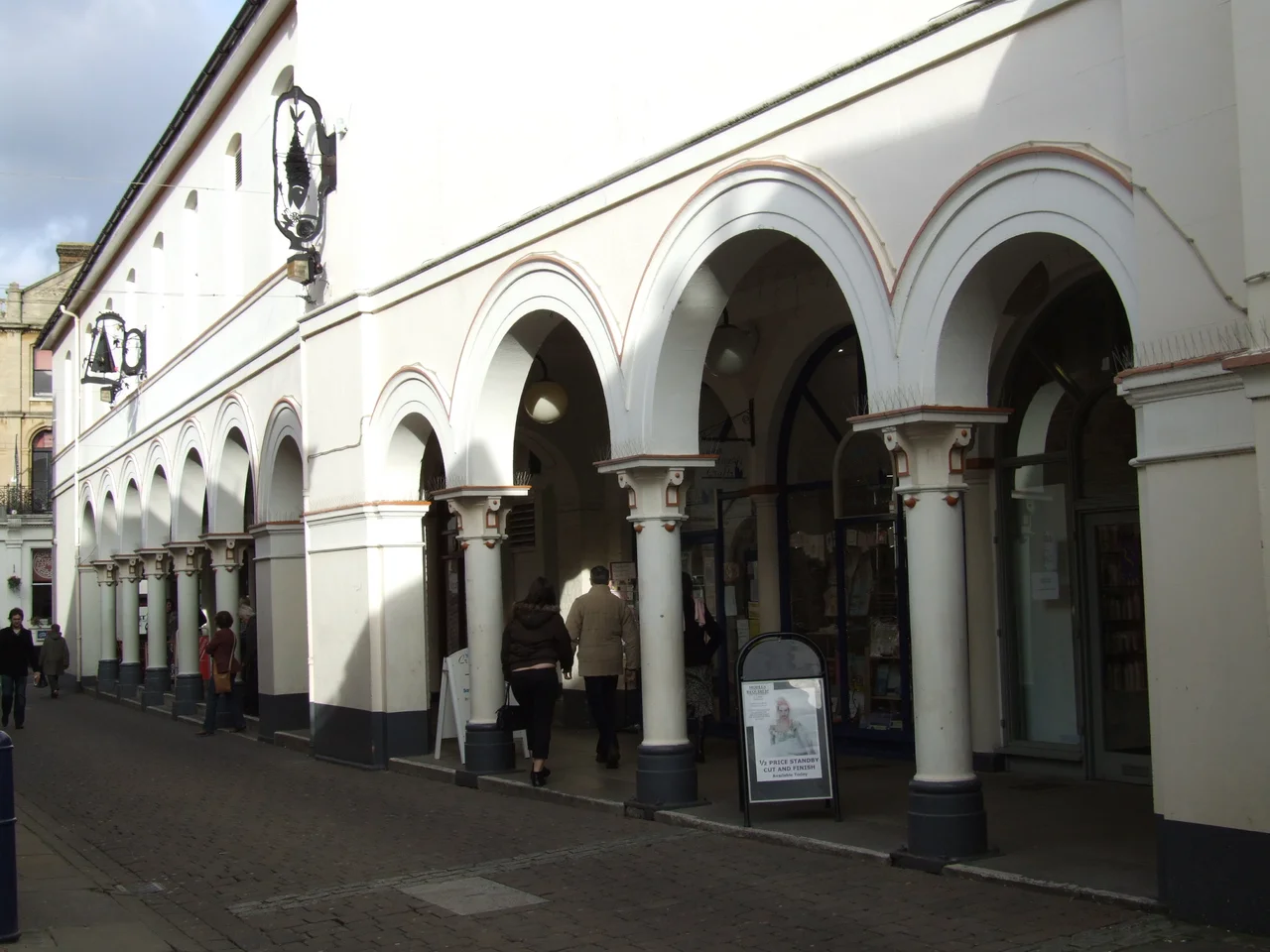
The older half of the complex - the rear building that locals once called the Market Buildings - was designed by John Whichcord Senior, the County Surveyor of Kent, and finished in 1835. Whichcord gave it eighteen bays of stuccoed neoclassical frontage running down the right-hand side, with a Tuscan colonnade broken into three sections of seven, four, and seven bays. On the upper floor, sash windows alternated with deliberately blind panels - the kind of decorative rhythm Georgian designers used to keep a long facade from feeling repetitive. The newer front block, the concert hall facing Earl Street, was added in 1869 in the same stucco neoclassical idiom. Three segmental-headed windows on the first floor, a triangular pediment crowning the roof. It was the architecture of confidence in markets, built when Maidstone was still the trading heart of an agricultural county that called itself the Garden of England.
When Wheat Stopped Paying
The Great Depression of British Agriculture began in the 1870s, when refrigerated steamships started bringing cheap grain and meat from North America, Argentina, and Australia. Kent's farms didn't disappear, but the corn exchanges - those buildings where farmers and merchants haggled by handful samples on long oak tables - simply stopped being needed. By the start of the 20th century, the ground floor of Maidstone's exchange had been carved into a parade of small shops. The upstairs assembly room, the high-ceilinged space where the auctions had once been held, was repurposed as a stage. They first called it the Maidstone Municipal Theatre, and a local amateur troupe known as the County Towners Variety Club performed two shows a year. Variety acts, music hall numbers, the occasional comic operetta - the kind of evening entertainment that filled the gap between cinema and television.
Named for a Difficult Man
By the mid-1960s, the building had been renamed for William Hazlitt - the essayist, critic, and journalist who was born in Maidstone in 1778. Hazlitt was a strange choice for civic honour. He had been politically radical at a time when radicalism cost you friends. He wrote venomously about Wordsworth's conservatism, about Coleridge's hypocrisy, about everyone who had abandoned the principles of the French Revolution as they grew older. His personal life, particularly the obsession with his landlady's daughter that he chronicled in the painfully candid "Liber Amoris," embarrassed even his admirers. But Hazlitt was also one of the finest prose stylists in the English language, and Maidstone in the 1960s decided to claim him. The Exchange Studio became the Hazlitt Theatre. The two performance spaces together - the smaller 200-seat studio and the larger 382-seat theatre - became the Hazlitt Arts Centre.
Tony Hart's Plaque
In 2009, the BBC came to the theatre for an unveiling. Carolyn Williams stood in the foyer and pulled the cloth from a plaque commemorating her father - Tony Hart, the children's television presenter who had taught a generation of British kids to draw using nothing but felt-tip pens and a quiet, patient voice. Hart was born in Maidstone in 1925. His shows - "Vision On," "Take Hart," "Hart Beat" - ran on the BBC for over thirty years, and the puppet character Morph, made of brown plasticine, became one of British television's most enduring icons. He died in January 2009 after a long illness. The plaque at the Hazlitt placed his name on the same walls where William Hazlitt had been honoured forty years earlier - two very different Maidstone artists, each shaped by a town that, between them, helped define the English voice.
A Building Still in Use
Maidstone Borough Council holds the freehold. In 1991, the Council sold a 125-year lease to a property company and then took the building back on a short sublease - one of those Thatcher-era property arrangements that made councils nervous about losing public assets. The shops on the ground floor still trade. Above them, the Exchange Studio still puts on plays, comedy nights, and the occasional pantomime. The Sleeping Beauty press launch in October 2022 - children in costume, the Mayor smiling, a press photographer arranging everyone under the chandeliers - looked, in essential ways, no different from a County Towners variety show from a hundred years before. Old buildings, used continuously, develop a certain stubborn dignity. The Hazlitt has it.
From the Air
Located at 51.274 north, 0.521 east, in central Maidstone on Earl Street near the River Medway. London Gatwick (EGKK) lies roughly 25 nautical miles to the west; Manston (EGMH) is about 30 nm to the east. The building is a low neoclassical block on a tight urban grid, recognisable from the air mainly by its position on the south side of the town centre block.
Nearby Stories
- Blackwall Tunnel 0.2 km away
- London Gateway 2.6 km away
- Canterbury Castle 4.2 km away
- Battle Abbey 7.4 km away
- Plymouth Brethren 9.9 km away
- The Carrington Event: The Solar Storm That Could Happen Again 12 km away
- Clacton Pier 32 km away
- 2008 Channel Tunnel fire 42 km away