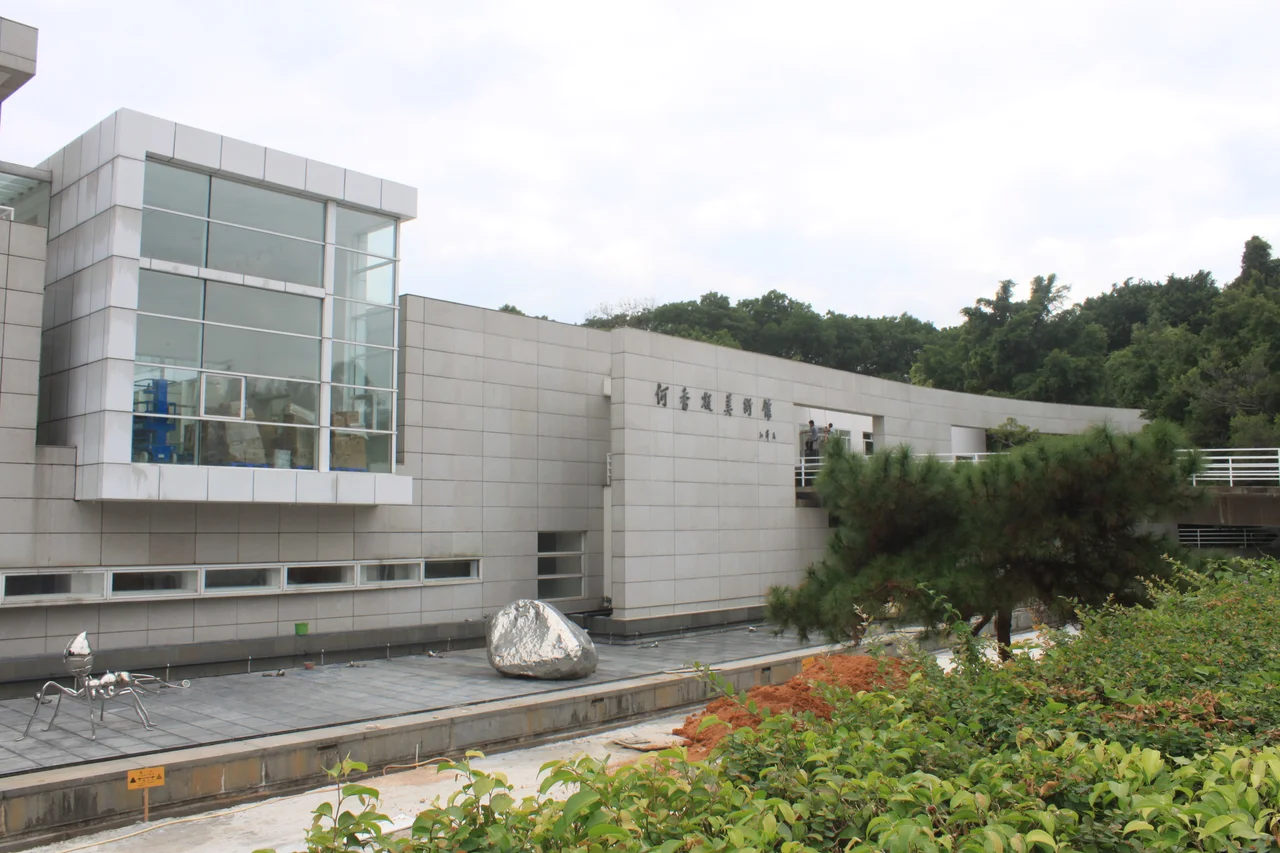

He Xiangning Art Museum
He Xiangning spent much of her long life doing things women in her era were not supposed to do. She joined Sun Yat-sen's revolutionary movement in the early 1900s, became a leading figure in the Kuomintang left, and outlived her husband Liao Zhongkai — who was assassinated in 1925 — by more than four decades, dying in 1972 at the age of 94. She also painted: tigers and plum blossoms, landscapes in ink, the kind of paintings that require stillness while the world around you refuses to hold still. In 1997, a museum in Shenzhen's Overseas Chinese Town opened in her name. It was the first national art museum in China dedicated to a specific person.
A Family Woven Into History
Understanding why this museum exists in Shenzhen requires understanding a family that shaped modern China. He Xiangning married Liao Zhongkai, a key ally of Sun Yat-sen and a leader of the Kuomintang's left wing, in the early twentieth century. After Liao was assassinated in 1925 — killed by political rivals — He Xiangning continued her political work, rising to lead the Revolutionary Committee of the Chinese Kuomintang. Her son, Liao Chengzhi, became head of the Overseas Chinese Commission, the body that administered the State Farm occupying what is now Overseas Chinese Town. That family connection is not incidental to the museum's location — it is the reason. When Shenzhen's Overseas Chinese Town was being developed into a cultural and tourism district in the 1990s, naming its anchor art institution after He Xiangning honored both the woman and the institutional lineage that shaped the land beneath it.
From State Farm to Cultural District
Before the Shenzhen Special Economic Zone transformed the Pearl River Delta, the land now occupied by Overseas Chinese Town was a State Farm — agricultural land managed by the Overseas Chinese Commission to support returned emigrants and their families. When Shenzhen's explosive growth arrived in the 1980s, OCT was redeveloped into something unusual: a planned district that blended theme parks, residential neighborhoods, and cultural institutions rather than purely industrial or commercial uses. Window of the World and Splendid China Folk Village, both within walking distance of the museum, brought international tourist traffic. Construction on the art museum began in 1995, and it opened in 1997 — a deliberate signal that Shenzhen's ambitions extended beyond manufacturing and trade.
Ink, Plum Blossoms, and Political Life
He Xiangning's paintings are part of the museum's permanent collection, and they carry a particular tension: artworks made in stolen hours by someone whose life left little room for the quietude that brushwork traditionally demands. She favored plum blossoms — a classical symbol of resilience, of beauty that persists through winter — and tigers, animals whose power and solitude she returned to repeatedly. Her work sits in the tradition of literati painting, the practice of scholar-officials who expressed character through ink. That she was neither an official nor a professional artist in the conventional sense only sharpens the point. The museum also holds regular exhibitions of contemporary art, positioning He Xiangning not as the endpoint of a tradition but as a figure through whom a living conversation about Chinese art and modern identity can be held.
A Museum First in Its Category
The distinction matters: no national art museum in China had previously been named for an individual when the He Xiangning Art Museum opened its doors. In a cultural landscape where institutional names tend toward the geographical or the generic, the decision to anchor a national institution to a specific person's biography was deliberate. It made the museum a place where the collection and the narrative reinforce each other — where seeing He Xiangning's paintings alongside exhibitions of contemporary work asks visitors to consider what continuity means in Chinese art, and what it costs to maintain it across a century of upheaval. The museum's location, surrounded by the pleasant incongruities of Overseas Chinese Town, only adds to that layered quality: a serious institution in a district that also contains full-scale replicas of world landmarks.
From the Air
The He Xiangning Art Museum sits at approximately 22.539°N, 113.988°E in Shenzhen's Nanshan District, within the Overseas Chinese Town cultural cluster. From the air at 3,000–5,000 feet, Overseas Chinese Town is identifiable by the distinctive layout of its theme parks — the miniature globe structure of Window of the World is a prominent visual marker to the west. The museum itself is embedded in the residential and cultural grid south of the theme park zone. The nearest major airport is ZGSZ (Shenzhen Bao'an International), approximately 20 kilometers to the northwest along the coast. VHHH (Hong Kong International) lies roughly 30 kilometers to the southwest, across the waters of the Pearl River estuary.
Nearby Stories
- Hong Kong Disneyland 4.1 km away
- Mount Guanyin (Dongguan) 7 km away
- 2024 Lixinsha Bridge Collapse 7.4 km away
- Portas do Cerco 12 km away
- Lotus Hill 15 km away
- Nanxiong Formation 78 km away
- Heyuan 130 km away
- Checheng Fu'an Temple 629 km away