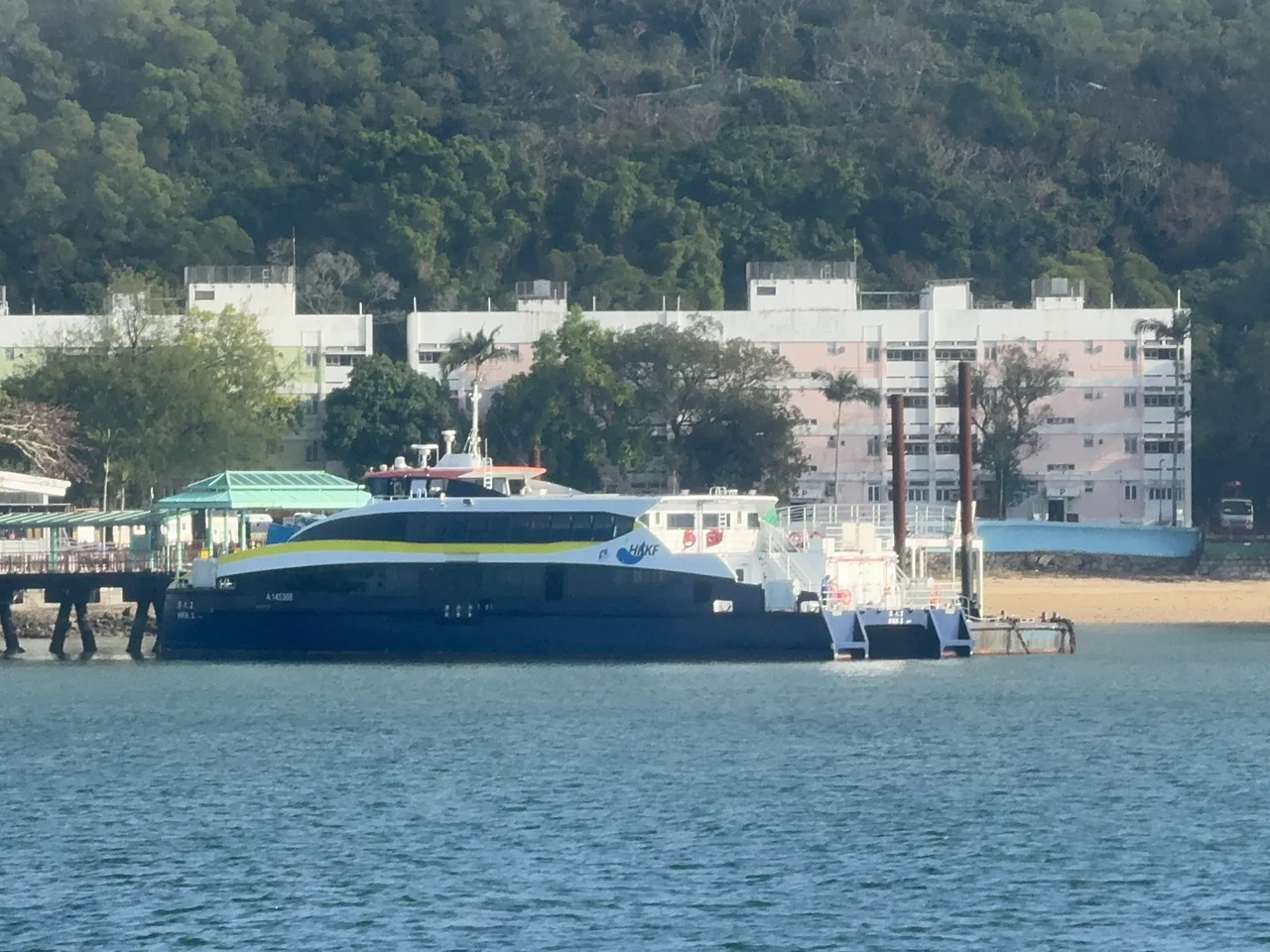

Hei Ling Chau
You cannot simply arrive at Hei Ling Chau. The ferry from Peng Chau will take you there, but disembarking requires a permit — a formality that, in a city defined by its relentless accessibility, immediately marks this L-shaped island as a place apart. Roughly 1.93 square kilometers of hillside and shore, tucked east of Lantau and south of Peng Chau, Hei Ling Chau has been home to fishing families, to people with leprosy who were isolated there by law, to prisoners serving their sentences, and to at least one creature — a small blind skink — found on only a tiny handful of islands in Hong Kong and nowhere else on the planet. The island's story is one of how a society decides who belongs where, and what it does with the people and places that don't fit neatly into the main.
A Hundred People and Ten Families
The island was originally called Nai Gu — a name that predates its current designation and the lives of anyone who remembers it. Settlers arrived in the late 19th century, and by 1951 the island supported roughly 100 people across ten families, making their living from the sea. Then came 1950, and a government designation: Hei Ling Chau would become a leprosy colony. The existing residents were not consulted. They were relocated to Tai Pak, Shap Long, and Cheung Chau — dispersed into the wider archipelago while the island they had built their lives on was repurposed for a different population. The logic of colonial public health administration rarely paused to consider the disruption it imposed on ordinary people, and this was no exception.
The Leprosarium Years
The leprosarium formally opened in 1951, built by the Tung Wah Hospital with government funding, with the Leprosy Mission also playing a role in its establishment. At its peak in the early 1960s, the facility housed up to 540 patients — men and women who had been diagnosed with leprosy, a disease that in the mid-20th century still carried the social stigma of centuries despite being treatable. Life on Hei Ling Chau during those years is not well-documented in official records; the people who lived it left few public traces. What's known is that two Tin Hau temples served the island's spiritual life — one built in 1925, predating the leprosarium entirely, eventually converted to a storeroom; the other built in 1985, after the colony had closed. In January 1975, the colony was shut down and its remaining patients transferred to the Lai Chi Kok Hospital. The island passed to the Correctional Services Department, which repurposed the facilities as prisons and rehabilitation centers — a transition that says something about how institutions think about land once it has been designated for the management of people society has placed aside.
The Creature Under the Leaves
Amid the island's layered history of displacement and confinement, nature preserved something quietly remarkable. Hidden in the forest floor — burrowing through soil, moving beneath dead leaves and debris — lives Dibamus bogadeki, a small legless lizard known as Bogadek's blind skink. Nocturnal and practically sightless, its eyes covered by scales, it was discovered by Father Anthony Bogadek, a Salesian priest and teacher working on the island, who found the first live specimen sheltering in a drain beside the woodland. The species was named in his honor. It is endemic to Hong Kong, found only on Hei Ling Chau and a tiny handful of neighboring islands — Shek Kwu Chau and Sunshine Island. In the taxonomy of life on this planet, this island and its two nearest neighbors are the only addresses this creature has ever known.
The Island Today
Hei Ling Chau continues as a restricted site. The Hei Ling Chau Correctional Institute occupies the eastern part of the island; the Lai Sun Correctional Institution — the first vocational training center operated by the Correctional Services Department — sits to the north, preparing inmates for reintegration into society. The Hei Ling Chau Addiction Treatment Centre occupies the northwest, and students sometimes visit as part of drug prevention education programs. The ferry from Peng Chau calls here on some sailings, though disembarking without a permit is not permitted. The island is visible from the air and from passing ferries as a green hill rising from the water between Lantau and Cheung Chau — quiet, self-contained, carrying a century's worth of complicated history behind its permit requirement.
From the Air
Hei Ling Chau sits at 22.25°N, 114.04°E in the western approaches to Hong Kong, between Lantau Island and Cheung Chau. From the air at 1,500–2,500 feet, the island's distinctive L-shape is clearly visible — a green ridge rising to 187 meters, surrounded by the blue-gray waters of the Lantau Channel. Hong Kong International Airport (VHHH) is approximately 10 nautical miles to the northwest. Lantau Island's peaks, including Lantau Peak and Sunset Peak, are visible to the west; Cheung Chau lies to the south.
Nearby Stories
- Lok Ma Chau Loop 2.3 km away
- Portas do Cerco 2.3 km away
- Kweilin Incident 17 km away
- Wanshan Archipelago Campaign 34 km away
- Nanxiong Formation 115 km away
- Battle of Nanpeng Island 148 km away
- Heyuan 169 km away
- Cape Maobitou 632 km away