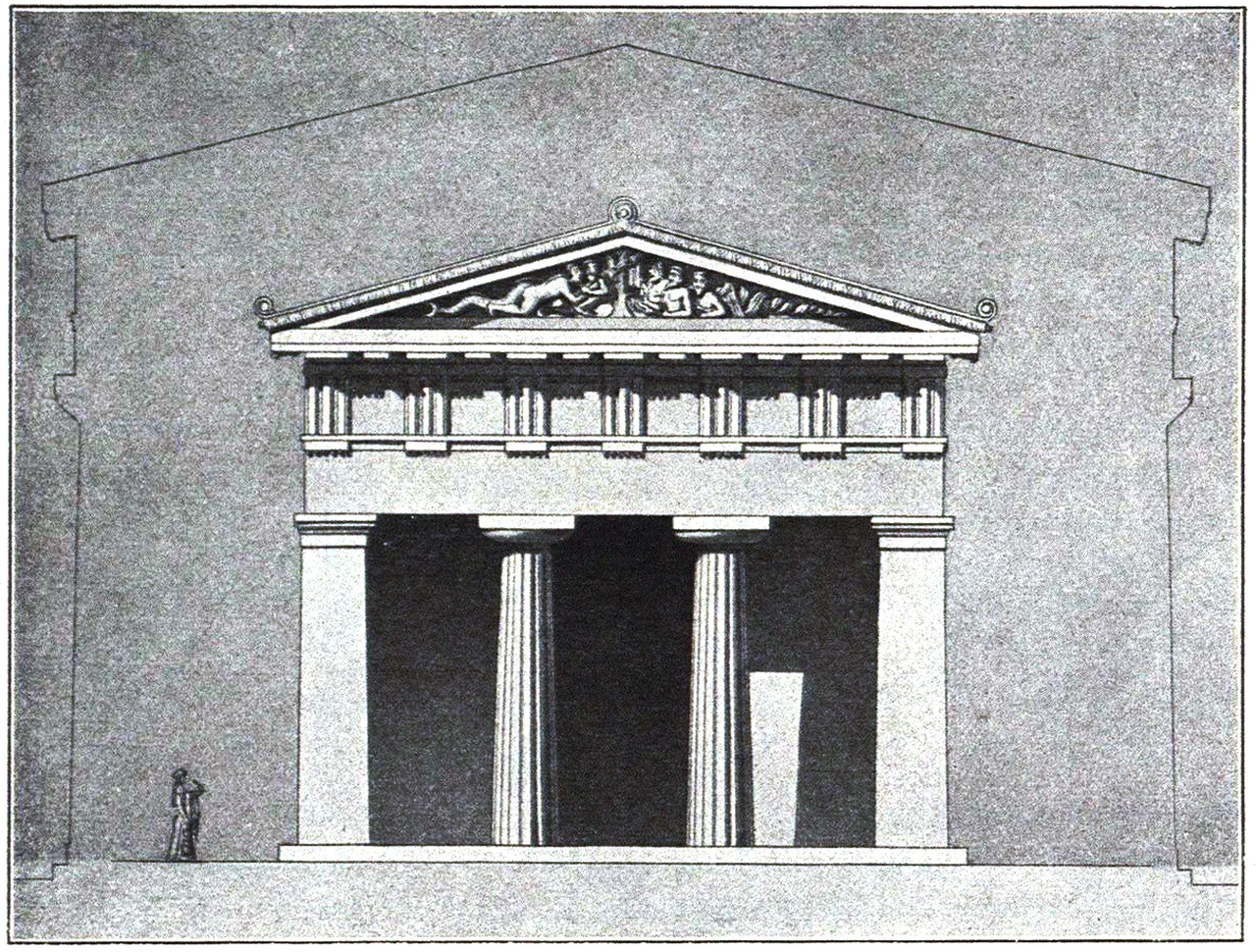

The Hekatompedon
Stand on the Acropolis today and you are standing on a palimpsest. Beneath the famous marble columns of the Parthenon, the Athenians built and rebuilt on the same rock for centuries, and the temple that occupied this spot two centuries before Pericles has very nearly vanished. Its name survives in old inscriptions: the Hekatompedon, the "hundred-footer," from the Greek for hundred (hekaton) and foot (pous). Its foundations are gone. What remains are broken pediments, weathered lionesses, and the snaking coils of a three-bodied monster - fragments scholars have spent more than a century trying to reassemble into a building.
The Hundred-Footer That Wasn't
The name is a puzzle in itself. "Hekatompedon" means one hundred feet long, yet the temple it described ran about 46 metres - which by any modern foot would be closer to 150. The discrepancy is a window into a vanished world of measurement: the ancient Greek foot was its own thing, and what the Athenians counted as a hundred of theirs amounts to roughly thirty of ours. The temple, in other words, was named for a number that no longer adds up unless you think in the units of people who died two and a half thousand years ago. It was raised around 570 to 550 BC, in the Archaic period, from limestone rather than the gleaming marble that would later define the Acropolis.
A Temple Built to Be Destroyed
The Hekatompedon stood for less than a century, and its end was a deliberate act of triumph. In 490 BC, after the Athenians stunned the Persian Empire at the Battle of Marathon, they tore their old limestone temple down to make room for something grander - a victory monument that became known as the Older Parthenon. The irony is brutal. That replacement was barely begun when the Persians returned in 480 BC, sacked Athens, and burned the half-finished temple to the ground. Only after that second catastrophe, decades later, did the Athenians raise the marble Parthenon that still crowns the hill. Three temples, one spot, each born from the wreckage of the last.
The Detective Story
Because the foundations disappeared, the Hekatompedon had to be reconstructed almost entirely from loose stones, and scholars disagreed for decades about even where it stood. The earliest investigator, Wilhelm Dorpfeld, attributed all the fragments to a neighbouring building entirely. In 1904 Theodor Wiegand argued the pieces belonged to an early temple on the site of the Old Temple of Athena. Then in 1922 Ernst Buschor moved it south, onto the very ground of the standing Parthenon, and christened the lost structure the Ur-Parthenon - the "original Parthenon." In 1936 Walter-Herwig Schuchhardt proved the pediments had been larger than anyone thought. Today the consensus, built on work by William Bell Dinsmoor and others, holds that the Hekatompedon was a Doric temple with a 46-metre platform, standing where the Parthenon stands now.
Lionesses and a Three-Bodied Demon
The surviving sculpture is where the temple comes alive. One pediment shows two lionesses tearing a bull apart at its centre; on one side Herakles wrestles the sea-god Triton, and on the other he grapples with a strange winged creature of three intertwined bodies, its upper hands holding a wave, a flame, and a bird. The lower portion dissolves into coiled serpent tails. Scholars read the trio as the elements - water, fire, air - and the figure as Nereus or Typhon, though its true meaning is lost with the religion that produced it. The second pediment, the Lioness pediment, sets two great cats over a dying calf, flanked by snakes. The painted blue beard of that three-bodied figure even earned the building a nickname among archaeologists: the Bluebeard temple.
Faces from the Archaic Age
The style of these carvings is unmistakably early. Pediments and friezes mix half-narrative scenes - human and semi-human figures - with animals arranged in tidy, repeating symmetry, the same instinct that decorated the painted pottery of the age. And the human faces wear that famous, faintly unsettling expression art historians call the Archaic smile: lips curved upward for reasons no one can fully explain, on figures who have watched the Acropolis change around them for twenty-five centuries. The horses, the gorgon from a rooftop ornament, the metope fragments - all of them now rest in the Acropolis Museum, the scattered remains of the temple that the Parthenon replaced and almost erased from memory.
From the Air
The Hekatompedon's remnants belong to the Acropolis of Athens, at 37.9715°N, 23.7267°E, rising about 150 metres above the surrounding city. The Acropolis is the single most recognisable landmark in Athens from the air - a flat-topped limestone outcrop crowned by the Parthenon, visible for miles in clear Mediterranean light. Athens International Airport (LGAV) lies roughly 30 km east-southeast. The surviving sculptures are displayed in the nearby Acropolis Museum at the foot of the hill.
Nearby Stories
- Great Sand Beach 5 km away
- Battle of Delium 7.7 km away
- Tower of Aliartos 9 km away
- HMHS Britannic 10 km away
- Saronic Gulf 15 km away
- Sousaki Volcano 17 km away
- Sanctuary of Apollo Maleatas 24 km away
- Skyros 66 km away