
ERT - The Hellenic Broadcasting Corporation
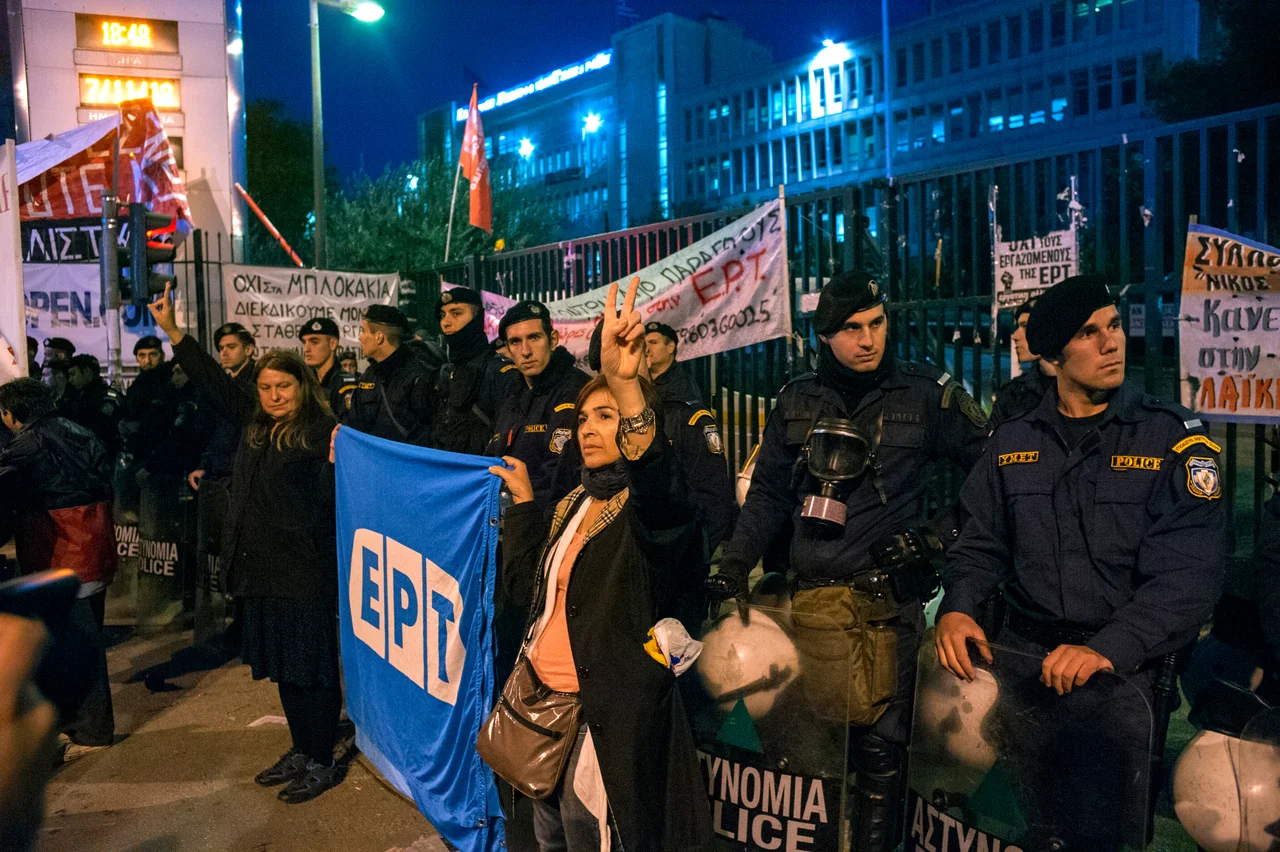
At 5:45 on the evening of 11 June 2013, a government spokesman went on television to announce that Greek public broadcasting would cease by the end of the day. A few hours later, riot police were forcing their way into transmitter stations across the country. But inside the headquarters at Ayia Paraskevi, the journalists did not stop. They kept talking into the cameras, kept the signal alive on satellite and the open internet, and dared the state to come and physically silence them. For a network founded in 1938, the night Greece pulled the plug on ERT became its most defining moment.
A Voice Older Than the Republic
ERT's roots reach back further than most of modern Greek broadcasting. It began in 1938 as the Radio Broadcasting Service, transmitting from the Zappeion hall in central Athens. Through the Axis occupation it was renamed and pressed into other purposes; after liberation, in 1945, it was rebuilt as the National Radio Foundation, and in 1950 it stood among the 23 founding members of the European Broadcasting Union. Television came slowly - test broadcasts in 1965, full service in 1966 - and for the first two decades a Greek TV set glowed only from late afternoon until somewhere between midnight and two in the morning. Round-the-clock broadcasting, three channels, the familiar ET1, NET and ET3, all of that came later.
The Shepherd Boy's Tune
There is a sound that generations of Greeks associate with the act of switching on the radio. ERT's interval signal - the chime that marks the gaps between programmes - is built from the opening bars of an old folk song, Tsopanakos Imouna, "Once I Was a Shepherd Boy." The same melody serves as the corporation's theme music, a small thread of national memory woven into the broadcast day. Behind it sits the largest audiovisual archive in Greece, a vault of recorded sound and image stretching across the country's modern history: the voices, the music, the news bulletins, the broadcasts of the 2004 Athens Olympics, which ERT carried as host broadcaster.
The Night the Screen Went Black
By 2013 Greece was deep in financial crisis, and the government framed ERT as a luxury it could no longer afford - a "haven of waste," the spokesman called it, even though the broadcaster ran a surplus funded by a licence fee outside the state budget. The shutdown order took effect within hours. The nearest transmitters to Athens fell silent at around 23:17. Twenty seconds later, the communist party's channel began relaying ERT's signal, until it too was ordered off the air. Around 2,500 to 2,656 employees lost their jobs at a stroke. The European Broadcasting Union condemned the closure that same night, declaring "profound dismay" and keeping ERT on its council on the grounds that it was, whatever Athens said, still a broadcaster.
Broadcasting from the Ruins
What happened next was extraordinary. Locked out of much of their own infrastructure, ERT's journalists improvised. The EBU beamed their feed across Europe by satellite; striking workers ran transmitters they still controlled. Even after the government lobbied a satellite operator to cut their capacity on 24 October, the resistance held. More than nine months after the shutdown order, the striking staff were still operating seventeen radio stations and a single television channel, ET3, broadcasting from regional studios and the ET3 building in Thessaloniki - on FM, on shortwave, and always on the web. Greece's highest administrative court had ruled the closure unlawful within a week of the announcement, ordering the state to maintain a public broadcaster.
Switched Back On
The government tried to fill the silence with a successor. NERIT - New Hellenic Radio, Internet and Television - launched in stages through 2013 and 2014, preceded by a stopgap channel simply called Public Television. It never won the public over. When Alexis Tsipras, who as opposition leader had branded the original shutdown "illegal," became prime minister, his government moved to undo it. On 11 June 2015 - two years almost to the day after the screen went black - ERT returned to the air, replacing NERIT at six in the morning. The shepherd boy's tune played again, and the largest archive in Greece had its broadcaster back.
From the Air
ERT's headquarters sit in Ayia Paraskevi, a northeastern suburb of Athens, at roughly 38.013°N, 23.826°E. The site includes a DVB-T transmitter that, on the night of the 2013 shutdown, kept a swathe of Athens supplied with signal. Athens International Airport (LGAV) lies about 12 km to the southeast. From the air the broadcast complex blends into the dense northeastern suburbs below the foothills of Mount Hymettus; transmission masts are the most visible feature.
Nearby Stories
- Great Sand Beach 5 km away
- Battle of Delium 7.7 km away
- Tower of Aliartos 9 km away
- HMHS Britannic 10 km away
- Saronic Gulf 15 km away
- Sousaki Volcano 17 km away
- Sanctuary of Apollo Maleatas 24 km away
- Skyros 66 km away