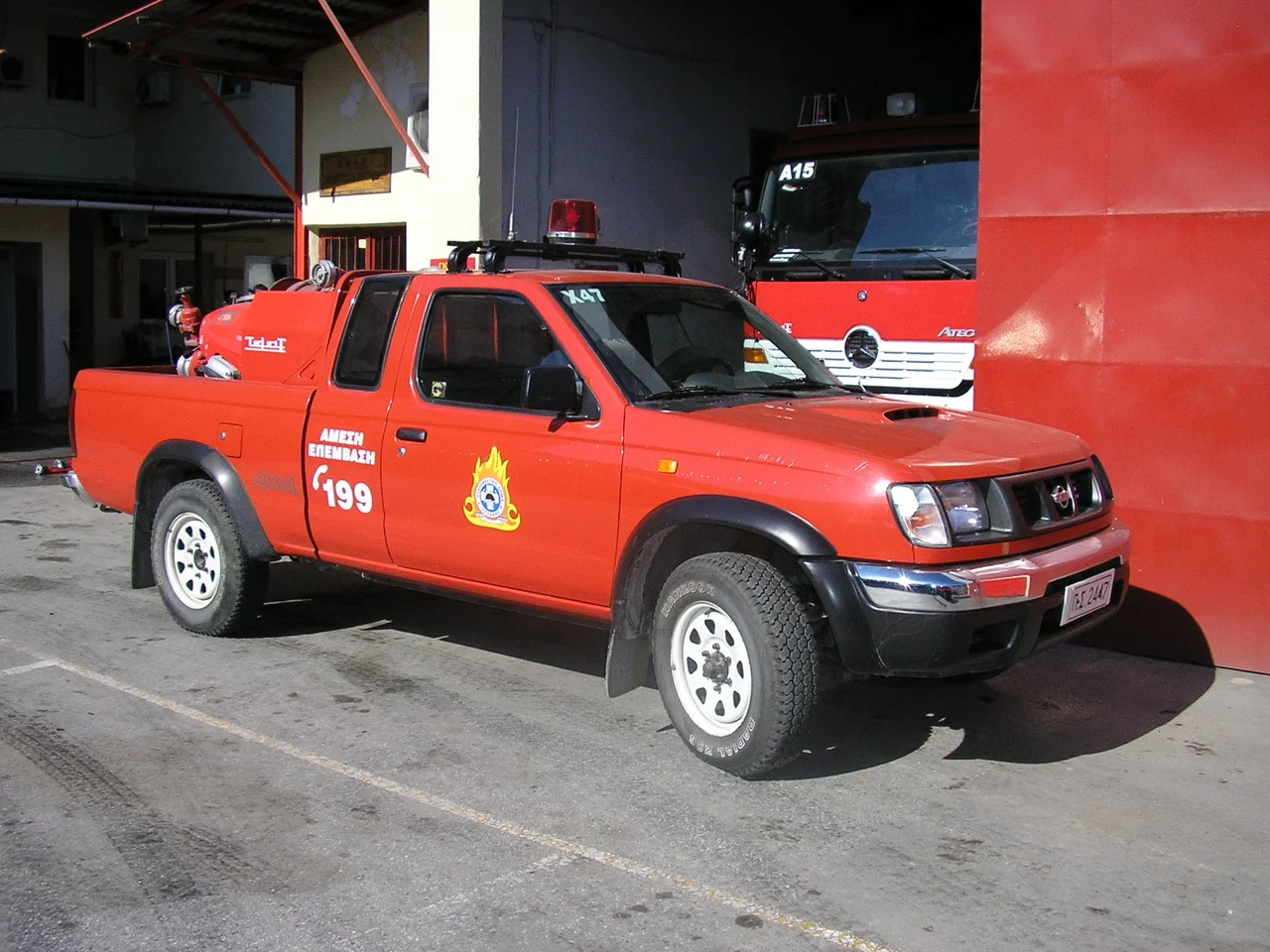

The Hellenic Fire Service
In Greek, a firefighter is a pyrosvestis - and the word means, quite literally, "fire extinguisher." Not the red cylinder on the wall, but the person: the one who puts the fire out. It is a fitting name for a service whose defining battle is fought not in burning buildings but across the tinder-dry hillsides of a Mediterranean summer, where every August the Hellenic Fire Service sends aircraft and crews against wildfires that can swallow whole landscapes. Headquartered in Athens, it is the national fire and rescue service of Greece, and its history is older and stranger than the engines parked outside its stations suggest.
From Prefects to a Company of 92
When the modern Greek state was founded in 1833, nobody owned the problem of fire. Responsibility was scattered among prefects and municipalities, with army pioneer companies looking after public buildings and "peacekeepers" expected to muster the means to fight a blaze. The first real firefighting unit came in 1854: a Firemen Company raised in Athens as part of the Greek Army. By 1861 it had grown into a mixed formation of sappers and firemen ninety-two men strong - soldiers who, between fires, also built roads. For decades firefighting in Greece was a military affair, an arm of the army rather than a civilian service, expanding only in 1914 to reach Thessaloniki, Patras and Piraeus.
The Man from St Petersburg
By the 1920s the system was failing. A fire service set up as a separate military branch in 1926 proved ineffective, and so in 1929 the Greek government turned to an unlikely outsider. Alkiviadis Kokkinakis was a Greek emigre from Russia who had run the fire service of St Petersburg - one of the great firefighting institutions of imperial Europe - and he was handed the task of rebuilding Greece's from the ground up. The reform took. In 1930 the Fire Corps was reconstituted as an independent national authority under the Ministry of the Interior. The expertise of a city on the Neva had been transplanted to the shores of the Aegean.
The Students Who Wouldn't Move
The service has guarded its independence fiercely. In 1984 the government of the day tried to fold all of Greece's security forces, the Fire Service among them, into a single unified Hellenic Police. The firefighters' answer came from the next generation: students at the Firefighting Academy occupied their own campus, squatting on the premises in protest, and the planned absorption was never carried out. The Fire Service stayed its own institution. The decisive expansion of its mission came later, in 1998, when it took over responsibility for forest fires from the Forestry Service - inheriting the duty that now dominates its summers, and absorbing the Forest Service's entire fleet of vehicles in the bargain.
Catastrophe Units and a Fleet for the Flames
Today the service is built for disaster on a national scale. Its specialist arm, known by the initials EMAK - the Special Unit Dealing with Catastrophes - handles heavy urban search-and-rescue and technical rescue work, and even fields teams of scuba divers, reporting directly to the corps' lieutenant general. The numbers are considerable: across the country the service runs roughly 2,500 trucks and cars, 44 firefighting aircraft, around twenty helicopters and ten firefighting vessels, with the Hellenic Air Force lending a hand on the fixed-wing fleet. Stations are graded A through D by the size and danger of their territory, and smaller posts, the klimakia, reach into places too remote for a full station - including monasteries and far-flung islands, where volunteers can be raised to stand guard.
Blue Coats and a Quiet Army of Volunteers
You can recognise a Greek firefighter by the bright blue turnout coat and the silver helmet. Behind the regulars stands a force that is easy to overlook: the Voluntary Corps, established in 1991, which now makes up about seventeen percent of the service's strength. These are unpaid citizens, trained and officially recognised by the state, who turn out for fires, floods, earthquakes and accidents alongside the professionals - a framework formalised by law in 2011. In a country where the fire season grows longer and fiercer with each passing year, they are often the difference between a contained blaze and a catastrophe, especially in the small communities where no professional station exists.
From the Air
The Hellenic Fire Service headquarters and its Firefighting Academy sit in the northern Athens area, near Kato Kifissia, at roughly 38.082°N, 23.788°E, in the green foothills north of the city centre. Athens International Airport (LGAV) lies about 25 km to the southeast. From the air this is where the firefighting aircraft and helicopters that patrol the Attica wildfire front are based; in summer the surrounding pine-clad slopes of Attica are exactly the terrain those crews are scrambled to defend.
Nearby Stories
- Great Sand Beach 5 km away
- Battle of Delium 7.7 km away
- Tower of Aliartos 9 km away
- HMHS Britannic 10 km away
- Saronic Gulf 15 km away
- Sousaki Volcano 17 km away
- Sanctuary of Apollo Maleatas 24 km away
- Skyros 66 km away