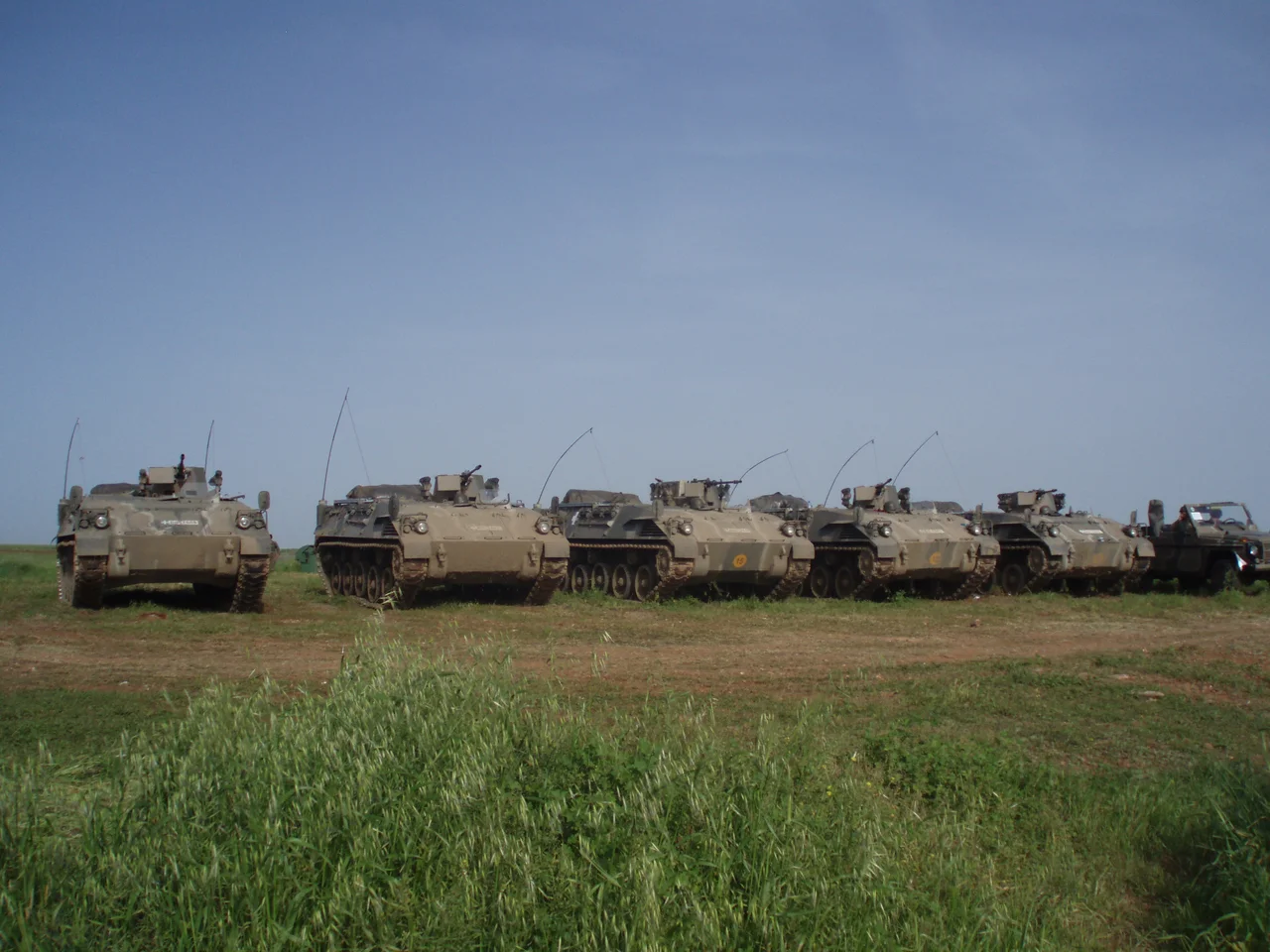

ELDYK - The Hellenic Force in Cyprus
On 19 July 1974, a Greek landing ship called the Lesvos pulled away from Cyprus carrying soldiers home to Greece, their tour of duty done. It never reached port. The next morning Turkish forces invaded the island, and the Hellenic Navy radioed the Lesvos - by then sailing off Rhodes - to turn around and put its men back ashore. Those soldiers sailed knowingly back into a war. They belonged to ELDYK, the Hellenic Force in Cyprus: a small, battalion-sized Greek garrison whose story begins not in Cyprus at all, but in a quiet suburb of Athens.
A Force Written Into a Treaty
ELDYK was formed on 20 November 1959 at Agios Stefanos, on the northern edge of Athens, in the wake of the Zurich and London Agreements that gave Cyprus its independence. The settlement made Greece, Turkey and Britain the new state's guarantor powers, and to balance the arrangement each of the two motherlands was permitted a small permanent garrison on the island. Greece's contingent numbered 950 men; Turkey's, known as TOURDYK, 650. On 16 August 1960, the very day Cyprus became officially independent, ELDYK's soldiers disembarked at Famagusta from the landing ships Limnos and Aliakmon, led by Colonel Dionysios Arbouzis, a veteran who had already commanded Greek troops in the Korean War.
The Names on the List
Peace on Cyprus proved fragile. When intercommunal violence erupted between Greek and Turkish Cypriots in December 1963, British intervention narrowly kept the two foreign garrisons out of the fighting. But ELDYK's men did not escape the bloodshed entirely. In March 1964, Sergeant First Class Sotirios Karagiannis was killed in a new round of violence. Two months later, in the Turkish-Cypriot quarter of Famagusta, Major Dimitrios Poulios and Captain Vasileios Kapotas were killed, Captain Panagiotis Tarsoulis was wounded, and their driver, the policeman Konstantinos Pantelidis, was killed alongside them. They were among the first of the force's dead - soldiers stationed far from home who paid for a conflict not of their making.
Twenty-Eight Days of War
When Turkey invaded on 20 July 1974, ELDYK was thrown into a fight against overwhelming odds. The Cypriot National Guard could muster only a fraction of its nominal 10,000 troops; the Turkish invasion force numbered around 40,000. Across twenty-eight days, until 16 August, ELDYK's units were scattered across the island to support the National Guard - at Paphos, at Kioneli, at Lapithos and Karavas. Greece flew in an airborne battalion to reinforce them, but the disparity was crushing. Three ELDYK conscript classes, the 103rd, 105th and 107th, found themselves in combat. Class 107 had stepped off the Lesvos just one day before the invasion began; Class 103, the men the ship had been carrying away, were turned back to fight.
The Battle of the Camp
The fiercest fighting centred on ELDYK's own base, west of Nicosia at Gerolakkos, beside the Turkish garrison. Greek and Cypriot soldiers defended it in two separate stands - on 22 to 23 July, and again in the final days of the invasion, 14 to 16 August. Among the dead was Captain Sotirios Stavrianakos, killed on 16 August, the last day of the battle, and promoted posthumously to major. Today the force's headquarters camp near Nicosia bears his name. More than 150 ELDYK men were killed or remain missing from the invasion. The old camp at Gerolakkos was destroyed, and the ground it stood on lies, to this day, under Turkish control on the far side of the divide.
The Tomb and the Hand That Points
Many of the fallen lie at the Tomb of Makedonitissa, a military cemetery west of Nicosia. It marks a particular tragedy: on 22 July 1974, during Operation Niki - a Greek airlift of special forces to reinforce the National Guard - one of the transport aircraft, a Nord Noratlas, was shot down here by friendly fire. At the modern ELDYK camp, a memorial sculpture shows a soldier raising his hand toward the site of the lost base at Gerolakkos, the names of the dead and missing inscribed on marble beneath. The force endures. ELDYK still stands in Cyprus, still trains beside the Cypriot National Guard, its motto borrowed from Herodotus: same blood, same language, same faith, same ways.
From the Air
ELDYK was founded at Agios Stefanos near Athens (about 38.13°N, 23.83°E), though the force itself is garrisoned near Nicosia, Cyprus, some 900 km to the southeast. The Athens-area coordinates here sit in the northern Attica suburbs; Athens International Airport (LGAV) is roughly 15 km to the south. The history described - the battles, the camp, the Tomb of Makedonitissa - unfolded on Cyprus, around Nicosia, where the island remains divided along the Green Line to this day.
Nearby Stories
- Great Sand Beach 5 km away
- Battle of Delium 7.7 km away
- Tower of Aliartos 9 km away
- HMHS Britannic 10 km away
- Saronic Gulf 15 km away
- Sousaki Volcano 17 km away
- Sanctuary of Apollo Maleatas 24 km away
- Skyros 66 km away