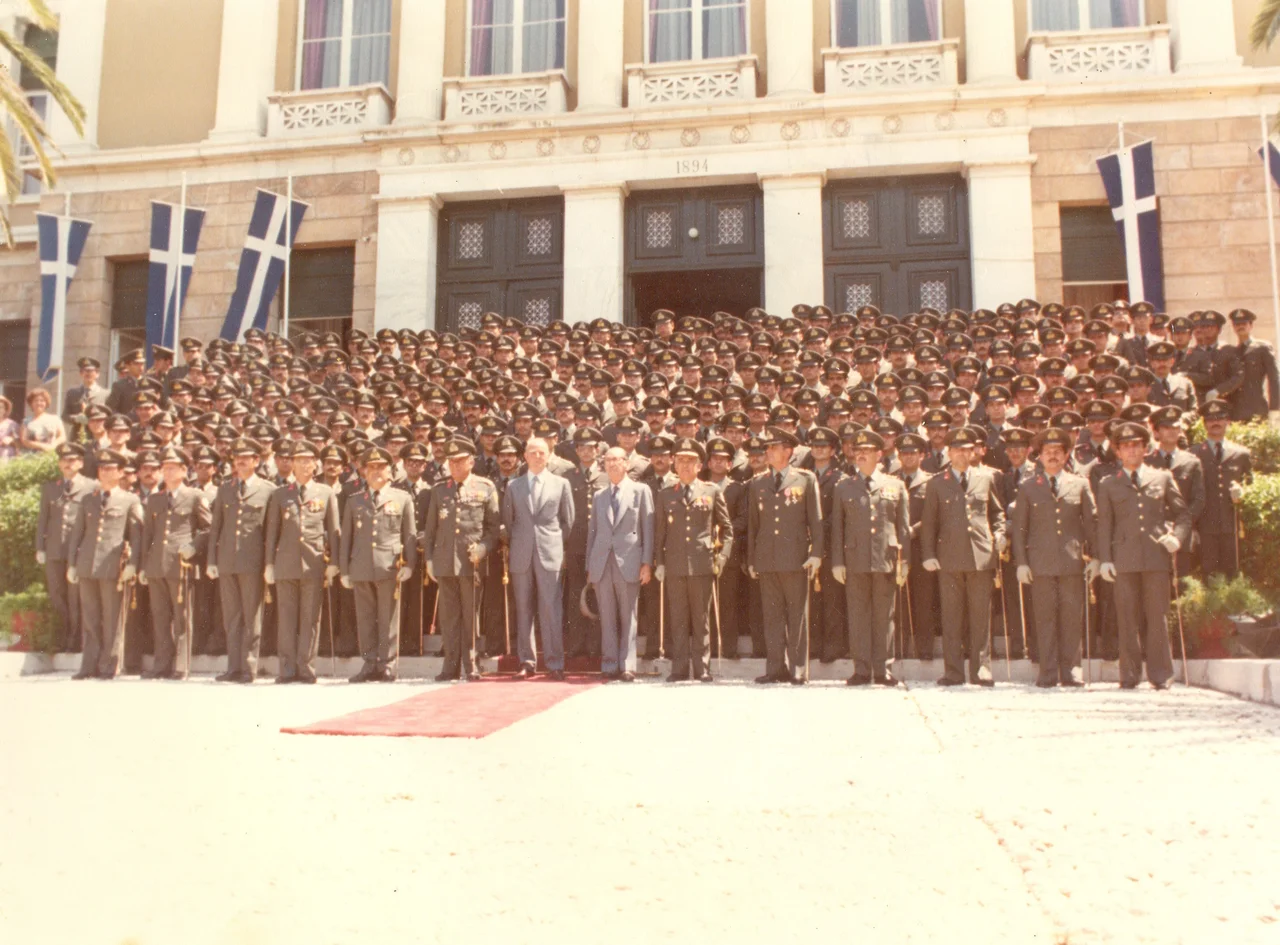

Hellenic Military Academy
Ioannis Kapodistrias had been governor of the new Greek state for less than a year when he announced the foundation of a military academy in June 1828. The country was barely a country — still fighting for its independence, governed from the provisional capital at Nafplio, with no established institutions and no officer corps to speak of. Creating a school to train officers was not an act of luxury; it was an act of state-building. Kapodistrias named the first five students himself, calling them "Evelpides" — a word he drew from a passage in Thucydides, where the Corinthians describe the Athenians as people who bear "high hopes when in danger." Nearly two centuries later, the Hellenic Military Academy still carries that name.
Kapodistrias and the First Five
The choice of the name Evelpides — "those who hold good hopes" — was deliberate and literary. Kapodistrias was a statesman of considerable education, and the reference to Thucydides' History of the Peloponnesian War placed his new institution within a long tradition of Greek civic virtue. The five young men he named as the first cadets in 1828 were receiving an education at a moment when the Greek state's survival was genuinely uncertain. The Ottomans had not yet formally recognized Greek independence; battles were still being fought. Training officers under those conditions was a wager on the future — an insistence that Greece would persist, and would need professionals to lead its army. The wager paid off. The Academy has operated continuously since that founding, through wars, coups, occupations, and political upheavals that might have destroyed a less deeply rooted institution.
Woven into the Nation's Struggles
The Academy's history cannot be separated from the history of modern Greece, because the Academy produced nearly every senior officer who led Greek forces through that history. Its graduates fought in the Greco-Turkish wars of the late nineteenth and early twentieth centuries, in the Balkan Wars of 1912–1913, in the First and Second World Wars, in the Greek Civil War, and in subsequent decades of NATO service. The state recognized the institution's contribution repeatedly: the War Flag was awarded in 1926, the Medal of Military Merit Class A in 1931, the War Cross Class A in 1943, and the Medal of Valor in 1946. These are not honorary decorations — they mark specific periods of active service and sacrifice. The Academy was not a school standing apart from events; its cadets and graduates were in the middle of them.
Education Between the Classroom and the Field
The four-year curriculum at the Hellenic Military Academy is designed to produce officers who are also educated people. Academic study covers subjects from the humanities and social sciences through chemistry, engineering, and psychology — a breadth that reflects the conviction that military leadership requires more than tactical training. The academic year runs 39 weeks, of which 26 are academic and 13 are purely military. Cadets rotate through field training at locations including Vari and mountain sites in the Parnassos region and Pieria, learning to command at increasingly complex levels: individual tactics in the first year, then team and platoon command, then company-level operations. Physical education is treated as integral, not supplementary — the expectation being that officers must be able to demand from their soldiers what they can themselves perform.
The Name That Travels
Today the Academy hosts cadets from 20 different countries. Foreign nationals attend the same program as Greek cadets, following the same schedule and meeting the same standards. The Academy's international dimension reflects Greece's role in NATO and its network of bilateral defense agreements, but it also carries forward something the institution has always implied: that the ideals encoded in the Evelpides designation — hope, daring, commitment under uncertainty — are not exclusively Greek. The two cadet battalions are named after heroes: the 1st after Infantry Major Velissarios Ioannis, the 2nd after Artillery Major Paparrodou Ioannis. The names honor specific people who served and died. The cadets who drill beneath those names carry them forward.
Greece's Oldest University
A fact that surprises many visitors: the Hellenic Military Academy is the oldest institution of higher education in Greece. It predates the University of Athens, founded in 1837, by nearly a decade. That precedence reflects the priorities of a young state that needed soldiers before it needed scholars in the conventional sense. The campus in the Vari area south of Athens is set apart from urban Piraeus and Athens, occupying grounds suitable for both academic and military training. The original building in Kypseli, Athens — long since outgrown — is a reminder of how the institution expanded with the state it serves. The name "Evelpidon" has attached itself so firmly to the Academy that in common Greek usage, you do not say "the Military Academy" — you say "the Evelpidon," invoking the Thucydidean echo that Kapodistrias built in from the start.
From the Air
The Hellenic Military Academy campus is located at approximately 37.842°N, 23.812°E in the Vari area, southeast of central Athens. From the air, the campus presents as a compound of organized buildings and parade grounds set among the scrubby hills of Attica, east of the Hymettus ridge. Flying south from Athens, the Saronikos Gulf opens to the south and the campus is visible in the middle distance. The nearest major airport is Athens International Eleftherios Venizelos (LGAV), approximately 15 km to the northeast — notably closer than to central Piraeus. Recommended viewing altitude is 2,000–3,500 feet.
Nearby Stories
- Parnitha 3.4 km away
- Kea (island) 7.3 km away
- Sanctuary of Apollo Maleatas 11 km away
- Sousaki Volcano 12 km away
- Battle of Leuctra 14 km away
- Great Sand Beach 18 km away
- Agios Georgios (island) 23 km away
- Skyros 84 km away