
Hellinikon Metropolitan Park
For decades, the southern suburbs of Athens looked out over a fence. On the other side lay the old Hellenikon International Airport — closed in 2001 when Eleftherios Venizelos opened to the east — its runways cracking in the Mediterranean sun, its terminals slowly emptying of everything except a handful of Olympic Airways jets that no one had gotten around to moving. Then, slowly and then all at once, something new began to take shape on that coastal ground: one of the largest urban parks in Europe, rising from 530 hectares of abandoned asphalt just minutes from the Saronic Gulf.
A Competition and a Vision
The ambition predates the construction by nearly two decades. In 2005, an international design competition drew more than 300 teams of architects. The winners — led by David Serero, Elena Fernandez, and landscape architect Philippe Coignet — proposed something unusual: a park whose water supply would come almost entirely from the site itself. Their design structured the 530 hectares around seven north-south green corridors called "Softscapes," irrigated channels that gather rainfall from the surrounding hills and direct it through the park. These weren't just functional — they created terraces, slopes, and varied topography where a flat airfield once lay. The financial crisis intervened. Construction that was planned to begin in 2008 was shelved, the plans revised and resubmitted, the timeline extended by years. It was not until July 2020 that ground was actually broken.
What Is Being Built
The park itself will encompass 263 hectares — an area larger than Monaco. Another hundred-plus hectares adjacent to it are earmarked for luxury housing, hotels, offices, and a marina. The Riviera Tower, permitted in 2022, will rise 200 meters, making it the tallest building in Greece and, its developers say, in Southeastern Europe. A Hard Rock Hotel and Casino is planned for the same height. In 2021, global design firm Sasaki was brought in to redesign the park and prepare it for permitting and construction. By April 2023, demolition of the existing airport infrastructure was underway. Phase 1 of the park was estimated for completion by early 2026, though large-scale urban projects of this ambition rarely land exactly on their announced timelines.
The Planes That Stayed
When Hellenikon Airport closed, a small fleet of aircraft remained on the apron — relics of Olympic Airways, the national carrier that itself would not survive the decade. A Boeing 747, a Boeing 727, a Boeing 737, and a BAC One-Eleven sat idle while the debate over the airport's future ran on and on. Lamda Development, the company leading the redevelopment, eventually acquired them with the intention of preserving them as display objects within the park — living artifacts of what this ground once was. There is something fitting about it: a park that holds its own history in place, where visitors can look up at the fuselage of a jet and understand, in one glance, what came before the trees.
Climate and Character
Elliniko — the neighborhood that gave the old airport its name — sits in the southern suburbs of Athens, where the city's character shifts noticeably. The Hellenic National Meteorological Service records an average annual temperature of 18.6°C here and just 366.5 millimeters of rainfall per year, a climate that edges into hot semi-arid territory while retaining the essential rhythms of the Mediterranean: warm dry summers, mild wet winters. The highest temperature on record is 43.0°C, set on 3 August 2021. This is a climate that demands intelligent water management — which is precisely what the Softscape corridors were designed to provide, capturing and recycling as much as 80 percent of the park's water needs from rainfall alone.
A City Turning Back to the Sea
Athens has always had a complicated relationship with its coastline. The city grew inland and upward, leaving the seafront to industry, military installations, and eventually to neglect. Hellinikon represents a deliberate reversal — an attempt to give Athenians back a stretch of coastline that was closed to them for sixty years of aviation. Whether the park will be truly public, or whether it becomes primarily a resort zone for the hotels and luxury residences that surround it, remains to be seen. What is not in question is the scale. When complete, the Hellinikon Metropolitan Park will stretch from the hills behind Voula to the edge of Phaleron Bay — green, coastal, and unlike anything Athens has had before.
From the Air
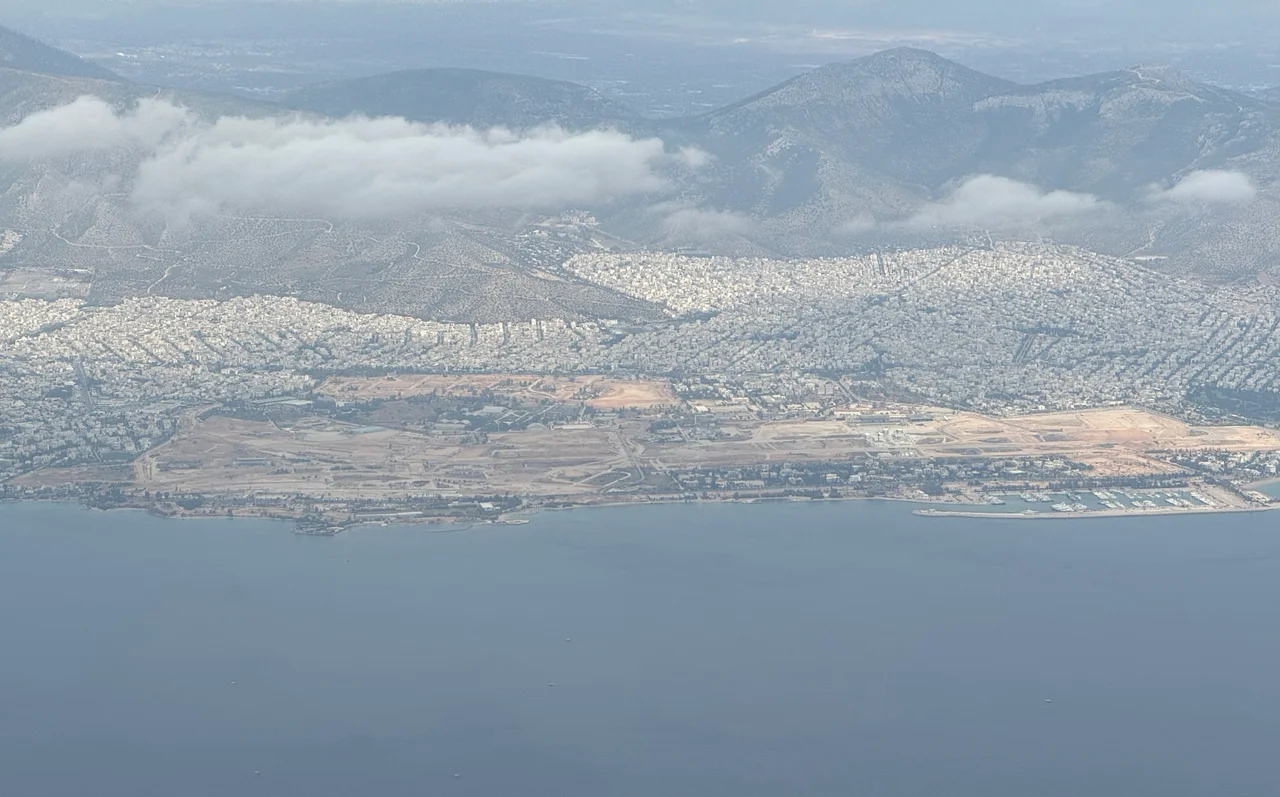
The Hellinikon Metropolitan Park is centered at approximately 37.8866°N, 23.7415°E, on the coastline of the southern Athens suburbs between Alimos and Glyfada. From the air on approach to Athens International Airport (LGAV), the site is visible to the southwest — a broad flat coastal expanse distinguishable by ongoing construction activity and the outlines of the old airport's taxiways still visible from altitude. LGAV lies approximately 19 kilometers to the east. Recommended altitude for viewing is 3,000–6,000 feet MSL on a southbound approach. The Saronic Gulf shimmers immediately to the south; the dense urban fabric of Piraeus and Piraeus harbor is visible to the northwest.
Nearby Stories
- Parnitha 3.4 km away
- Kea (island) 7.3 km away
- Sanctuary of Apollo Maleatas 11 km away
- Sousaki Volcano 12 km away
- Battle of Leuctra 14 km away
- Great Sand Beach 18 km away
- Agios Georgios (island) 23 km away
- Skyros 84 km away