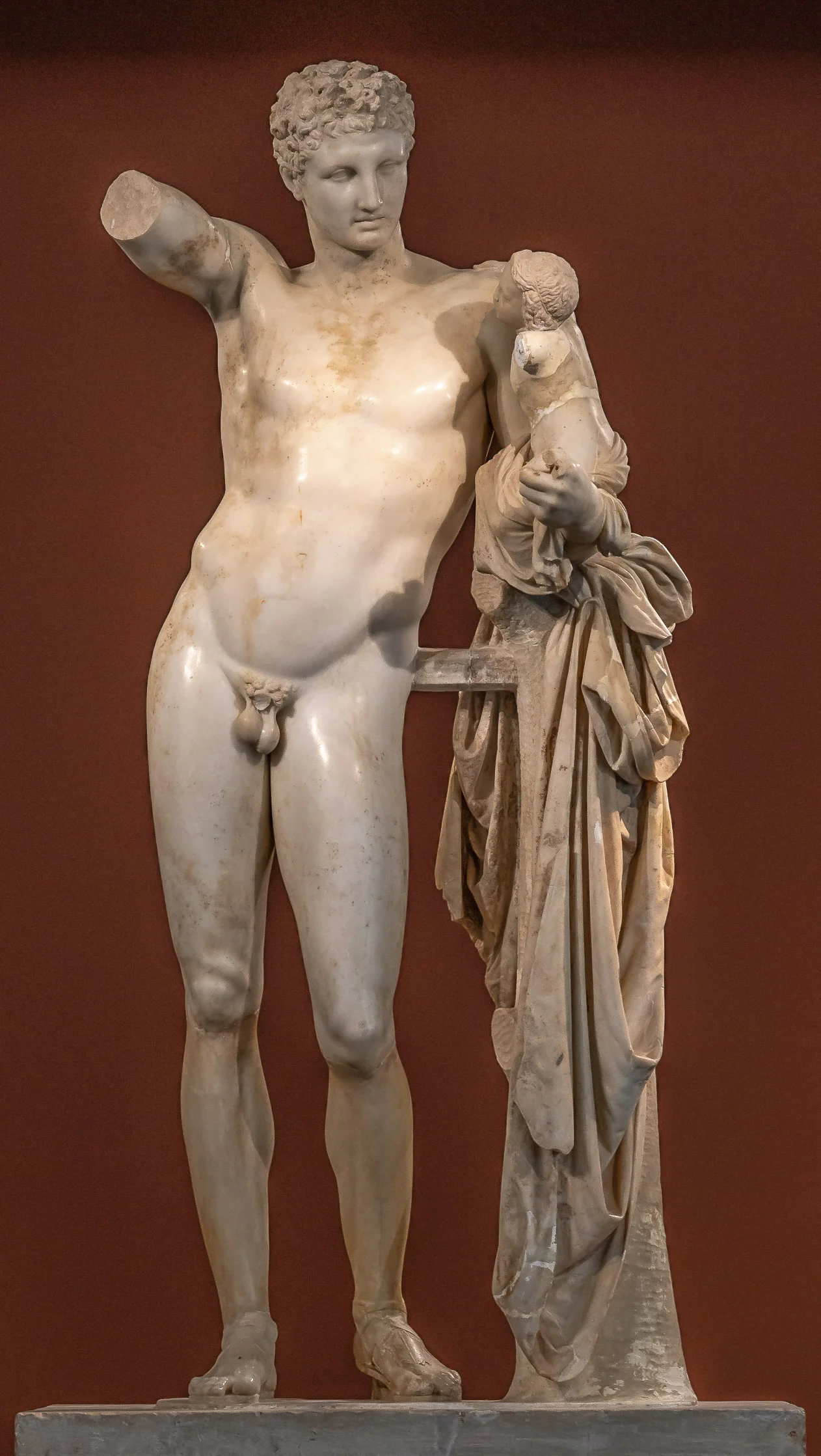

Hermes and the Infant Dionysus
On 8 May 1877, archaeologist Ernst Curtius was working through the collapsed rubble of the Temple of Hera at Olympia when his crew uncovered something extraordinary: the head, torso, legs, and left arm of a marble statue of a young man leaning against a draped tree trunk, in a condition so fine that the glowing surface of the face looked almost freshly worked. A thick clay layer had sealed it, protecting it from the centuries. It took six more separate excavation discoveries to assemble the rest of the group as it stands today. The statue is known as Hermes and the Infant Dionysus — and ever since Curtius found it, scholars have been arguing passionately about exactly what they have.
The Sculpture Itself
The group shows Hermes, the divine messenger and guide of souls, holding the infant Dionysus — god of wine and theater — in his left arm. Hermes leans casually against a tree trunk draped with his mantle, his right arm raised and extended, apparently dangling something toward the baby (that right forearm is missing, so we can only infer). The mood is intimate and playful rather than solemn. Carved from a single block of fine Parian marble from the island of Paros, Hermes stands 2.10 to 2.12 meters tall — about 3.70 meters including the base. The polished surface of the face and torso is, as the art historian John Boardman half-jokingly suggested, partly the result of generations of temple workers keeping it clean. The back of the sculpture, by contrast, was never fully finished: tool marks from rasp and chisel are still visible.
The Praxiteles Question
The attribution to Praxiteles — the most celebrated Greek sculptor of the fourth century BC, known for his revolutionary softness and sensuality in marble — rests on a single passage from Pausanias, a travel writer of the second century AD. Pausanias visited Olympia and noted seeing, in the Temple of Hera, a marble Hermes carrying the infant Dionysus, the work of Praxiteles. That mention set the art world ablaze when Curtius's discovery seemed to match the description. The sculpture fits what scholars call the Praxitelean style: the elegant S-curve of the body, the dreamy facial expression, the soft modeling of muscle rather than the harder definition of earlier classical art. But problems accumulated. No ancient replica of this group has ever been identified — unusual for a work by a sculptor as famous as Praxiteles, whose statues were widely copied across the Roman world. The controversy remains genuinely unresolved.
Hidden by an Earthquake
The statue's long absence from the world began with a natural disaster. During the reign of the emperor Diocletian, in the final years of the third century AD, an earthquake struck the Olympia site and collapsed the roof of the Temple of Hera. The marble group tumbled and was buried under rubble and, eventually, the thick clay that proved to be its salvation. For roughly fifteen centuries it lay there, perfectly sealed, while the site above changed hands — from Roman to Byzantine to Frankish to Ottoman — and the Games it had once witnessed passed from memory into legend. The clay preserved what the centuries would otherwise have destroyed.
What Survives, and What Does Not
The statue as it stands today is fragmentary in ways that matter. Hermes is missing his right forearm (the one that held the unidentified object extended toward Dionysus), two fingers of his left hand, both forearms below the elbow, his left foot, and — as the Wikipedia article states plainly — his penis. Dionysus is missing both arms except for the right hand resting on Hermes's shoulder, and the end of his right foot. The tree trunk and plinth are largely gone, though an ancient base of grey limestone between two marble blocks survives. Traces of cinnabar — a red mercury sulfate compound that may have prepared the surface for gilding — were found in the hair when the statue was discovered. Cinnabar also tints the sandal straps of the surviving original foot, with traces of gold gilding still faintly visible.
At the Museum of Olympia
Today the Hermes and the Infant Dionysus is displayed in the Archaeological Museum of Olympia, a few hundred meters from where it was found. It is the museum's centerpiece and one of Greece's most visited ancient sculptures. Whether it is a genuine Praxiteles or a later, very fine copy — or something else entirely, made by another hand in the Praxitelean tradition — does not diminish the experience of standing before it. The face of Hermes looks past the infant with a distracted, almost melancholy expression. The baby reaches up toward whatever was once in that missing right hand. The moment captured is domestic and divine at once: a god doing babysitting, caught between one world and another. The sculpture doesn't need its attribution settled to hold you.
From the Air
The Archaeological Museum of Olympia is located at approximately 37.644°N, 21.630°E, immediately adjacent to the ancient Olympia site in the Alpheios River valley of the western Peloponnese. The river valley provides a clear navigation corridor; the archaeological site is visible as a cluster of excavated foundations and pine trees. Nearest airport: LGRX (Araxos Airport), approximately 55 km northeast near Patras. Viewing altitude of 2,000–3,000 feet gives the best orientation to the site's layout relative to the surrounding agricultural plain and river system. Weather in the Alpheios valley is generally mild and clear in summer months.
Nearby Stories
- Santameri Castle 4.6 km away
- Aristarchos 2.3 m Telescope 4.8 km away
- Lepreum 9.1 km away
- Arcadia (region) 13 km away
- Peloponnese 14 km away
- St. Mark's Roman Catholic Church 20 km away
- Strofades 22 km away
- County Palatine of Cephalonia and Zakynthos 39 km away