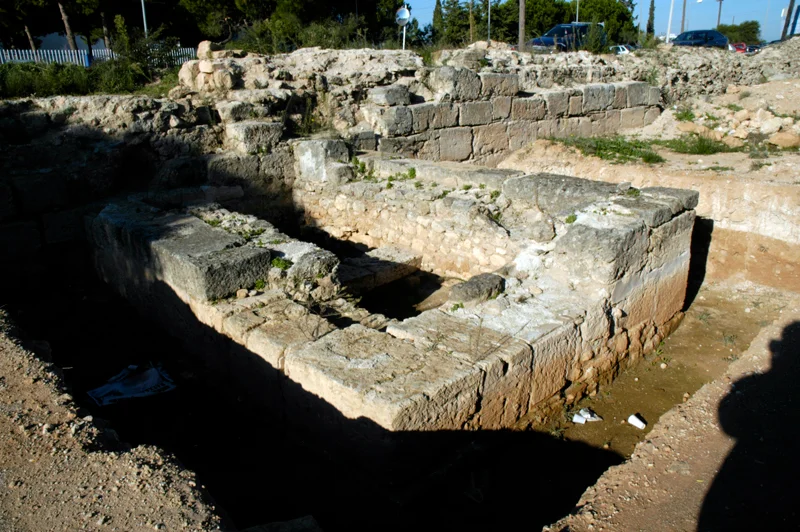

Hexamilion Wall
The idea was simple and had been obvious for centuries: if you control the Isthmus of Corinth, you control who enters the Peloponnese. The strip of land connecting the peninsula to mainland Greece is barely six kilometers across at its narrowest. Greek city-states had discussed walling it off as far back as the Persian Wars — when Xerxes invaded in 480 BC, Herodotus records that the Peloponnesian cities wanted to pull back to the Isthmus rather than fight at Thermopylae. They never built the wall then. It took the disintegration of the Roman Empire to finally make them try. Between 408 and 450 AD, under the emperor Theodosius II, workmen threw a wall across the Isthmus from the Gulf of Corinth to the Saronic Gulf. They called it the Hexamilion — the Six-Mile Wall.
What They Built
The Hexamilion ran between 7,028 and 7,760 meters across the Isthmus, enclosing the only land approach to the Peloponnese. At its heart sat the Fortress of Isthmia, a stronghold of 2.7 hectares positioned on the southern side of the wall, northeast of the ancient Sanctuary of Poseidon. The fortress contained nineteen rectangular towers and served as the main garrison; its northeast gate was the formal entrance to the Peloponnese. Justinian later reinforced the wall in the 6th century, adding towers until the total reached 153 — a formidable line of stone across a critical chokepoint. Local Corinthians built it and, for a time, maintained it, irrespective of their political or religious affiliations. Later, Justinian replaced those local volunteers with a professional military garrison. Graves found within the fortress compound, containing women and children, suggest that over time the military installation became something closer to a community — families living inside walls built for war.
The Fortress Peloponnese That Never Quite Held
The Hexamilion was motivated by fear. The Visigoth chieftain Alaric had swept through Greece in 396 AD, and Visigoths sacked Rome itself in 410. With the empire crumbling at its northern edges, the Roman authorities in Greece needed something solid between themselves and what was coming. The wall gave them a line, a gate, and a garrison. For a while it worked, or seemed to. Military use fell off after the 7th century; by the 11th century, domestic structures were being built into the wall, suggesting it had become more backdrop than barrier. Then, in the 15th century, the Ottomans arrived, and the question of the Hexamilion became urgent again. In 1415, the Byzantine emperor Manuel II personally supervised forty days of repairs to the wall — a remarkable imperial gesture that nonetheless generated serious resentment among local elites who had to fund and provide labor for the effort.
Breached, Rebuilt, Breached Again
The Ottomans breached the wall in 1423. It was repaired. They breached it again in 1431 under the command of Turahan Bey. The future emperor Constantine Palaiologos — then Despot of Morea — and his brother Thomas restored it in 1444. The Ottomans came through again in 1446. In October 1452, less than a year before the fall of Constantinople, the wall fell once more. After Constantinople itself fell in 1453 and the Ottomans completed their conquest of the Peloponnese in 1460, the Hexamilion was simply abandoned. It had never quite worked. The source article notes plainly that during its entire history, the wall never succeeded in fulfilling the function for which it was constructed. A wall across the Isthmus was only as useful as the navy that controlled the seas on either side — a lesson Herodotus had spelled out a thousand years earlier, and that the builders of the Hexamilion apparently hoped geography might let them ignore.
What Survives
Elements of the Hexamilion survive today, visible south of the Corinth Canal and at the Sanctuary of Poseidon at Isthmia. What remains is fragmentary — rubble core exposed where the facing stones were long ago robbed for other construction, tower foundations showing spoliated architectural members with carved molding taken from earlier Greek and Roman buildings. The wall was built in part from the ruins of what came before it: a pattern repeated so often in the Isthmus's layered history that it becomes almost characteristic. The Ohio State University has conducted ongoing excavations at the site. Walking the line of the wall today, you can stand at what was once the formal gate of the Peloponnese and watch the modern highway and rail line cross the Isthmus on almost exactly the same axis the ancient defenders chose — because geography, after all, has not changed.
From the Air
The Hexamilion Wall ran across the Isthmus of Corinth at approximately 37.93°N, 22.97°E, crossing from the Gulf of Corinth in the northwest to the Saronic Gulf in the southeast. From altitude, the Isthmus is clearly visible as the narrow neck of land connecting mainland Greece and the Peloponnese, with the modern Corinth Canal cutting straight through it. The Fortress of Isthmia sat near the southeastern end of the wall, northeast of the Sanctuary of Poseidon site. Recommended viewing altitude: 3,000–6,000 feet for the full isthmus geography; 1,000–2,000 feet to see the surviving wall fragments near the canal zone and the Isthmia sanctuary. Nearest major airport: LGAV (Athens International Eleftherios Venizelos), approximately 75 km east-northeast. The ancient site of the wall aligns roughly with the modern Corinthia regional boundaries.
Nearby Stories
- Stymfalia 3 km away
- Sanctuary of Asclepius, Epidaurus 4.6 km away
- German Submarine U-133 (1941) 5.9 km away
- Battle of the Trench (1821) 6.7 km away
- 1981 Gulf of Corinth Earthquakes 12 km away
- Aigeira 13 km away
- Agios Thomas, Boeotia 14 km away
- Agios Georgios (island) 36 km away