
Heysham
Six rock-hewn graves lie open to the weather on a low cliff above Morecambe Bay. They were cut directly into the living sandstone, one of them with a clear head-shaped depression at one end. They are about a thousand years old — Black Sabbath put them on a CD cover in 2000 — and they sit beside the ruined walls of St Patrick's Chapel, named for the Irish saint who, legend says, came ashore here after crossing the sea from Ireland. The history is older than that. The chapel is only about 1,300 years old. The labyrinth carved into a rock nearby is older still, one of only three such labyrinth carvings known in Britain and Ireland — its precise age is disputed, with theories ranging from the Bronze Age to the 18th or 19th century.
The Stones Beneath the Power Station
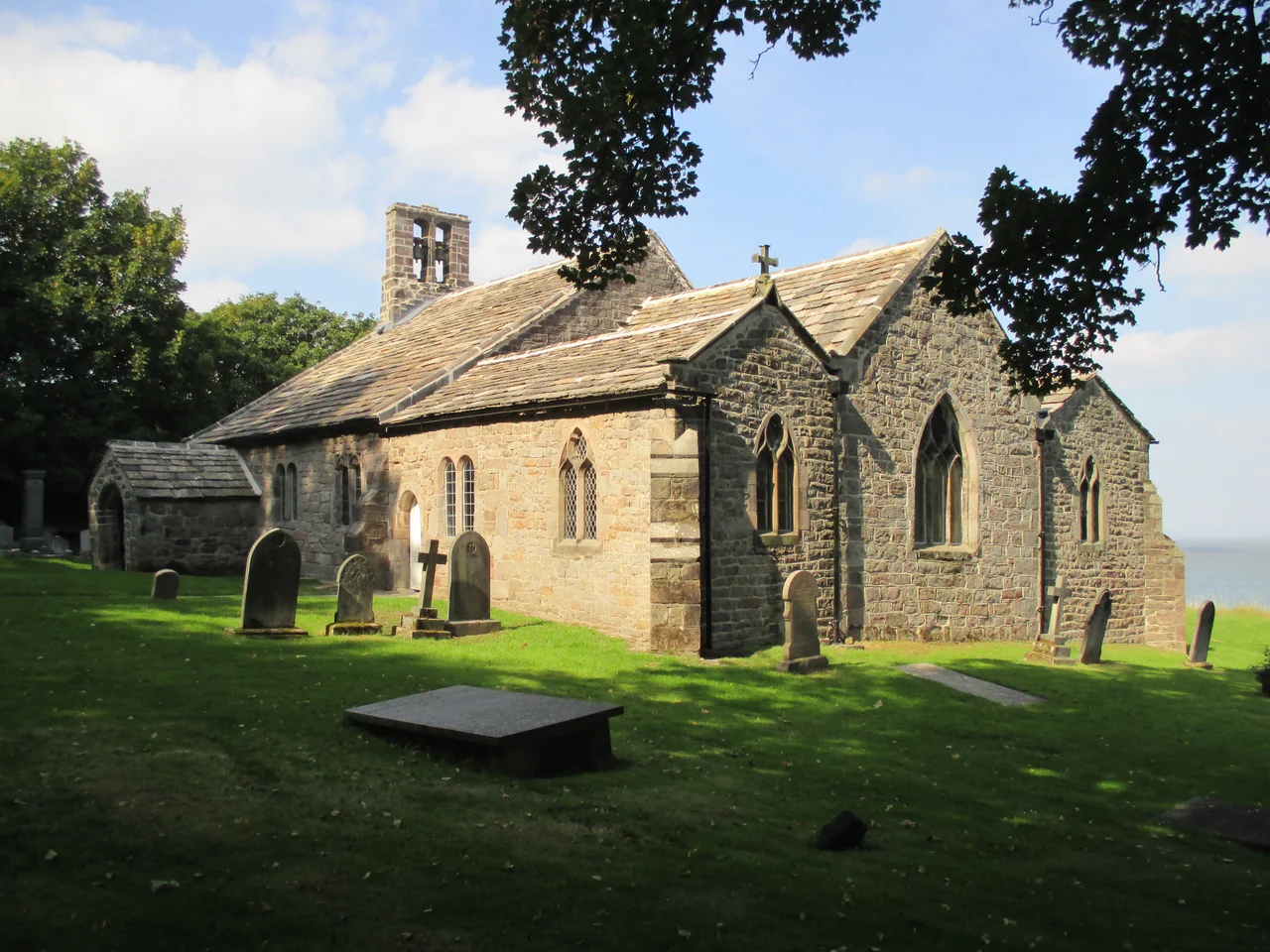
Patrick himself almost certainly never came to Heysham — the chapel was built around three hundred years after his death — but the legend points at something real. This headland was a Celtic Christian site early, and the strata of belief here go deeper than that. St Peter's Church just below the chapel contains a Viking-era hogback stone, a coffin-shaped block of carved sandstone of the kind found mainly in northern England and southern Scotland. Four figures on it have been interpreted as Norðri, Suðri, Austri and Vestri — the four dwarves who, in Norse mythology, hold up the four corners of the sky. Around the church are Anglo-Saxon and Viking carvings. A labyrinth of disputed age is etched into a separate rock — one of only three such carvings known in Britain and Ireland, with the others at Tintagel in Cornwall and Hollywood in County Wicklow, Ireland.
The Barrows
Lancaster Museum holds stone axe and hammer heads found around Heysham, some weighing up to 4 kilograms, dating back to the New Stone Age. Their locations suggest this stretch of coast was once an ancient burial ground, and the locals still call the cliffs above the chapel "The Barrows." These are the only sea cliffs in Lancashire, and they pack a remarkable amount of habitat into a small area: woodland, open grassland, sandy beaches, deep rock pools. J. M. W. Turner came here in the 1790s on his tours of Britain, and again in August 1816 he made sketches that became the watercolour Heysham and Cumberland Mountains, now in the British Museum. It shows the village with the Lakeland fells rising across the bay, the same view that still rewards anyone who walks up to St Patrick's Chapel today.
Ferries and Reactors
From 1899 to 1928 Heysham was its own urban district. Then in 1928 it merged with Morecambe to form the Municipal Borough of Morecambe and Heysham; in 1974 the lot was folded into Lancaster City Council. The town's modern shape was made by industry. Heysham Port opened in 1904 with Isle of Man and Irish services, and the village grew around it. The Heysham oil refinery operated from 1941 to 1976. The Stanlow–Heysham oil pipeline and a gas pipeline from the Morecambe gas fields in the Irish Sea both terminate here. Then came the reactors: two nuclear power stations, Heysham 1 and Heysham 2, providing baseload electricity for the grid. The Bay Gateway dual carriageway opened in October 2016, linking Heysham directly to the M6 — modernity arriving by motorway as it once arrived by Midland Railway.
Whitethroats and Warm Water
The Lancashire Wildlife Trust manages a 3-hectare nature reserve right next to the power stations, an arrangement that turns out to suit the birds beautifully. Two warm-water outfalls from the reactors enrich the food supply for migratory seabirds. Little gulls and Mediterranean gulls turn up to feed; kittiwakes and purple sandpipers winter here; whitethroats breed on the scrubland. A patch of shoreline rock called Red Nab is a regular roost for waders and gulls. Heysham has produced its share of people, too. Gertrude Partington Albright was born here in 1874, became an etcher and Cubism-influenced landscape painter in California, and taught at the California School of Fine Arts for nearly thirty years before her death in 1959. Lizzi Collinge, born around 1980, became Morecambe and Lunesdale's MP in 2024. The longhouse in Main Street is now the Heysham Heritage Centre, run by volunteers, holding the memory of everything that's washed up on this small Lancashire shore.
From the Air
Located at 54.05°N, 2.89°W on the southern shore of Morecambe Bay, Lancashire. Nearest airport is Blackpool International (EGNH), about 30 km south. Manchester (EGCC) lies 95 km southeast. From the air the twin-domed Heysham nuclear power stations are unmistakable on the headland, with St Patrick's Chapel ruins on the cliffs just to the north and Morecambe town curving up the bay to the northeast.
Nearby Stories
- Grizedale Hall 3.4 km away
- Lytham St Annes 5.2 km away
- Hawes Junction Rail Crash 9.1 km away
- Helmshore Mills Textile Museum 14 km away
- Sawley Abbey 17 km away
- Egremont Castle 18 km away
- Egremont, Cumbria 48 km away
- Llandudno 56 km away