
Highland Papua
Indonesia became independent in 1945, took over Western New Guinea in 1963, and carved Highland Papua out of the old Papua province on 25 July 2022. This made it, at birth, the only landlocked province in a country of more than seventeen thousand islands. There is no sea coast here. There are, instead, 1.47 million people scattered across 51,000 square kilometers of mountain and valley, speaking dozens of languages, living in a region that was still being systematically mapped in the middle of the twentieth century. The capital sits in Jayawijaya Regency. The roads, such as they are, wash out. Everything else moves by air.
Discovered Three Times
Dutch explorer van Overeem and his colleague Kremer reached the Swart Valley - now called the Toli Valley - in 1920, meeting the Lani people who farmed there and opening a northern approach to the peaks later renamed Trikora. The Baliem Valley's two hundred thousand people remained unknown to the outside world until Richard Archbold's 1938 expedition from the American Museum of Natural History photographed them from the air. In 1954, missionaries from the American Christian and Missionary Alliance - Lloyd Evan Stone and Einer Mickelson among them - flew from Sentani into the Baliem and began mission work. In 1959, the Royal Netherlands Geographical Society reached the Star Mountains in the far east and climbed Juliana Peak, now Mandala. The Dutch built Wamena in 1956 as a government post. Dutch rule ended in 1963 when Indonesia took over. Each of these 'discoveries' arrived from outside a region that had been continuously inhabited for at least nine thousand years.
The Shape of the Land
Highland Papua is mountains with valleys inside them. The Jayawijaya range runs through the province from west to east, part of the larger New Guinea Highlands that continue into Papua New Guinea. Puncak Trikora, 4,760 meters, and Puncak Mandala, 4,750 meters, dominate the skyline. Valleys at 1,500 meters and higher host most of the settled population and most of the sweet-potato agriculture that feeds it. The Baliem Valley in Jayawijaya Regency is the most famous, but the Toli Valley in Tolikara, the Pass Valley in Yalimo, and the smaller valleys of Lanny Jaya and Nduga all hold similar Dani, Lani, or Yali farming communities. Some of these highland valleys are cold enough to get frost, which periodically destroys crops and triggers local famines - as happened in Kuyawage, Lanny Jaya, where infrastructure makes relief difficult. Two great rivers rise in these mountains: the Mamberamo flowing north to the Pacific, the Digul flowing south to the Arafura Sea.
Stone Burning and the Pikon
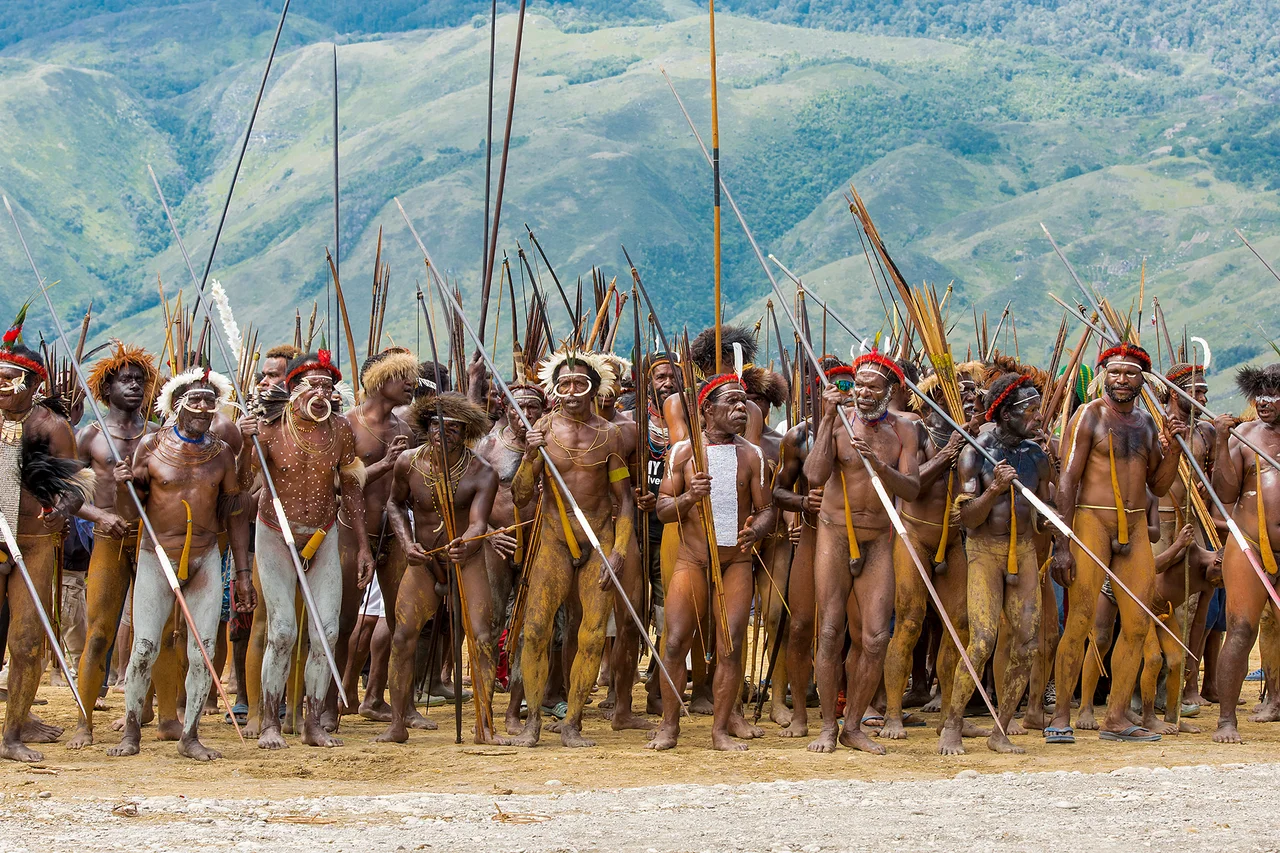
Almost every highland Papuan tribe practices bakar batu - the 'stone burning' tradition. Rocks are heated in an open fire until they glow, then layered into a pit with banana leaves, pork, sweet potatoes, vegetables, and more leaves on top. The stones cook everything together over hours while the community gathers. Births, weddings, tribal coronations, the return of warriors - each occasion has its own version, and each language has its own name for the practice: Barapen in Biak, Lago Lakwi in Tolikara Lani, Kit Oba Isogoa in Wamena, Kerep Kan in Nduga. The koteka, a penis gourd traditionally worn by men of certain highland tribes, is now seen mainly during cultural festivals and in remote villages; the Indonesian government's 1971 'Operation Penis Gourd' tried to replace it with Western clothing, with unintended consequences that included skin diseases from unwashed shirts. The pikon is a small sound-producing instrument of wood or bamboo, traditionally played by Dani men as a rest from labor.
The Honai
The honai is a circular house with a wooden frame, woven walls, and a conical thatched roof. The ceiling is only about a meter above the floor, and a fireplace burns in the center. Smoke fills the space. For the Dani who have lived under honai roofs for generations, smoke is not an irritant - it is heat in a cold mountain night and a preservative for the sweet potatoes stored in the rafters. Walk through any Dani or Lani settlement in the Baliem Valley or the Toli Valley and you will see honai clustered in family compounds, pig pens nearby, gardens stretching out beyond the fence lines. The design has not changed in any important way in centuries. It works. It fits the altitude, the climate, and the material culture that built it.
Air, Only Air
There is effectively no way to reach most of Highland Papua by road. The Trans-Papua Highway is under construction in fragments, vulnerable to landslides, and in places actively contested by armed groups. What connects the province is its airports: Wamena in Jayawijaya, Nop Goliat Dekai in Yahukimo, Oksibil in Pegunungan Bintang, Tiom in Lanny Jaya, Karubaga and Elelim in Tolikara, Kobakma in Mamberamo Tengah, Kenyam in Nduga. Beyond the regency capitals, hundreds of small airstrips - many unpaved, many usable only by specialized STOL aircraft - serve villages that otherwise would require a week's walk to reach. Pioneer-route subsidies from the Indonesian government keep these routes flying. Susi Air, MAF, and a handful of other operators fly the circuits. If you live in a Yali village at 2,500 meters and you need to get to a hospital in Wamena, the only realistic option is a single-engine aircraft on a dirt strip, flown by a pilot who knows the weather in your particular valley. This is not an exotic quirk of life in Highland Papua. This is how it works.
From the Air
Highland Papua spans roughly 3.5 S to 5.0 S latitude, 137 E to 141 E longitude - Indonesia's only landlocked province. Terrain ranges from valley floors at 1,500-1,800 m to peaks exceeding 4,760 m (Puncak Trikora) and 4,750 m (Puncak Mandala). Weather is orographic and morning-preferred; most VFR operations close by early afternoon as cumulus builds over the ridges. Primary airports: Wamena (WMX / WAVV, 1,660 m elevation) in the Baliem Valley; Nop Goliat Dekai (DEX / WAVD) in Yahukimo; Oksibil (OKL / WAJO) in Pegunungan Bintang. Dozens of smaller strips serve remote districts, many operated by Susi Air and Mission Aviation Fellowship. All operations visual; no precision approaches. Jayapura's Sentani (DJJ / WAJJ) on the north coast is the primary gateway from outside the province.
Nearby Stories
- 1981 Irian Jaya Earthquake 44 km away
- Puncak Trikora 50 km away
- New Guinea Highlands 87 km away
- Merpati Nusantara Airlines Flight 9760D 114 km away
- Foja Mountains 126 km away
- Lake Sentani 137 km away
- Mamberamo River 270 km away