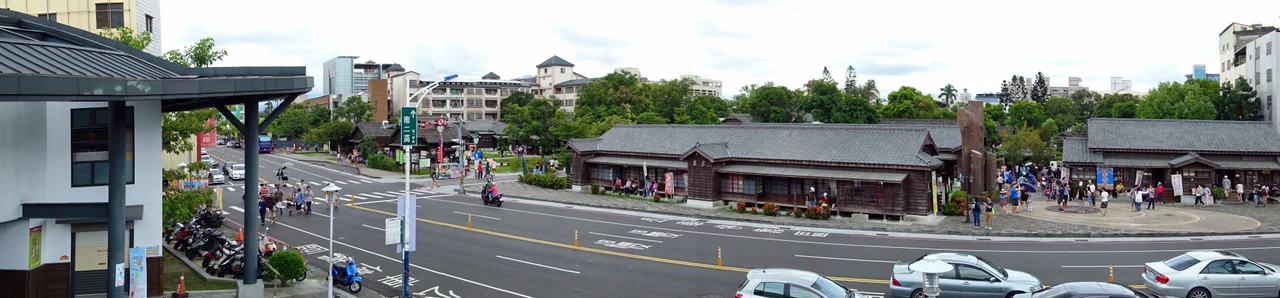

Hinoki Village
The word *hinoki* means Japanese cypress, and if you know the smell — warm, faintly resinous, clean in the way that old wood gets after decades of settling — you understand immediately why these buildings were worth saving. Hinoki Village, officially the Cypress Forest Life Village, occupies a cluster of twenty-eight wooden dormitories in Chiayi City's East District, Taiwan, that date from the Japanese colonial period. They were built to house staff of the Chiayi Forest division of the Forestry Bureau under the Taiwan Governor-General's Office — the administrators and workers who managed the vast cypress and cedar forests of the Alishan mountain range. When the forestry bureau moved on, the buildings stood empty. It took decades, a government decision in 2009, and construction work completed in 2013 before the village found its second life. It opened to the public in January 2014.
The Forest That Built a City
To understand Hinoki Village, you have to understand what the Alishan forests meant to the Japanese colonial economy. From the early twentieth century, the mountains east of Chiayi harbored stands of Chamaecyparis obtusa — Japanese cypress — and Taiwan red cypress that colonial administrators recognized as extraordinarily valuable. The Alishan Forest Railway, begun in 1906, was engineered specifically to bring that timber down from elevations above 2,000 meters to the processing facilities and rail yards of Chiayi. The city grew wealthy on wood. The Chiayi Forest division was the administrative heart of that enterprise, and the dormitories of Hinoki Village were where its managers and workers lived. They were built in Japanese residential style — low, wooden, with the particular proportions and joinery of the period — practical structures that happened to be beautifully made. The forestry economy that sustained them is long gone, but the buildings outlasted it.
From Dormitories to Village
When Taiwan's Executive Yuan approved the establishment of the Cypress Forest Life Village on 26 February 2009, the project faced a familiar heritage dilemma: how do you restore old buildings without turning them into a theme park? The approach taken here was pragmatic. Construction preserved the existing structures but dismantled the internal partition walls of individual dormitories, opening each building into continuous space suitable for exhibitions, shops, cafes, and cultural programming. The restoration was completed in 2013, and the transfer of operations to the new managing organization was finalized on 28 September 2013. What opened in January 2014 included the dormitory buildings alongside the Alishan Forest Club, the former director's official residence, a guest house, and a public bathhouse — the full social infrastructure of a colonial-era forestry settlement, repurposed for a civilian cultural audience.
Wood, Light, and Atmosphere
Walking through Hinoki Village is a sensory experience that photographs don't fully capture. The buildings are low and human-scaled, set along pathways shaded by mature trees. The cypress wood in the walls and floors has aged to a deep honey-gold, and on warm days the characteristic hinoki fragrance is present — subtle, clean, slightly sweet. The Japanese residential style means rooms feel quiet and considered rather than grand: sliding openings, careful proportions, an attention to the relationship between interior and garden that is distinctly Japanese in origin. The site also includes landscaped outdoor spaces created from the footprints of demolished partition walls, giving the village a rhythm of built space and open green that makes it feel less like a museum and more like a neighborhood that has simply shifted purpose. Which, in a sense, is exactly what it is.
Neighbors: Prison, Shrine, and Railway
Hinoki Village sits in a part of Chiayi City dense with Japanese-era heritage. Beimen Station of the Alishan Forest Railway is within walking distance to the north — the same railway that once delivered the logs these dormitories' occupants were administering. The Chiayi Old Prison, another preserved colonial-era complex, is nearby to the east. These sites form an accidental cluster of colonial memory: the railway that moved timber, the dormitories where forestry officials lived, the prison where those the colonial state detained were held. None of these institutions existed in isolation; they were all part of the same administrative machinery. Seeing them in proximity to one another, rather than in separate museum contexts, makes their historical relationship legible in a way that individual preservation cannot.
A Living Place
One of the things that distinguishes Hinoki Village from purely archival heritage sites is that it functions as an active cultural and commercial space. The restored buildings house independent shops, tea rooms, and exhibition spaces that draw local visitors as well as tourists. Events and markets occupy the outdoor areas. The children's programs and craft workshops connect the colonial-era setting to contemporary creative practice. This is, arguably, the most sustainable form of heritage preservation: old buildings that earn their keep by being useful to the people who live near them. The hinoki wood absorbs the activity. Decades from now, when the dormitories have aged another generation, they will carry both the memory of the Japanese forestry bureau and the accumulated texture of the cultural village that gave them their second century.
From the Air
Hinoki Village is located at approximately 23.486°N, 120.454°E in the East District of Chiayi City, Taiwan. At 1,500 to 2,500 feet, the low-rise wooden village complex is visible amid the city's denser urban fabric — look for a greener, lower-density cluster near the Alishan Forest Railway corridor. The nearest airport is Chiayi Airport (RCKU), approximately 2.5 km to the southwest. The Alishan mountain range rises prominently to the east; on clear days the switchback forest railway route is traceable up the mountain slopes. Approach from the west over the coastal plain for best visibility of the city center.
Nearby Stories
- Paiyun Lodge 1.2 km away
- Wushantou Reservoir 4.3 km away
- 1999 Jiji Earthquake 6.5 km away
- Xiluo 7.4 km away
- Bunun Cultural Museum 27 km away
- TransAsia Airways Flight 222 28 km away
- Mudouyu Lighthouse 29 km away
- Daya Bay 551 km away