.jpg)
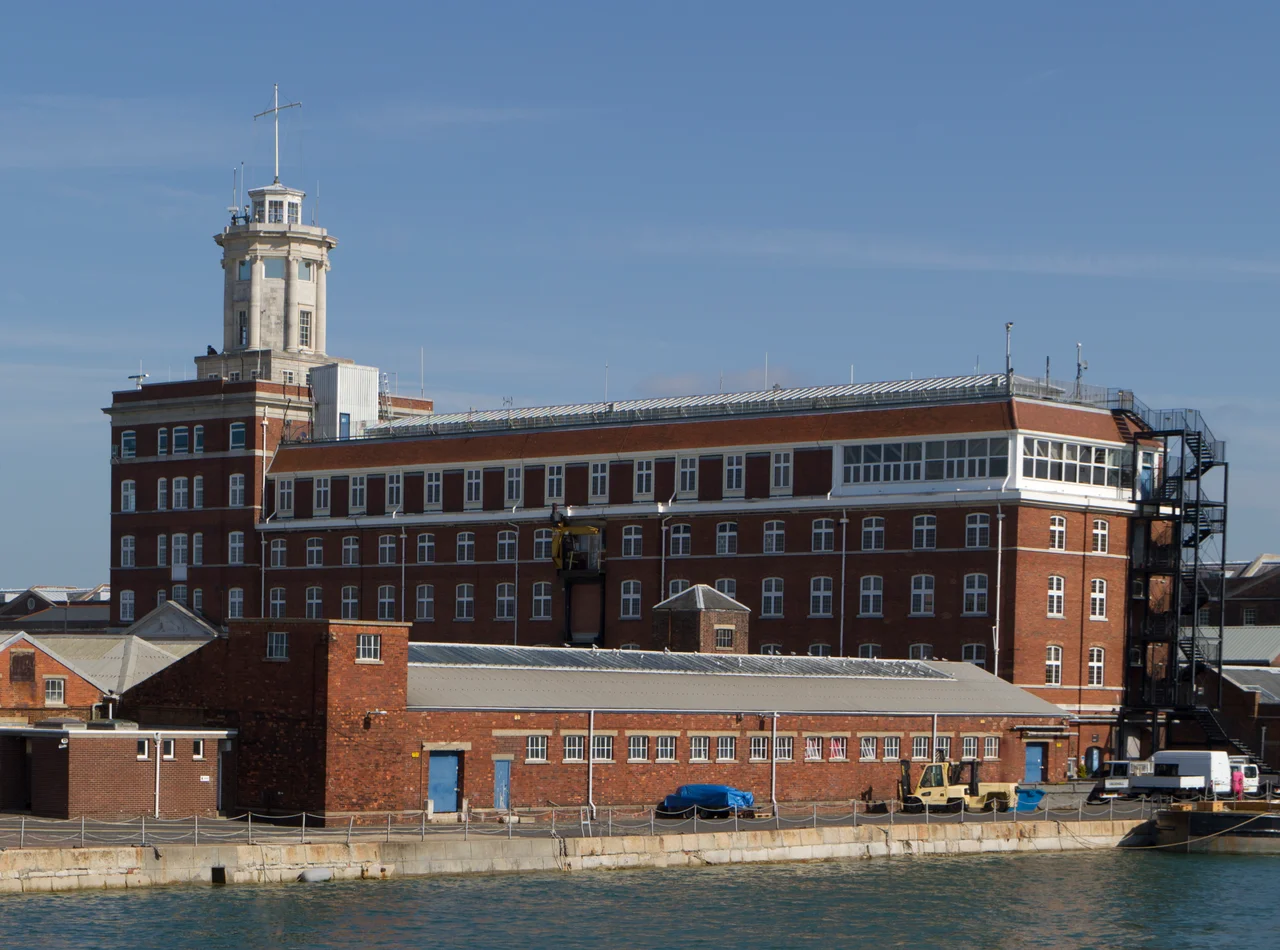
HMNB Portsmouth
Richard the Lionheart ordered the first dock at Portsmouth in 1194, on his way out to a French campaign. Eight hundred and thirty years later, the same patch of water on the eastern shore of Portsmouth Harbour is still building, repairing, and basing warships - the same activity, on the same coordinates, with most of the names of the streets in between unchanged. It is the oldest naval base in the Royal Navy. By 1800 it was the largest industrial complex in the world. Today, two Queen Elizabeth-class aircraft carriers, every Type 23 frigate still in service, and a flotilla of patrol vessels call HMNB Portsmouth home.
Henry VII's Dry Dock
The first recorded dry dock in the world was built at Portsmouth in 1495, on Henry VII's orders. It was, on this single piece of evidence alone, the most innovative piece of marine engineering anywhere on the planet. Then came the Mary Rose in 1509 and the Peter Pomegranate in 1510 - the new king Henry VIII's first warships, both rebuilt at Portsmouth in 1536, the Mary Rose lost in the Solent in 1545, and her museum now sitting inside the historic dockyard four centuries later. The first warship actually launched on the site was the Sweepstake in 1497. After Chatham Dockyard opened in the mid-1500s, Portsmouth built no new naval vessels for almost a hundred years - but its existing ships sailed against the Spanish Armada in 1588.
Dummer's Great Stone Dock
By 1689, France was again a serious threat, and Parliament ordered a new dry dock at Portsmouth large enough for first-rate ships of the line. Edmund Dummer, surveyor to the Navy Board, drew the Great Stone Dock - the first stepped masonry dry dock in England, with brick and stone where wood had been, and stepped "altars" that let shipwrights work close to the hull and reduced the timber needed for shoring. Construction began in 1691 on reclaimed mud flats. The Great Stone Dock - now No 5 dock - was rebuilt in 1769 and is still in use. Every dock built at Portsmouth thereafter expanded onto reclaimed land. By the time the Royal Navy reached its 1805 strength of 684 ships, Portsmouth Dockyard was simply the largest industrial site on earth.
Steam Power and Block Mills
Samuel Bentham arrived in 1796 as Inspector General of Naval Works with a brief to drag the dockyards into the modern world. He installed the first steam engine ever used in a Royal Naval Yard in 1799 - a table engine designed by his staff chemist, James Sadler. He invented the inverted-masonry-arch construction that became the world standard for dry docks. He built the first successful steam-powered bucket dredger and put it to work in the harbour in 1802. Then, with Marc Brunel (father of Isambard Kingdom Brunel) designing the machines and Henry Maudslay building them, Bentham fitted out the Block Mills - the first factory in the world to use steam-powered machine tools for mass production. The mills made the pulley blocks that the Royal Navy needed by the hundreds of thousands. In 1805 Horatio Nelson toured the new mills before boarding HMS Victory at Portsmouth for the last time. He did not come back.
HMS Victory in Stone
Nelson's flagship at Trafalgar - launched in 1765, fought at Cape St Vincent in 1797, Trafalgar in 1805, and Baltic actions thereafter - was brought into Portsmouth's No 2 Dry Dock in 1922 and has never left. She has been continuously commissioned since 1778, making her the oldest naval ship in the world still in commission. The Trafalgar Sail - the foretop sail that flew above her at the battle - hangs in the National Museum of the Royal Navy beside the dock. Around the corner sits HMS Warrior, the world's first ocean-going iron-hulled armoured warship, built in 1860 and brought to Portsmouth in 1987 after a long restoration on the River Tees. The Mary Rose Museum, opened in its current form in 2013, completes the trio. Three ships, three eras of naval warfare, all walkable in an afternoon at the Portsmouth Historic Dockyard.
Two World Wars
HMS Dreadnought - the battleship that gave its name to the entire class and made every other capital ship in the world obsolete - was built at Portsmouth in 1905-06, completed in one day more than a year. More dreadnoughts followed: Bellerophon in 1907, Iron Duke in 1912, Queen Elizabeth in 1913. In 1913, suffragette arson at the dockyard killed two men and forced the battlecruiser Queen Mary to be towed clear of the flames. During the First World War, more than 1,200 ships were refitted here, 1,658 were dry-docked for repairs, and 2,122 women worked in roles that had been exclusively male. In June 1944 Portsmouth was the main departure point for the Sword Beach landings; most of the naval support for Operation Overlord, including the Mulberry Harbours, left from here. Boathouse 4, built at the start of the war, turned out landing craft and midget submarines.
Carriers in Portsmouth
Shipbuilding came back to Portsmouth in 2003 when VT Group put up a new yard on the site of No 13 dry dock. Modules for the Type 45 destroyers and the Queen Elizabeth-class aircraft carriers were assembled here under BAE Systems Maritime - Naval Ships - until 2014, when the work was consolidated in Glasgow. But the carriers themselves came home. A £100 million upgrade of the base, completed in time for HMS Queen Elizabeth's arrival in 2017, strengthened the jetties and dredged the harbour approach. HMS Prince of Wales followed in 2019. Today, two-thirds of the Royal Navy's surface fleet is based at Portsmouth - the largest concentration of naval power in the country. The Naval Base Commander since September 2024 has been Commodore Marcel Rosenberg; the King's Harbour Master controls roughly 50 square miles of water surrounding the base. The Round Tower, built into the medieval defences, still stands at the harbour mouth - a watchpost from the same coastline that Richard's masons fortified in 1212.
From the Air
Located at 50.80°N, 1.10°W on the eastern shore of Portsmouth Harbour, immediately south of Whale Island. The harbour mouth between the Round Tower and Fort Blockhouse is one of the most distinctive features along the south coast - the carriers, when in port, dominate the view from any altitude. Active naval base with permanent restricted airspace (DA / restricted areas around HMNB Portsmouth and the carrier berths); check NOTAMs. Lee-on-Solent (EGHF) sits 4 nm west; Southampton (EGHI) is 14 nm west-northwest; Sandown (EGHN) on the Isle of Wight is 9 nm south.
Nearby Stories
- Bluestonehenge 3.5 km away
- Charterhouse School 7.5 km away
- Amberley Museum & Heritage Centre 12 km away
- 1958 BOAC Bristol Britannia Crash 14 km away
- Swanage Lifeboat Station 14 km away
- Siege of Basing House 18 km away
- Wellington Clock Tower 51 km away
- D-Day: The Longest Day 157 km away