,_West_Float,_Birkenhead_(geograph_4520417).jpg)
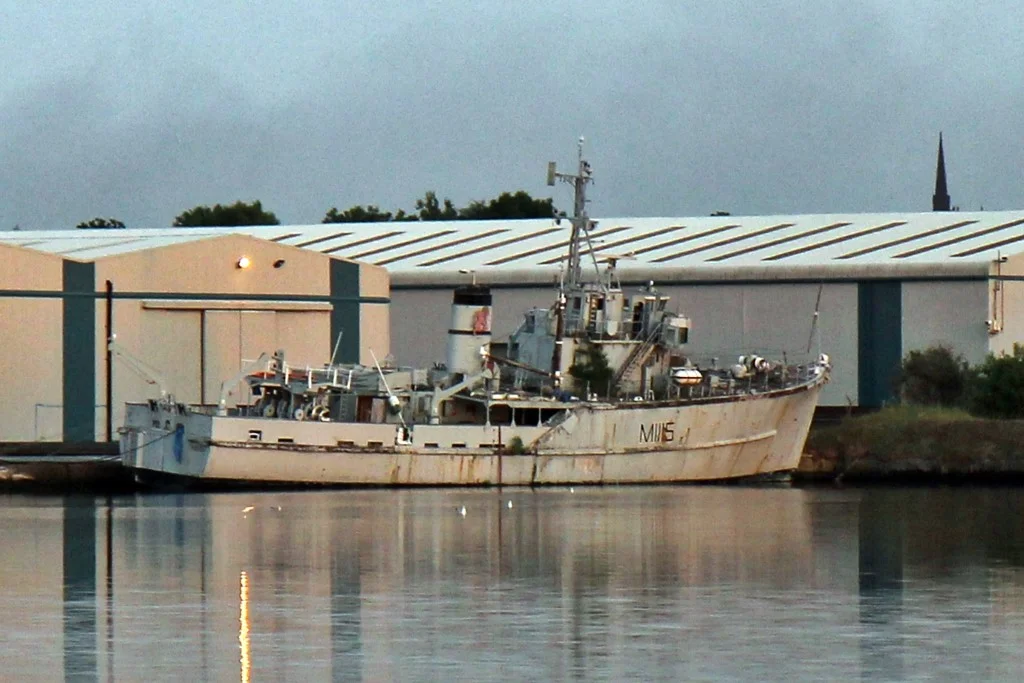
HMS Bronington
She was wood when the navy had already gone to steel. HMS Bronington was launched in 1953 as one of the last wooden-hulled warships of the Royal Navy, her mahogany planking on oak frames designed to keep her magnetic signature low enough to sweep mines that detonated on the slightest steel. For 35 years she did exactly that, in the North Sea and in the Mediterranean, occasionally commanded by men who became admirals and once, for nine months in 1976, by a man who became King.
Built at Beverley
Bronington was laid down on 30 May 1951 at Cook, Welton & Gemmell in Beverley, Yorkshire, a yard on the River Hull better known for trawlers. She was launched on 19 March 1953 and commissioned the following summer, on 4 June 1954, as HMS Humber. She joined the 101st Minesweeping Squadron of the Royal Naval Volunteer Reserve, spending four years on weekend duty with part-time crews who were learning the navy's wooden-hulled trade. In 1958 she reverted to her original name, Bronington, after a Welsh village near Wrexham. The Royal Navy's Ton-class minesweepers all carried village names: Cuxton, Hubberston, Lewiston, Pollington. They were small ships, 153 feet long, displacing 360 tons, with crews of 38.
Charles Takes Command
Between 9 February and 15 December 1976, the ship was commanded by Lieutenant The Prince of Wales (now King Charles III). It was his only sea command in five years of naval service, and although he was only aboard for nine months, the ship spent the rest of her life identified by it. Bronington operated as part of the 1st Mine Counter Measures Squadron during his tenure, working off the British coast. The Prince left command in December 1976 to take up royal duties. His successor, Lieutenant A B Gough, ran the ship aground in the River Avon a short time later while departing Bristol, an incident that became briefly newsworthy because it was the ship Charles had so recently captained. Bronington herself came off lightly. The mishap was made into a footnote in her record.
Service Continues
Bronington had been converted from a minesweeper to a minehunter at Rosyth Dockyard between 1963 and 1965, an upgrade that fitted her with sonar capable of finding mines on the seabed rather than just towing sweep gear to detonate them. By the late 1980s she was operating in the Mediterranean Sea with the 2nd Mine Counter Measures Squadron, working with NATO's Standing Naval Force Channel, and serving as a fishery protection vessel in British waters. She was decommissioned from active service in 1988. By then her hull was nearly forty years old, her wooden construction limiting how much longer she could realistically stay at sea, and the Royal Navy was moving toward new fibre-reinforced plastic minehunters. The Hunt and Sandown classes would replace her generation.
A Museum Ship at Birkenhead
In January 1989 the Bronington Trust, a registered charity whose patron is now the King, bought the ship to preserve her. She was moored at Birkenhead, where Cammell Laird had built so many other navy vessels, and opened to the public as a museum ship. Visitors could walk her decks, see the small wardroom where the future king had eaten his meals, and read the explanations of how a minehunter worked. For thirteen years the arrangement held. Then in 2002 funding troubles forced the trust to scale back. The ship was no longer maintained as intensively, and her wooden hull, like all wooden hulls, needed continuous care. Without it, water began to find its way in faster than pumps could send it out.
Sunk at Her Moorings
Some time in 2016 HMS Bronington sank at her moorings at Birkenhead. The wreck settled on the riverbed in a partial roll, with parts of the deck and superstructure remaining above the waterline at low tide and submerged at high. Photographs of the listing hull, taken from the dockside, made national newspapers under headlines that mentioned the future King. In December 2021 a new HMS Bronington Preservation Trust was formed with the aim of raising and restoring her. A dive survey in June 2022 found the hull in surprisingly good condition, with only two minor holes. The trust hopes to raise her, move her into the dry dock at Cammell Laird, and restore her for static display or even for sailing. The National Museum of the Royal Navy has suggested that Portsmouth Historic Dockyard could potentially host her if the work succeeds. For now she remains where she sank, partly visible at low water on the Birkenhead shore, a wooden ship that is waiting to come back.
From the Air
HMS Bronington's wreck lies on the Birkenhead waterfront at the West Float at 53.40°N, 3.03°W, on the west bank of the Mersey. Cammell Laird's shipyard sits immediately upstream. Best viewed from 2,000-3,000 ft. Liverpool John Lennon Airport (EGGP) is 7 nm south-southeast; Hawarden (EGNR) is 12 nm south. Look for the dock basins of the Birkenhead docks system on the Wirral shore, with the partially submerged hull visible at low tide along the dockside.
Nearby Stories
- RAF Wrexham 3.3 km away
- Birkdale Palace Hotel 3.7 km away
- Turton Tower 4.1 km away
- Tatton Park 5.6 km away
- Abergele Rail Disaster 9.6 km away
- Diglake Colliery Disaster 13 km away
- Ysbyty Ifan 16 km away
- Celtic Array 62 km away