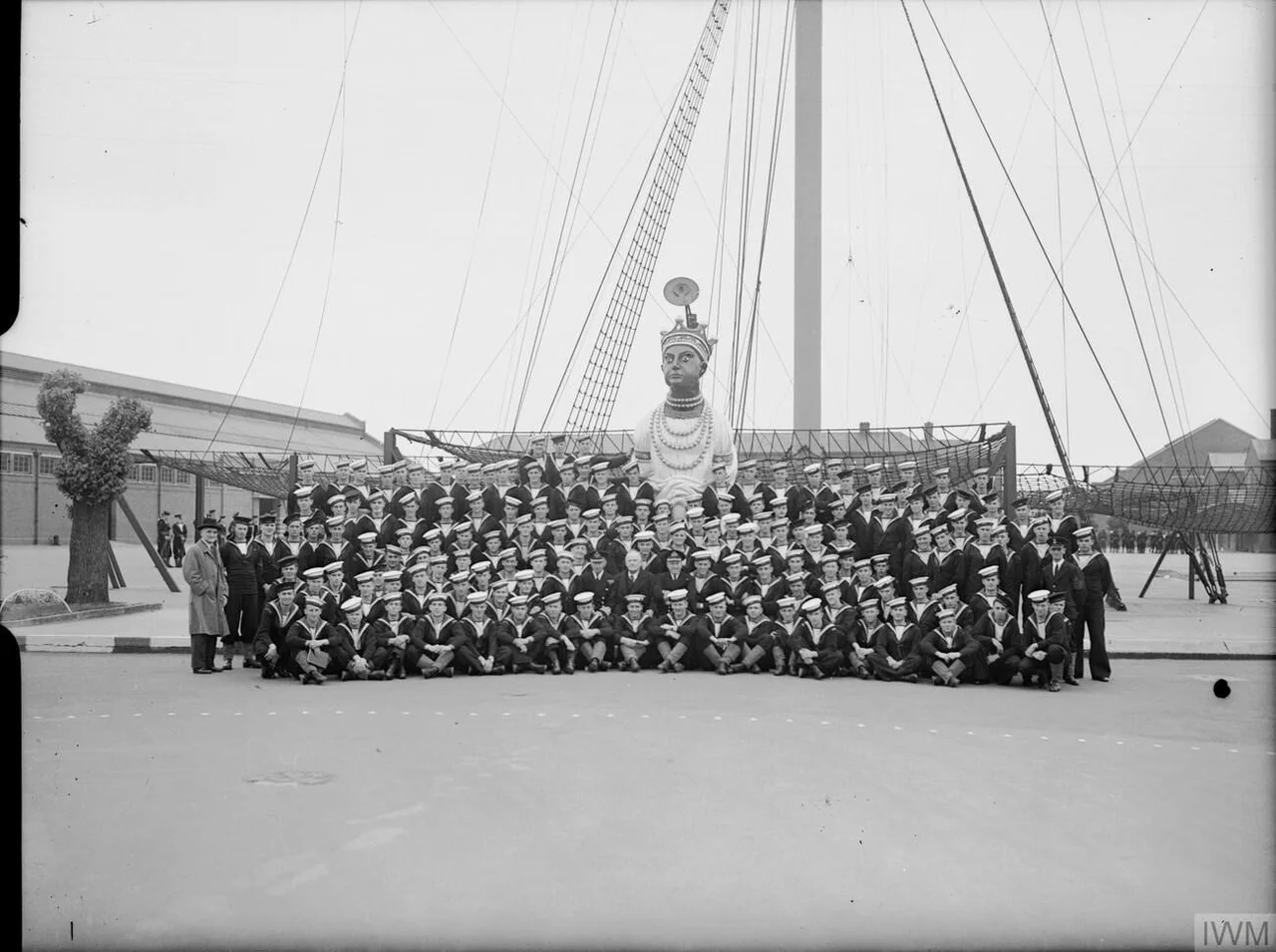

HMS Ganges (shore establishment)
If you have ever met an older Royal Navy man with a faraway look when he talks about climbing a wooden mast in the dark in winter, he probably trained at HMS Ganges. From 1865 to 1976, the establishment turned boys into seamen. At its peak in the Second World War, more than 60,000 young men passed through. The 143-foot mast they climbed during training - taken from a steam corvette and re-erected at Shotley in 1907 - became the visible symbol of the place. By the time the white ensign came down for the last time on 28 October 1976, the establishment had outlived empire, two world wars, and the kind of navy it had been built to populate.
The Hulks at Falmouth
In the mid-19th century, as the Royal Navy professionalised and modernised, the Admiralty set aside five old laid-up hulks in different ports to serve as floating schools. Volunteers aged 15 to 17 would spend a year aboard, learning seamanship, gunnery, and the routines of naval life. The total annual intake was planned at 3,500 boys. The 84-gun second-rate Ganges - launched in 1821, the last sailing ship of the line to serve as a Royal Navy flagship - was assigned to this duty in 1865, moored at Falmouth in Cornwall. Despite initial concerns that her layout did not suit a school, the conversion went ahead. She would lend her name to an institution that lasted 111 years and ranged across three locations.
Move to Shotley
By 1899 the school had moved to Harwich, and in 1903 the decision was made to move ashore at Shotley Point on the Suffolk side of the harbour. The Royal Naval Sick Quarters were already there. Twenty thousand pounds was set aside for shore-based accommodation, with another eighty thousand earmarked for expansion. On 4 October 1905 Royal Naval Training Establishment Shotley was formally established, with buildings ashore and ships - HMS Ganges, HMS Caroline, HMS Boscawen II - moored offshore. Across the next decade a confusing parade of ships were renamed Ganges or Ganges II as old hulks rotated in and out. In 1907 the 143-foot mast from the corvette HMS Cordelia went up, and would dominate the skyline for nearly seventy years. Manning the mast - climbing to the top in formation - became a Ganges tradition.
Bombs, Mutiny, and Influenza
The First World War tested the establishment. In 1916 a German Zeppelin bombed it. In 1917 the rationing came close to triggering a mutiny among the boys, though it dispersed peacefully. Staff and trainees together produced 600 miles of anti-submarine netting and a trawler base operated from Ganges II. In 1918 outbreaks of Spanish flu and diphtheria swept through the barracks. Armistice Day was celebrated with mast manning - boys lining the yards in formation, an old display in a new world. In the 1920s and 1930s the establishment continued through name changes, royal visits, and reorganization. Eight internal divisions were named after famous admirals. In 1930 the Prince of Wales - briefly the future Edward VIII - visited.
Sixty Thousand Ratings
When the Second World War broke out, boys' training stopped on 16 May 1940 and the establishment became a Hostilities Only New Entry Training centre, processing wartime conscripts at speed. An overflow centre opened at Highnam Court near Gloucester in 1941. By war's end, 60,968 ratings had passed through Ganges. Royal visits punctuated even the worst years: Princess Marina, Duchess of Kent, in October 1941; Prince Henry, Duke of Gloucester, the following year. After the war, in October 1945, Ganges reopened as a boys' establishment and resumed its old shape. Prince Philip visited in 1956. The Queen came in 1961. Lord Mountbatten was the guest of honour when the establishment opened to the public for the first time in 1975.
The Last Climb
The Royal Navy that had needed boy entrants had already gone by the mid-1970s. In 1973 the last boy entrants joined as Recruitment 41. On 6 June 1976 the Admiralty closed HMS Ganges. The white ensign came down for the last time on 28 October. Training duties moved elsewhere. The married quarters housed RAF personnel from nearby bases. In 1999 The Welbeck Estate Group acquired a large section of the former NCO housing. The 143-foot mast still stands on the site, a Grade II listed structure, and the HMS Ganges Museum at Shotley Gate preserves photographs, uniforms, and memorabilia. Generations of British sailors learned their trade here. The buildings remain. The boys are now grandfathers, and the navy they served no longer exists in the form that trained them.
From the Air
HMS Ganges sat at Shotley Point, 51.96 N, 1.27 E, on a peninsula between the Stour and Orwell estuaries opposite Harwich and Felixstowe. From altitude, look for the small peninsula between the two estuaries, just south of the Orwell. The site is now a residential area with the HMS Ganges Museum and the famous mast still visible. Nearest airports: RAF Wattisham (EGUW) 20 miles west, Stansted (EGSS) 55 miles west, Cambridge (EGSC) 65 miles west. Harwich and the Felixstowe container port both visible across the water.
Nearby Stories
- Ickworth House 3.6 km away
- Framlingham 7.9 km away
- Castle Hedingham 8.6 km away
- Battle of Assandun 8.6 km away
- Margate Surfboat 33 km away
- 1382 Dover Straits Earthquake 41 km away
- Four Days' Battle 48 km away
- Battle of Lowestoft 85 km away