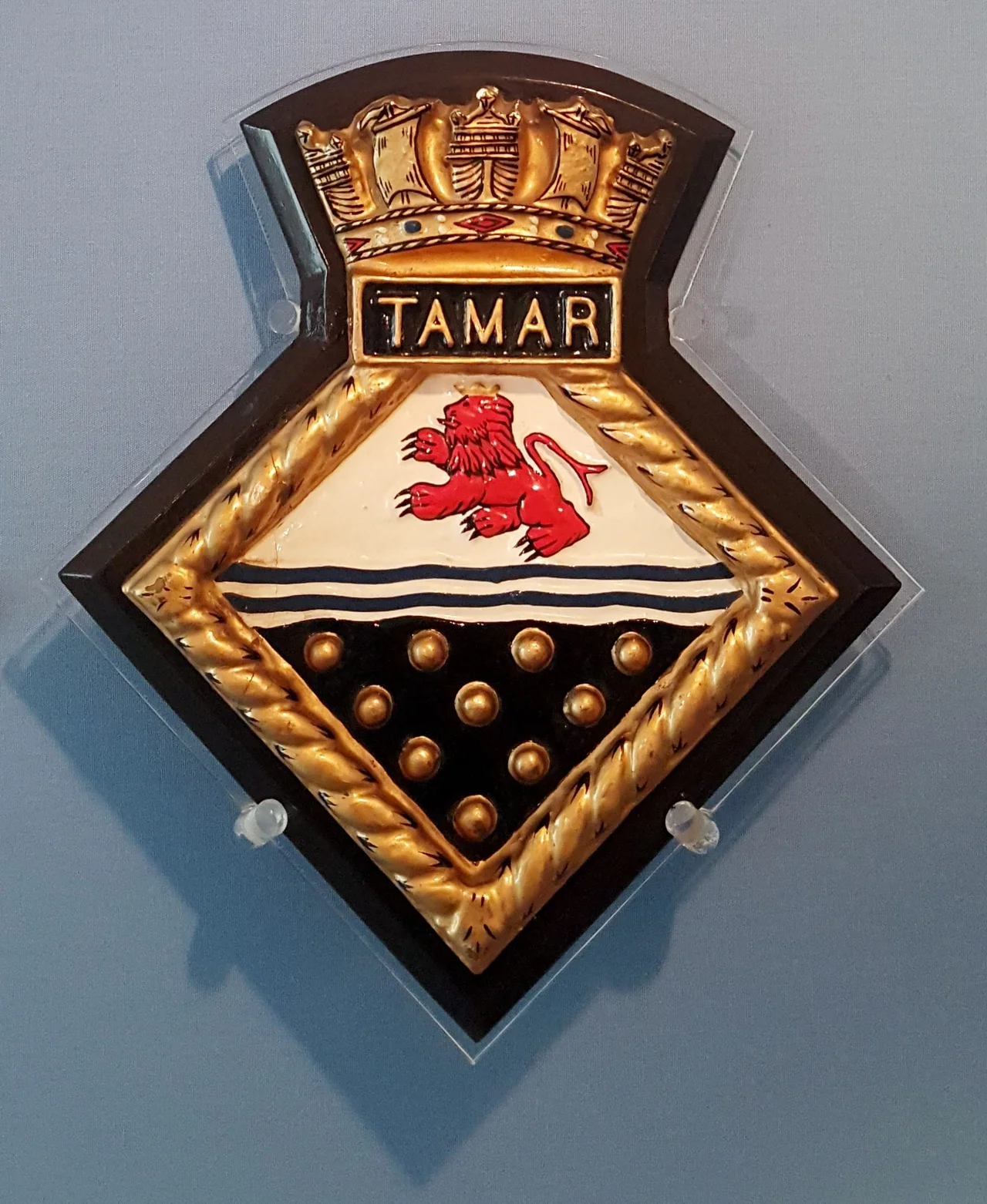

HMS Tamar (shore station)
The ship that gave HMS Tamar its name was scuttled on purpose. On 12 December 1941, as Japanese forces pressed their invasion of Hong Kong, the Royal Navy sank its own vessel in Victoria Harbour rather than let the enemy use it. The 4,650-ton troopship that had floated in the harbour since 1897, lending its name to the entire British naval establishment on the waterfront, went to the bottom by deliberate act. It was the end of one chapter and, after the war, the beginning of another — because the name Tamar, and the institution it represented, survived the scuttling. HMS Tamar as a shore station outlasted the ship by more than half a century, finally closing in 1997 when Britain handed Hong Kong back to China.
The Navy Arrives
The British naval presence in Hong Kong predates the station's formal name by decades. Sir Edward Belcher came ashore from HMS Sulphur on 25 January 1841, during the First Opium War, and the Navy established its first foothold — the HM Victualling Yard, as the registers called it — on the waterfront almost immediately. The first naval storekeeper, Thomas McKnight, was appointed on 21 March 1842. For the remainder of the 19th century, the Navy expanded its presence steadily, occupying barracks, building drydocks, and pressing into the limited flat land of Victoria Harbour's northern shore. The original HMS Tamar — a troopship laid down in 1861 and launched in 1863 — first visited Hong Kong in 1878, returned in 1886, and was stationed permanently from 1897 onward, serving as the receiving ship for the whole establishment. She gave the base its name: a naval tradition of naming shore stations after the ships that gave them birth.
Reclamation and Expansion
By the turn of the 20th century, the Navy needed more space than the land could provide. The site was hemmed in by army barracks on every side; there was no room to expand. The solution was to make new land. Beginning in 1902, the Navy undertook a major reclamation project: 160,000 square meters of land was created from the harbor, along with a 36,000-square-meter floating basin for repairing and refitting vessels, and a 183-meter graving dock for dry-docking ships. It was an enormous engineering undertaking, and it transformed the waterfront of what would become the Admiralty district. The dockyard that resulted handled ships from across the China Station for the first half of the 20th century, a base for the China Squadron, the Yangtse Flotilla, the West River Flotilla, and all the smaller craft that kept British influence operating from Hong Kong through the treaty ports of the Chinese mainland.
Scuttled and Revived
The Battle of Hong Kong began on 8 December 1941, the day after Pearl Harbor. For eighteen days, British, Canadian, and Indian forces held out against the Japanese invasion. HMS Tamar — the original ship — was scuttled on 12 December 1941 to prevent capture. The shore station fell with the colony. After the Japanese surrender in August 1945, the Royal Navy returned and the station resumed operations. But the world had changed. Britain's imperial reach was contracting, and in 1957 the Navy announced the dockyard would close over two years. It did. Yet the Navy held onto its waterfront land and in 1959 began planning a compact new naval base. The Prince of Wales Building, completed in 1978, became the primary headquarters of the renamed establishment until the very end — a modernist block on the Admiralty waterfront that now serves as central barracks for the People's Liberation Army.
A Century of Commodores
The succession of officers who commanded HMS Tamar across its hundred years represents, in aggregate, a substantial portion of Britain's post-Victorian naval history in Asia. From Commodore Oliver J. Jones in 1866 through a long chain of successors to Captain Andrew K. Steele in 1996, the command passed through dozens of hands. The operational history is similarly layered: the Dragon Squadron, the 6th Mine Countermeasure Squadron, the 6th Patrol Craft Squadron, the Hong Kong Royal Naval Volunteer Reserve. In 1997, as the handover approached, HMS Tamar was formally decommissioned. The Royal Navy's century-long presence in the harbour — begun when Britain was an imperial power at the height of its reach — ended quietly, in keeping with the understated way that empires often conclude their smaller chapters.
What the Harbour Holds
Today, the Admiralty district where HMS Tamar once stood is one of Hong Kong's most intensively developed urban precincts — government buildings, hotels, shopping malls, the PLA headquarters in the old Prince of Wales Building. Victoria Harbour, whose floor holds the scuttled hulk of the original Tamar, is visible from the surrounding towers but no longer navigable in the way it once was; land reclamation has narrowed it substantially since the Victorian era. The Royal Naval Hospital at Wan Chai became Ruttonjee Sanatorium, one of the city's public health institutions. Lei Yue Mun Fort is now a museum. The physical traces of HMS Tamar's century have been absorbed into the texture of a city that has rebuilt itself several times over since the Navy first arrived with Edward Belcher in 1841. What remains is a name: Tamar — applied now to government buildings, a public pier, a cultural complex — carrying the memory of the ship, the station, and the century they defined.
From the Air
The site of HMS Tamar sits at 22.28°N, 114.17°E on the northern shore of Hong Kong Island in the Admiralty district, at the eastern edge of Central. From the air at 1,500–3,000 feet, the Admiralty waterfront is visible as a cluster of government and commercial towers at the base of the Mid-Levels slope, adjacent to Victoria Harbour. Hong Kong International Airport (VHHH) is approximately 23 nautical miles to the west on Lantau Island. The dense high-rise clusters of Wan Chai lie to the east, and the Peak rises to the south.
Nearby Stories
- Lok Ma Chau Loop 2.3 km away
- Portas do Cerco 2.3 km away
- Kweilin Incident 17 km away
- Wanshan Archipelago Campaign 34 km away
- Nanxiong Formation 115 km away
- Battle of Nanpeng Island 148 km away
- Heyuan 169 km away
- Cape Maobitou 632 km away