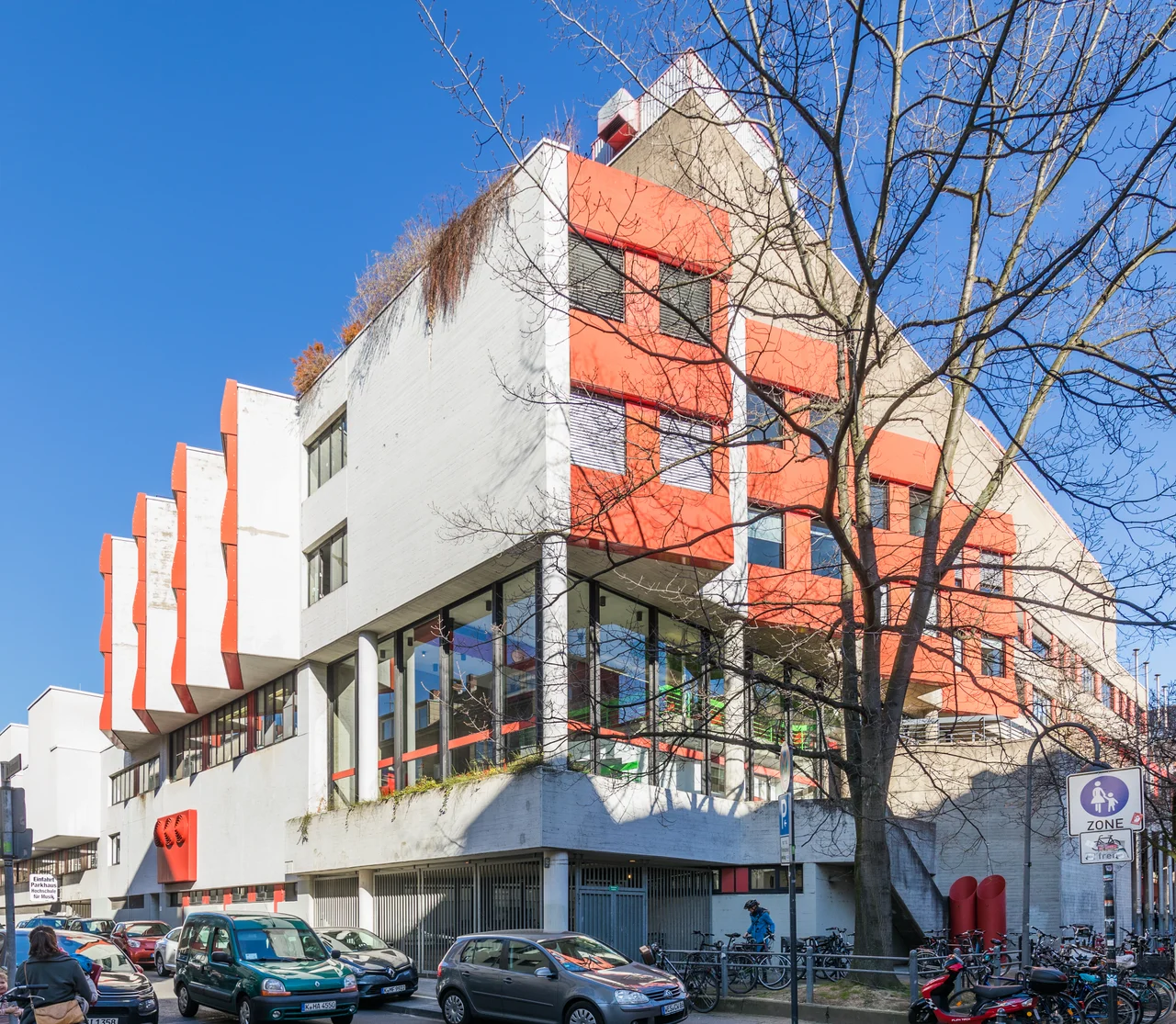

Hochschule für Musik und Tanz Köln
In 1958, when most of European academia still treated jazz as something happening in the wrong kind of room, the Cologne conservatory hired Kurt Edelhagen and let him teach it. Edelhagen had spent the preceding decade leading some of the most accomplished big bands in postwar Europe, and the Hochschule fuer Musik Koeln gave him a syllabus. That was the school in microcosm: Romantic violinists hired in the nineteenth century, atomic-age modernists arriving in the twentieth, big-band horn players turning up in the lecture halls in between. Founded in 1850 as the Conservatorium der Musik in Coeln by the composer Ferdinand Hiller, it has grown into one of Europe's largest music academies, with roughly 1,400 students, more than one hundred professors, and campuses in Cologne, Aachen, and Wuppertal.
Hiller's Conservatorium
Ferdinand Hiller knew Mendelssohn, Schumann, and Chopin personally. By 1850 he was Cologne's municipal music director, and he turned the city's existing instruction into a proper conservatory. The school grew steadily through the nineteenth century, hiring serious players: in 1895 the violinist Willy Hess became principal professor of violin. In 1925 it took the name Staatliche Hochschule fuer Musik. In 1972 it absorbed previously independent conservatories in Aachen and Wuppertal and became the Staatliche Hochschule fuer Musik Rheinland. The current name, with Tanz added to acknowledge a growing dance program, dates to a later renaming. The line from Hiller's 1850 founding to today's nearly two thousand students and faculty is unbroken.
The Stockhausen Generation
The most famous name on the alumni list is Karlheinz Stockhausen. He came to Cologne after the war to study, stayed to teach, and helped make the city one of the world's centers of electronic music. He is listed both as an alumnus and as a former lecturer here; his composer son Markus, a trumpeter and improviser, was also a student. They are not alone. Hans Werner Henze taught here. So did Mauricio Kagel, the Argentine-born composer whose theatrical works expanded what concert music could be. So did Vinko Globokar, the Slovenian-French trombonist-composer who treated his instrument as a sound source rather than a horn. Bernd Alois Zimmermann, the composer of the opera Die Soldaten, both studied and later taught here. The conservatory's twentieth-century roster reads like a directory of postwar European modernism, with Cologne sitting at the center of it.
Jazz, Early
When the Hochschule began jazz seminars in 1958, it was a genuinely radical academic move. Most German conservatories of the era took popular music seriously the way medical schools took naturopathy seriously: not at all. Kurt Edelhagen ran the seminars. The trombonist Jiggs Whigham, an American who built a long career in German broadcasting, later taught here as well. So did the bandleader and arranger Chris Walden among the alumni. The pattern continued: by the time most European conservatories had built jazz departments, Cologne had been graduating jazz musicians for a generation.
A Wider Range of Voices
In November 1998 the university hosted a conference titled Frau Musica (nova), focused on historical and living women composers. Pauline Oliveros, the American composer and deep-listening pioneer, wrote a new piece on commission for the gathering. The conference paired academic papers with concerts, which is how composers are best understood. The Hochschule's alumni and faculty roster lists a long line of women: the singer Anja Harteros, the soprano Mojca Erdmann, the cellist Maria Kliegel, the soprano Edda Moser, the harpsichordist and conductor Maria Jonas. The pianist Olga Scheps trained here. The Korean violinist Mayu Kishima did too. The conservatory's job, finally, is to teach people of any background to be excellent musicians. The list of who has come through to do that is long.
A New Campus in the Kunibertsviertel
In 2023 the Bau- und Liegenschaftsbetrieb NRW broke ground on a new Cologne campus in the Kunibertsviertel district, north of the Cathedral. The project modernizes an existing former university building and adds an extension, about 2,500 square meters in total. Plans call for rehearsal rooms, teaching spaces, a combined dance and concert hall, a library, and a courtyard cafe. The building is intended to meet contemporary sustainability standards: photovoltaic panels on the roof, energy-efficient mechanical systems, a green roof. Completion is planned for 2026. The Cologne campus serves as the central administrative hub and hosts the majority of the academic departments; the Aachen and Wuppertal campuses continue to offer specialized programs. A school founded in the year that Chopin died is still rearranging itself for the next century of musicians.
From the Air
Coordinates 50.9476 N, 6.9612 E, in Cologne's Innenstadt district, a short walk north of the cathedral and about 400 m east of the main railway station. The new Kunibertsviertel campus, opening in 2026, is in the same neighborhood. Recommended altitude 1,500-3,000 ft AGL. Nearest major airport: Cologne Bonn (EDDK / CGN), 8 nm southeast. Düsseldorf (EDDL / DUS) sits 22 nm north. Cologne Class C airspace surrounds the area; the Rhine bridges and cathedral spires are the obvious visual landmarks.
Nearby Stories
- Diamond Interchange: How a Simple Idea Reshapes Towns Like Julich 2.8 km away
- Dusseldorf-Unterbach 6.1 km away
- Baumwollspinnerei Ermen & Engels 11 km away
- RAF Bruggen 15 km away
- Hagen Open-air Museum 21 km away
- Belgium 130 km away
- Marcinelle Mining Disaster 173 km away
- Zwingenberg Castle 178 km away