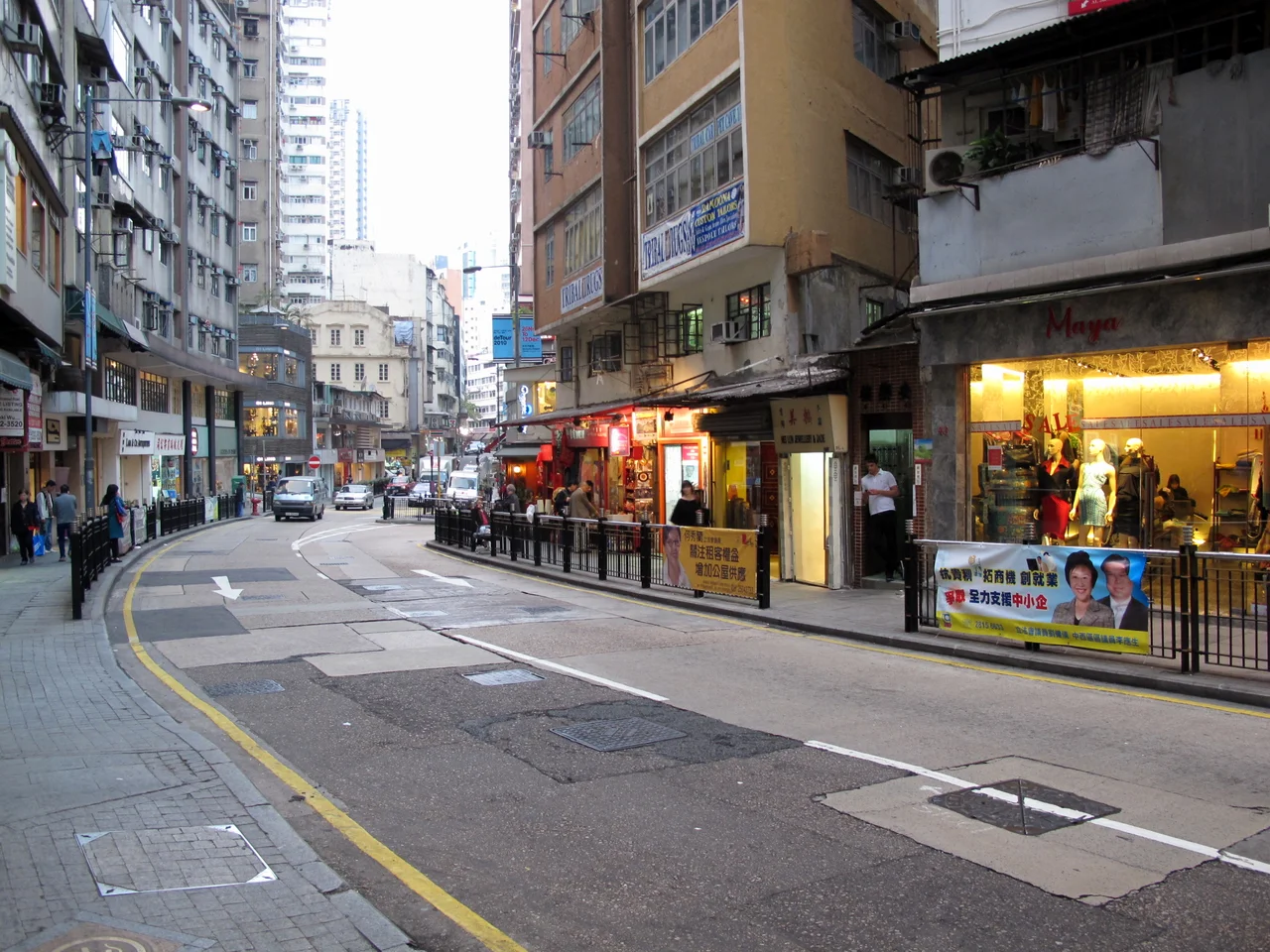

Hollywood Road
The name doesn't come from California. It probably comes from a manor house in a Bristol suburb — the home of Sir John Francis Davis, second Governor of Hong Kong, who is thought to have christened the road after his family estate in Henbury, a suburb of Bristol. A cheerful folk story says holly shrubs were growing here when the road was cut, but holly is not native to Hong Kong and would have needed to be imported. So the road carries an English country name on a Chinese hillside, which is, in its way, a perfect introduction to what Hollywood Road has always been: a place where distant worlds conduct strange and intimate commerce.
The First Road They Finished
When Britain established its colony here in the 1840s, it needed roads quickly. Hollywood Road was the second to be laid out — after Queen's Road Central — but it was the first to be completed, built by the Royal Engineers along the lower slopes of Hong Kong Island. For a street so central to the colony's founding, its early life was unremarkable: a working road serving a working city, climbing the hill between the harbour districts of Central and Sheung Wan. Then, in 1847, something was built that changed its character permanently. A temple appeared at the junction with Ladder Street — Man Mo Temple, known in Cantonese as Man Mo Miu (文武廟). Dedicated to the god of literature and the god of war, it functioned not only as a place of worship but as an informal courthouse in the colony's early decades, before proper legal institutions took hold. Tung Wah Group of Hospitals has managed it since 1908. It is now a declared monument, and its incense coils still spiral toward the ceiling, wrapping the interior in a sweet, eye-stinging haze that makes it feel exactly like the nineteenth century.
The Market for Everything Old
At some point — no one date marks the transition — the antique dealers arrived. Today Hollywood Road is one of the most concentrated markets for Chinese antiquities outside mainland China: lacquered furniture and blue-and-white porcelain, bronze Buddha figures and Tibetan rugs, Japanese netsuke and Coromandel screens, Ming dynasty ceramic horsemen riding in glass cases next to kitsch Maoist memorabilia. The range is staggering, and the density is half the attraction. Walking the road is itself a kind of browsing, even if you never step inside a shop. The goods in the windows tell you something about Hong Kong's position at the edge of China, the clearinghouse where things moved — legitimately and otherwise — between a vast interior and the rest of the world. In 1987 a gallery called Plum Blossoms opened here, the first dedicated contemporary art space on the road. Others followed. Hollywood Road now operates as both antique corridor and contemporary art district, two markets that coexist without much apparent tension, sharing the same narrow hillside.
A Police Station Becomes Something Else
At the Central end of the road stands a compound that shaped the colony more than most people realize. Central Police Station was the first police station in Hong Kong. The oldest structure inside the compound — a barrack block — dates to 1864, built alongside Victoria Prison. An extra storey was added in 1905; the Headquarters Block facing Hollywood Road followed in 1919; the Stable Block appeared in 1925, later repurposed as a munitions store. For over a century the compound held cells, courts, and the paraphernalia of colonial order. It has since been transformed into Tai Kwun, a mixed-use arts and heritage destination that opened in 2018, preserving the Victorian and Edwardian architecture while filling it with galleries, restaurants, and performance spaces. The stones remember their history. So do the names on some of the doors.
On Screen and in Imagination
In 1960, a Hollywood production of a different kind briefly visited: the film adaptation of Richard Mason's novel The World of Suzie Wong used part of Hollywood Road as a location, transforming an old wooden building on the street into a bar for the movie. The film's vision of Hong Kong — atmospheric, slightly seedy, thoroughly romanticized — became one of the defining images of the city for Western audiences for decades. The real Hollywood Road has always been more complicated than that. Along its length, past the antique shops and galleries and the temple and the old police compound, are also Hollywood Road Park, the Liang Yi Museum (a private collection devoted to design, craftsmanship, and heritage), and PMQ — the former Police Married Quarters, now a creative hub for local designers and artists. The road accumulates functions the way it accumulates objects: one on top of another, nothing quite displaced, the old and the new sharing shelf space.
The Road as Palimpsest
What makes Hollywood Road worth understanding, as much as visiting, is the way it layers time. The 1847 temple sits beside galleries that opened in the 1990s. A Victorian police compound has become an arts venue. A street named after an English manor house runs through the oldest continuously commercial district in a Chinese city-state. The antique trade, for all its hustle, deals in exactly this kind of temporal compression — objects from one century priced and sold in another. Walking from the Sheung Wan end toward Central, you move through different geological strata of the city's past, each one still visible, none entirely buried. Not many streets in the world can say the same.
From the Air
Hollywood Road runs east-west across the northern slopes of Hong Kong Island at approximately 22.284°N, 114.150°E, roughly 50–100 meters above sea level. From the air, it traces a clear line through the dense Mid-Levels urban fabric, parallel to and uphill from the waterfront towers of Central. Victoria Peak (552m) rises visibly to the southwest. The nearest major airport is Hong Kong International Airport (VHHH), located on Lantau Island approximately 34km to the west. Approach views from the east offer clear sightlines over the island's ridge, with the road identifiable by its relatively older, lower-rise building stock compared to the glass towers closer to the harbor.
Nearby Stories
- Lok Ma Chau Loop 2.3 km away
- Portas do Cerco 2.3 km away
- Kweilin Incident 17 km away
- Wanshan Archipelago Campaign 34 km away
- Nanxiong Formation 115 km away
- Battle of Nanpeng Island 148 km away
- Heyuan 169 km away
- Cape Maobitou 632 km away