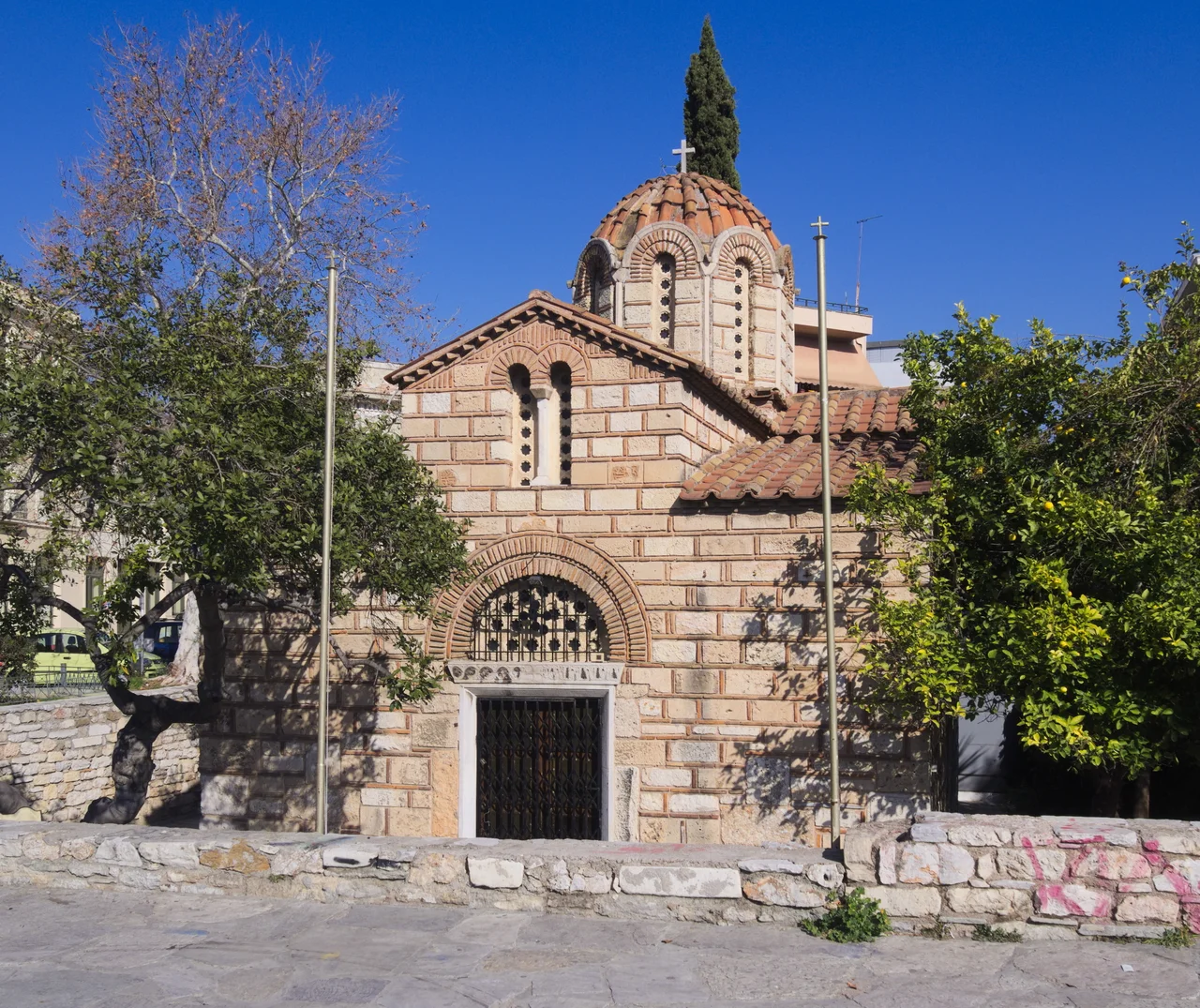

Holy Archangels Church, Thiseio
Look at the western wall of this small church and you will find something unexpected: panels of ornamental Arabic script, the angular Kufic style, set into the brickwork of a Greek Orthodox temple. No one carved Quranic verses here. The builders of Byzantine Athens simply liked the look of the patterns, copying them as decoration the way a tailor might borrow a foreign weave. The Church of the Holy Archangels has stood through nine centuries of this kind of borrowing, and it now sits about two meters below the modern street, the city having risen around it while it stayed where it was.
Sunk Below the City
The church goes by two names. Officially it honors the Holy Archangels; locals call it Agii Asomati, the "Bodiless Ones," an old Orthodox phrase for the angels. It crowns Agion Asomaton Square at the western end of Ermou Street, a few steps from the Theseion and the ancient Agora where Socrates once argued with strangers. Experts cannot pin down an exact date, but the architecture places its construction in the second half of the eleventh century or the twelfth. Athens has grown upward since then, layer by layer, so the floor now rests roughly two meters beneath the pavement outside. You descend to reach the threshold, stepping down into an older version of the city.
A Cross Written in Stone
The plan is a cross-in-square crowned by an Athenian dome resting on four columns, a textbook example of the local school of church-building from that era. The lower walls are laid with large stones arranged in the shape of a cross, a signature of Athenian masonry of the period. Around the facades ran a frieze of clay tiles bearing that relief Kufic decoration, and the horseshoe arch over the northern entrance carries the same Islamic flavor. Historians suspect these eastern motifs reflect a small community of Arab merchants living in medieval Athens, their visual language seeping into the city's sacred architecture without anyone treating it as strange.
What the Restorers Found
By the twentieth century the church had been altered so heavily that its original shape had nearly vanished. In 1959 and 1960, restorers stripped away the later additions and worked the building back toward its medieval form. The effort uncovered hidden things. Beneath the accumulated changes lay worn frescoes from a later period, possibly late Byzantine, their faces dimmed by time. And in the Holy Altar, the restorers opened a silver case holding the relics of a saint whose name no record preserves, an anonymous holiness tucked into the heart of the building.
Still a Parish
This is no museum piece sealed behind glass. The Church of the Holy Archangels remains a working parish of the Archdiocese of Athens, its doors open to the Orthodox faithful of the neighborhood. Each November 8, the day the Orthodox calendar honors the angelic powers, the small space fills with candlelight and chant for its feast. The crowds streaming along Ermou Street toward Monastiraki mostly pass without noticing the sunken roofline below them, and that is part of its charm: a thousand-year-old church living an ordinary life in the middle of a modern capital.
From the Air
The Church of the Holy Archangels sits at 37.9777 N, 23.7212 E in central Athens, on Agion Asomaton Square at the western end of Ermou Street, beside the Theseion and the ancient Agora. From the air it is a small dome among the dense rooftops of the historic center, best identified by the green expanse of the Agora archaeological park and the temple of Hephaestus just to the south. Nearest airport is Athens International (LGAV), roughly 30 km to the east-southeast. Approach from the west over the Saronic Gulf offers clear views of the Acropolis ridge that anchors this district; visibility in summer is typically excellent.
Nearby Stories
- Great Sand Beach 5 km away
- Battle of Delium 7.7 km away
- Tower of Aliartos 9 km away
- HMHS Britannic 10 km away
- Saronic Gulf 15 km away
- Sousaki Volcano 17 km away
- Sanctuary of Apollo Maleatas 24 km away
- Skyros 66 km away