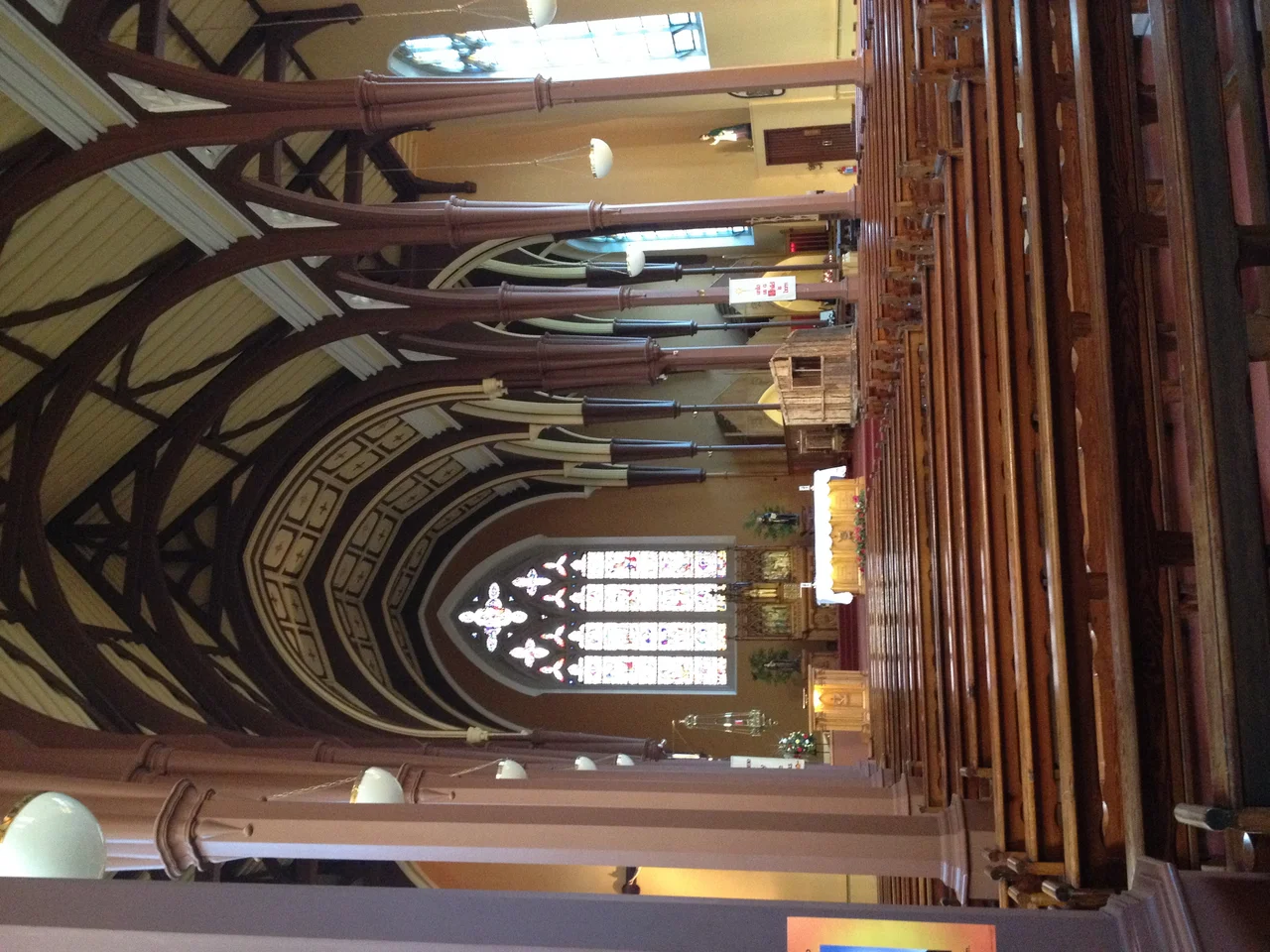

Holy Trinity Church, Cork
Father Theobald Mathew began the church on his own birthday, 10 October 1832, and did not live to see it finished. He died in 1856, the spire still missing, the portico unbuilt, the interior bare. It would take another generation - and the symbolic pressure of the centenary of his birth in 1890 - to push the work over the line. By then Mathew had become one of the most famous Irishmen of the nineteenth century: the Apostle of Temperance, the priest whose anti-drink pledges, taken by an estimated three million people, briefly reduced Irish whiskey consumption by half. The church on Fr. Mathew Quay is the only one in the world dedicated to him. The spire, when it finally rose, was described by one chronicler as "more air than stone."
Building on a marsh
The Capuchin friars had been in Cork since 1637, and their cramped chapel on Blackamoor Lane - built in 1771 by Father Arthur O'Leary - was no longer fit for the size of the congregation. Father Mathew launched a competition in 1825 and selected the design of George Richard Pain, a former apprentice of John Nash and the architect responsible for Blackrock Castle and Cork's Washington Street courthouse. Pain produced plans for a Regency Gothic church, one of the first large churches in the south of Ireland in that style. The site was a problem. The friars chose Charlotte Quay - Morrison's Island - rather than the firmer ground offered on Sullivan's Quay across the river. Building on the marsh meant draining the land and laying a foundation deep enough to bear the church's weight, at a cost of nearly £1,600 before a single column rose. The cast-iron columns Pain specified for the nave were not chosen for fashion. They were chosen because stone would have sunk.
Father Mathew's pledge
Theobald Mathew was already famous when he laid Holy Trinity's foundation stone in 1832. Six years later, in April 1838, he launched the temperance crusade that would consume the rest of his life. Standing in his Capuchin habit, he asked people to take a pledge - to abstain from all alcohol, total and lifelong - and they came in their thousands. Then their tens of thousands. By 1843 he had administered the pledge to an estimated three million people in Ireland alone, and was touring Britain and the United States. Whiskey distillers went bankrupt. Doctors reported sharp drops in admissions for drink-related illness. The pledge did not hold against the desperations of the Great Famine - the very crisis that froze construction on Holy Trinity Church itself - but Mathew's reputation as a moral force outlived the movement. He died in 1856 worn out and in debt, having spent his own money keeping the temperance campaign alive.
The centenary push
Construction had stalled before the Famine and resumed only fitfully afterward. Thomas Deane, whose original 1825 entry had lost, was hired to complete the church without its planned portico and spire. William Atkins took the interior. The doors opened on 10 October 1850 - Mathew's birthday again, and the last one he would see alive. For four more decades the building stood essentially unfinished. Then in the late 1880s, Father Paul Neary, the Capuchin provincial superior, organised the centenary celebrations of Mathew's birth and put completion of the church on the agenda. Another competition was held; Walter G. Doolin's entry was praised by the consulting architect George Ashlin, but the committee instead chose a smaller-scale design by Dominic J. Coakley, closer to Pain's original. The Cork builder John Sisk took on the work. Denny Lane warned that failure to finish in time would be "a national disgrace." On 13 October 1890, with the centenary just past, Holy Trinity was reopened with a ticketed Mass. The lacy spire was finally on the skyline.
Harry Clarke's windows
In the second decade of the twentieth century, Cork's labour movement commissioned a window for Holy Trinity to honour Father Thomas Dowling, the Capuchin brother who had mediated an industrial dispute through the years of the First World War. The window was made by the studio of Joshua Clarke and Sons in Dublin, designed by Joshua's son Harry Clarke - the most original stained-glass artist Ireland has ever produced - and supervised by him personally. It shows Christ as Prince of Peace and Saint Francis holding a dove, with the spires and quays of Cork running along the bottom of the panel like a signature. Two further Clarke windows followed: a Sacred Heart and an Immaculate Conception, with Munster saints venerating them, made together with Harry's brother Walter between 1918 and 1929. Inside the church there are also stained glass memorials to Daniel O'Connell, the Liberator who had pledged himself to temperance under Mathew's hand, and to Pope Leo XIII. The 1980s renovation was controversial - it slimmed the casings around the original cast-iron columns and removed the high altar - but the Clarke windows survived.
From the Air
Holy Trinity Church stands at 51.8956 N, 8.4709 W on Fr. Mathew Quay - the south side of the River Lee's south channel, a kilometre east of St Fin Barre's Cathedral. The single lacy spire is one of the most distinctive points on the south-facing river quay and is best seen from the north bank with the river in the foreground. Cork Airport (EICK) is 6 km south. The church sits in the dense quayside skyline of central Cork, framed by the spires of Saints Peter and Paul (Roman Catholic) to the north and St Fin Barre's (Church of Ireland) to the southwest. Recommended viewing 1,500-2,500 ft AGL.
Nearby Stories
- Ballyvourney 1.6 km away
- Castlemartyr 3.9 km away
- Ballybeg Priory 4.1 km away
- Kilbrittain 5.2 km away
- Shanbally Castle 10 km away
- Skibbereen 17 km away
- Castleisland 22 km away
- SM U-27 118 km away