.jpg)
Holy Trinity Church, Long Melford
Simon Jenkins gave it five stars. There are only eighteen five-star churches in his England's Thousand Best Churches and Holy Trinity, Long Melford, is the only one in Suffolk. Nikolaus Pevsner called it one of the most moving parish churches of England, large, proud and noble. The nave runs 152.6 feet, which is believed to make it the longest of any English parish church. None of that prepares you for the fact that when you walk in, the windows in the north aisle still hold the faces of fifteenth-century Englishmen and women: kneeling donors painted onto glass before Columbus sailed, somehow surviving the Reformation, the Civil War, the long English appetite for smashing things, and still here.
Built by Wool
Holy Trinity is a Suffolk wool church, which means it was paid for by a local industry making astonishing amounts of money. East Anglia in the late fifteenth century was the centre of the English woollen cloth trade, and the merchants who got rich from it converted their wealth into stone. The principal benefactor here was John Clopton of nearby Kentwell Hall, a Lancastrian supporter during the Wars of the Roses who in 1462 was thrown into the Tower of London with John de Vere, 12th Earl of Oxford, and accused of treasonable correspondence with Margaret of Anjou. The others were executed. Clopton somehow talked his way out, returned to Suffolk, and spent the rest of his life building the church that now overlooks the village green. The rebuilding ran from 1467 to 1497, financed by wills and bequests as the merchants who had grown rich on broadcloth made their peace with eternity.
The Glass That Survived
Most of England's medieval stained glass was destroyed twice: first by the iconoclasts of the Reformation in the sixteenth century, then by Puritan zealots in the seventeenth. Long Melford's glass is a freak survival. Eight medieval windows remain, including a rare Pieta of the Virgin Mary believed to be one of only three of its kind in England. The surviving windows are attributed to the Norwich School and date from the same mid-to-late fifteenth century as the church itself. What Pevsner called a unique collection of kneeling donors looks out from the glass: Elizabeth Talbot, Duchess of Norfolk; two lord mayors of London; three royal justices; two Knights of the Garter; assorted Cloptons; and Elizabeth de Mowbray, Duchess of Norfolk, whose painted face is said to have inspired John Tenniel's illustration of the Queen of Hearts in Alice's Adventures in Wonderland.
The Towers Story
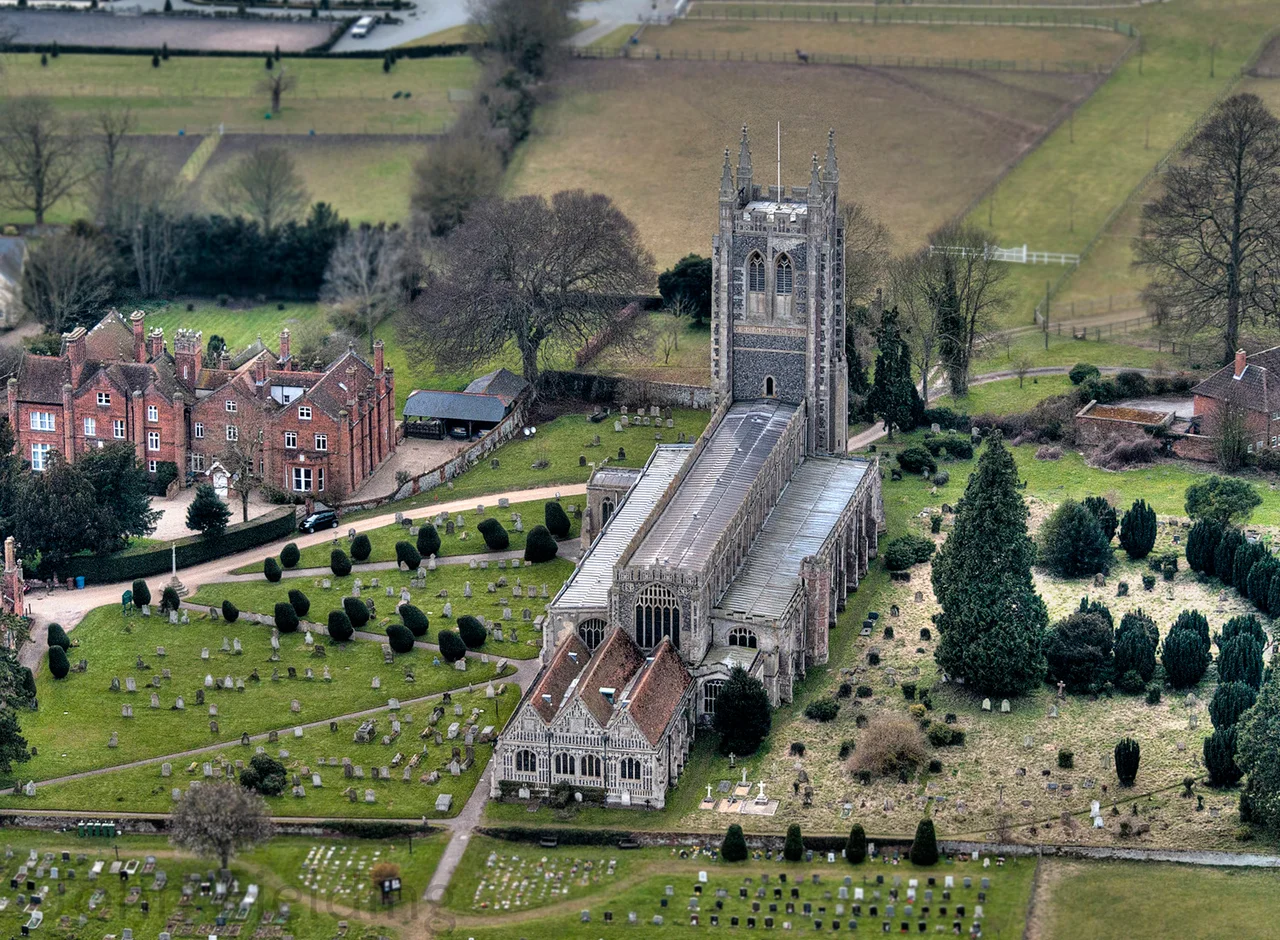
The tower you see today is not the medieval one. In 1710 lightning destroyed the original, which was replaced in the eighteenth century with a plain brick structure that nobody much loved. Between 1898 and 1903, George Frederick Bodley, the founder of Watts and Co. and one of the great architects of the Gothic Revival, designed the present tower. He brought it back toward its original form with stone and flint facing and added four corner pinnacles, but the tower remains a Victorian interpretation of the medieval rather than the real thing. It is still the focal point of the village skyline from any approach.
Chapels and Chantries
The Clopton family treated this church as a private mausoleum, and the north-east corner is theirs. The tomb of Sir William Clopton, who died in 1446, sits in an alcove with his effigy in chain mail and plate armour on top, and several brass memorials are set into the floor: two from 1420, one of two women in the butterfly-style head attire of around 1480, and one of Francis Clopton, who died in 1558. Beyond that is the Clopton Chantry Chapel, originally the Lady Chapel and the oldest part of the current structure. John Clopton's will provided for the chapel to be extended so he could be buried there beside his wife, and his tomb is set in the wall. Inside, the canopy vault still shows faded portraits of the couple and a Latin text - 'everyone who lives and believes in me shall never die.' John Lydgate's poem 'Testament' is painted along the cornice. Lydgate, who died in 1451, was the most prolific English poet of his century. To find his work this far from a library, painted as a scroll along a Suffolk church roof, is a small wonder.
The Lady Chapel
The current Lady Chapel is a separate building attached to the east end. It has a strange layout: a central sanctuary surrounded by a pillared ambulatory, designed as a chantry to hold John Clopton's tomb at its centre. He never used it; when his wife died before the building was complete he buried her in the older Lady Chapel and was eventually laid beside her. The stone carving here resembles work at King's College Chapel, Cambridge, where Reginald Ely was master mason, and although there is no documentary proof, it is widely believed Ely worked at Long Melford too. From 1670 to the early eighteenth century the chapel was used as a school; a multiplication table painted on the east wall is the only domestic detail in an otherwise wholly sacred building, a small reminder that English parish churches have always done more than one thing at a time.
From the Air
Holy Trinity Church stands at 52.09°N, 0.72°E, on a rise above the village green at the north end of Long Melford in Suffolk. The flushwork facade and tall Victorian tower with its four pinnacles are visible from a wide area; the church is unusually large for a parish church and dominates any approach. Sudbury (no civilian airfield) is 3 nm south, RAF Wattisham (EGUW, Army Air Corps Apaches) about 14 nm east. Lavenham is 4 nm northeast, with its own taller wool-church tower at St Peter and St Paul standing 138 feet.
Nearby Stories
- Ely Cathedral 6.2 km away
- Aldeburgh Festival 8 km away
- Bungay Castle 8.4 km away
- Thetford Castle 9.1 km away
- White House Farm murders 12 km away
- RAF Bottisham 12 km away
- North Weald Airfield 20 km away
- Broadstairs 55 km away