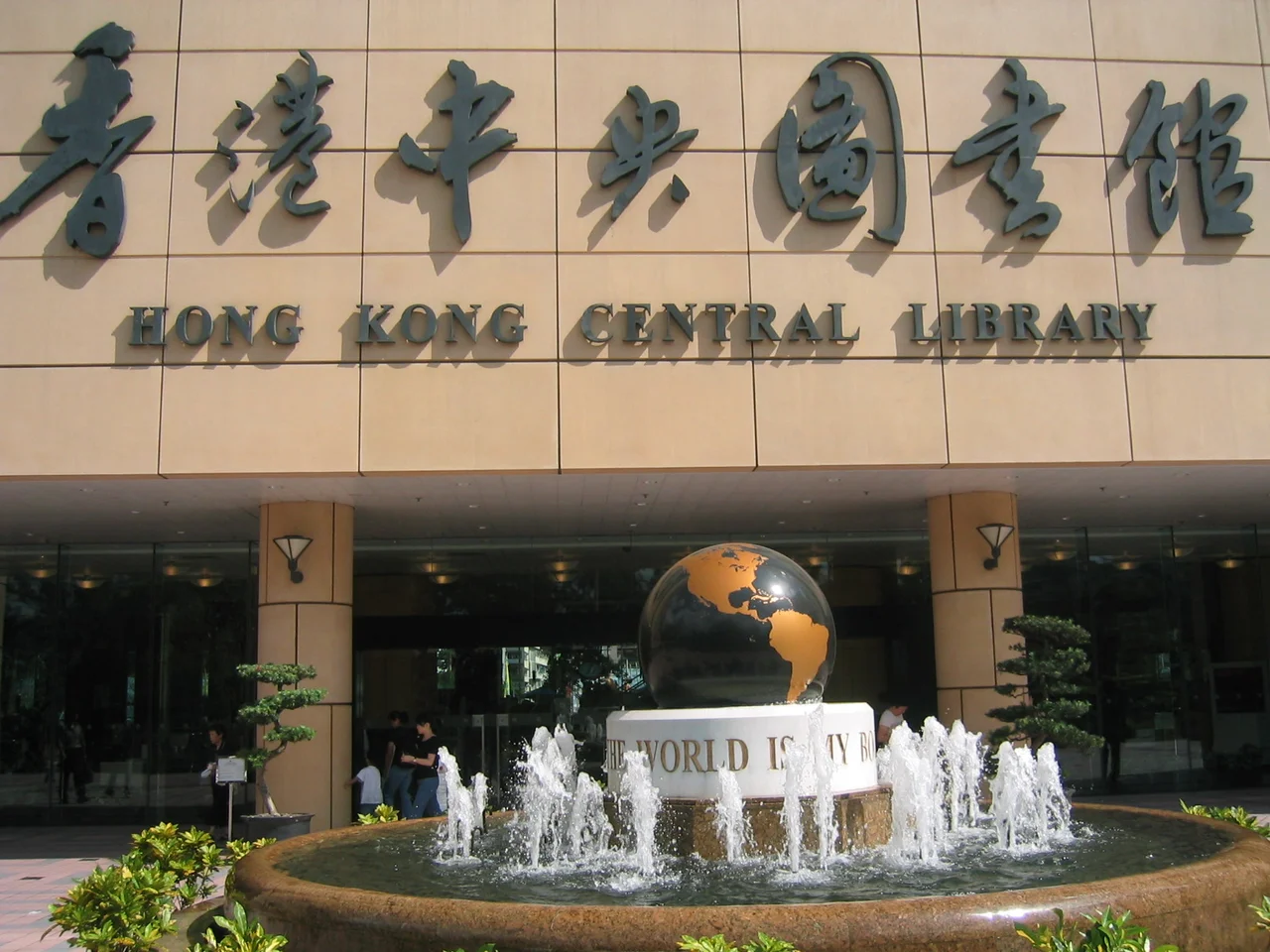

Hong Kong Central Library
A tie vote is a strange way to design a library. In August 1997, the Provisional Urban Council of Hong Kong found itself deadlocked — 21 votes for the design by prominent architect Rocco Yim Sen-kee, 21 votes for the original design by government senior architect Ho Chiu-fan. The architects who had reviewed both called Yim's design significantly superior. But the Council's chairman, Ronald Leung Ding-bong, broke the tie by casting his second vote for the original. The building that stands today at the corner of Moreton Terrace and Causeway Road — 12 storeys, 33,800 square meters of floor space, an arch-shaped doorway symbolizing the Gate to Knowledge — is the one that lost the professional vote. It opened on 17 May 2001, and it is the largest library in Hong Kong.
The Gate to Knowledge
The front facade of the Hong Kong Central Library is dominated by a large arch, and the designers did not leave its symbolism to chance. The arch is composed of three geometric forms: a circle, a square, and a triangle. The circle represents the sky. The square represents the land. The triangle represents the accretion of knowledge — the upward accumulation of understanding over time. Whether you find this clarifying or overwrought may say something about your relationship to public architecture. What is not in dispute is the scale: the building faces Victoria Harbour and occupies a gross site area of 9,400 square meters, containing 2.3 million items — roughly one-fifth of the entire Hong Kong Public Libraries system's 12.1 million items. The 11th floor houses the HKPL head office. The library functions as Hong Kong's national library, which is a significant role for an institution whose design was determined by a chairman's tiebreaker.
A Deposit Library for the World
Nine international organizations have designated the Hong Kong Central Library as their legal deposit library — meaning that materials they publish must be sent here in perpetuity. The list reads like a directory of global governance: the Asian Development Bank, the European Union, the International Labour Organization, the International Maritime Organization, the United Nations, UNESCO, the World Bank, the World Trade Organization, and the World Food Programme. These materials sit in the library's collections and are accessible to the public. It is an unusual distinction for what is technically a municipal library, but Hong Kong's position — a major financial and legal hub between international institutions and the Chinese mainland — makes the designation logical. The library also holds 11 special collections, mostly related to Hong Kong, including an oral history collection, a music collection, and a Hong Kong literature collection. Quotations from Chinese classics are carved into the steps leading to the entrance.
The Plaque That Got It Wrong
When the library first opened, it included memorial plaques dedicated to famous modern Chinese writers. One of them honored Qian Zhongshu (錢鍾書), the scholar, novelist, and literary critic best known for his satirical novel Fortress Besieged. The second character of Qian's given name — zhong, written 鍾, meaning 'to favour' — was carved on the plaque as a different character: zhong written 鐘, which means 'clock.' The mistake was noticed and drew criticism: a library that holds the greatest number of reference books among Hong Kong's public libraries had misspelled the name on a plaque inside its own entrance. The anecdote is minor, but it has stuck — perhaps because it captures something about the gap between institutional ambition and human execution, or perhaps simply because the irony is too clean to let go.
The Building's Hidden Burden
The library's design controversy was not the last difficulty the building faced. Between its opening in 2001 and 2016, there were multiple incidents of people jumping to their deaths from the internal balconies. After three such cases, tall fences were installed along the railings on the fifth and sixth floors in 2015. A further death occurred in 2016, and the fences were extended from the third floor upward. The library's atrium — an airy, multi-storey interior space meant to embody the openness of knowledge — became a space requiring physical barriers. The fences are visible and conspicuous. They don't resolve the deeper question they represent, but they mark it honestly.
Reading in the Digital City
The Hong Kong Central Library was built with digital infrastructure from the start — network flooring, data lines throughout, a three-tier multimedia system that allows audio and video on demand through around 90 ATM terminals and over 400 LAN workstations. This was forward-thinking for 2001. The Online Public Access Catalogue connects readers to the holdings of all Hong Kong public libraries, allowing real-time checking of availability and reservations from any terminal. Discussion rooms are available for rent by the hour. A Délifrance café operates just inside the entrance. The library's intelligent building design has aged better than its architectural controversy, quietly doing what libraries are supposed to do: making information available, in as many formats as possible, to anyone who comes in.
From the Air
The Hong Kong Central Library is located at 22.280°N, 114.190°E in Causeway Bay, on the northeastern edge of Victoria Park — one of the few large green spaces visible on Hong Kong Island from the air. The library's distinctive 12-storey building with its large frontal arch faces north toward Victoria Harbour. From the air, Causeway Bay's dense urban grid east of Central is easily distinguishable; the green rectangle of Victoria Park provides a clear orientation point. Hong Kong International Airport (VHHH) is approximately 37km to the west. The Tung Chung flight path over the harbor offers clear views of the northeastern Hong Kong Island waterfront.
Nearby Stories
- Lok Ma Chau Loop 2.3 km away
- Portas do Cerco 2.3 km away
- Kweilin Incident 17 km away
- Wanshan Archipelago Campaign 34 km away
- Nanxiong Formation 115 km away
- Battle of Nanpeng Island 148 km away
- Heyuan 169 km away
- Cape Maobitou 632 km away