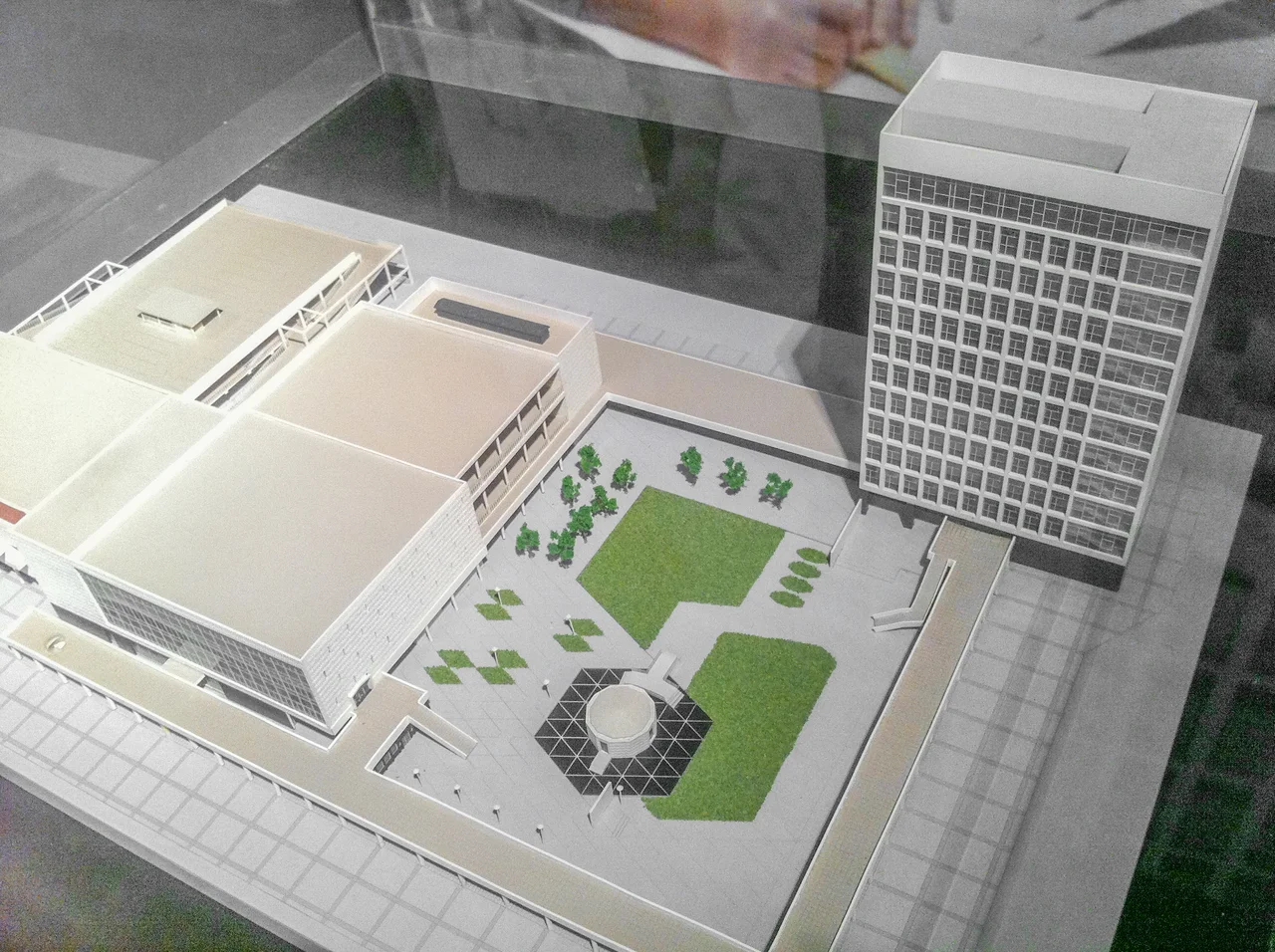

Hong Kong City Hall
Hong Kong's City Hall has never had a city to govern. There is no mayor, no city council, no municipal cabinet meeting in its chambers. The name is a kind of historical quirk: the Crown Colony of Hong Kong was run by a Governor, not an elected government, so what might elsewhere be a seat of political power became instead a seat of culture. When it opened on 2 March 1962, it was a concert hall, a library, a theater, a gallery, and a wedding registry — a civic space built for a city that had administration but not self-governance.
A Building Born from Reclaimed Ground
The current City Hall is the second to carry that name. The first, designed by French architect Achille-Antoine Hermitte, was opened on 28 June 1869 by Prince Alfred, Duke of Edinburgh — and stood roughly where the HSBC and Bank of China towers now dominate the skyline. The western portion was demolished in 1933 when the Hongkong and Shanghai Bank acquired the land; the remaining eastern section came down in 1947 to make way for the Bank of China building. A public campaign led by the Sino-British Club eventually secured a new site: 10,000 square meters of newly reclaimed seafront in Central, about 200 meters from the original location. Governor Sir Robert Brown Black laid the foundation stone on 25 February 1960. The building cost HK$20 million and opened two years later. It was designed by Professor Gordon Brown, the first head of the Department of Architecture at Hong Kong University, and completed by British architects Ronald Phillips and Alan Fitch.
International Style on the Harbour
The building's clean geometry was deliberate. With stark lines, steel and concrete construction, and extensive use of glass and anodised aluminium, the City Hall became a landmark of the International Style in Hong Kong — the same architectural language that was reshaping cities from Chicago to Chandigarh in the mid-twentieth century. The designers gave particular attention to public space: the Memorial Gardens and the piazza in front were conceived as extensions of the street, places for movement and openness in a city that was already becoming dense. That sense of breathing room in the middle of Central remains one of the building's defining qualities, even as towers have risen around it on every side.
Where Governors Swore and Artists Performed
City Hall's civic weight was real, even if unconventional. The 24th through 28th Governors of Hong Kong all took their oaths of office here. The concert hall and theater hosted some of the territory's most significant cultural milestones: the Hong Kong Arts Festival debuted here in 1973, the Asian Arts Festival followed in 1976, and the Hong Kong International Film Festival launched in 1977. The High Block once housed the principal public library until the Hong Kong Central Library opened in 2001. The art gallery on the tenth and eleventh floors eventually became the Hong Kong Art Museum, though it moved out in 1991. For three decades, nearly every significant cultural institution in Hong Kong had its beginning or its home in these two connected blocks.
The Garden of the Fallen
Tucked between the High Block and Low Block, sheltered from the street, is the City Hall Memorial Garden. At its center stands a twelve-sided Memorial Shrine commemorating the soldiers and civilians who died defending Hong Kong during the Second World War, from December 1941 through the occupation years. The gates bear the regimental emblems of the Hong Kong Volunteer Defence Corps and the Royal Hong Kong Regiment. Inside, a Roll of Honour and plaques name the combat units. Eight Chinese characters inscribed on the shrine walls invoke the everlasting spirit of the brave and the dead. It is also, incongruously, a popular backdrop for wedding photographs — couples who have just registered their marriages at the City Hall Registry often step outside to the garden. The juxtaposition of grief and celebration has been happening here for decades.
Declared a Monument at Sixty
Hong Kong has a complicated relationship with its built heritage. Much of what the colonial period produced has been demolished to make way for the towers that define the skyline today. City Hall survived. It was listed as a Grade I historic building in 2009, and on 20 May 2022, it was declared a monument under the Antiquities and Monuments Ordinance. That made it the youngest building ever to receive such protection — and the first post-World War II structure to be declared a monument in Hong Kong. At sixty years old, it entered the official canon of places that the city has decided are worth keeping. Its Concert Hall still holds 1,430 seats. Its Theatre seats 463. People still get married downstairs.
From the Air
Hong Kong City Hall sits at approximately 22.282°N, 114.161°E on the Central waterfront of Hong Kong Island, directly adjacent to Edinburgh Place. From the air, it is visible as part of the dense Central district cluster — look for the low-rise complex set against the harbor between the HSBC Tower and the waterfront. Hong Kong International Airport (VHHH) lies roughly 26 km to the northwest. On approach to VHHH from the east, Central's waterfront is visible off the left side as the aircraft tracks across the harbor; City Hall's open piazza and garden distinguish it from the taller office buildings surrounding it.
Nearby Stories
- Lok Ma Chau Loop 2.3 km away
- Portas do Cerco 2.3 km away
- Kweilin Incident 17 km away
- Wanshan Archipelago Campaign 34 km away
- Nanxiong Formation 115 km away
- Battle of Nanpeng Island 148 km away
- Heyuan 169 km away
- Cape Maobitou 632 km away