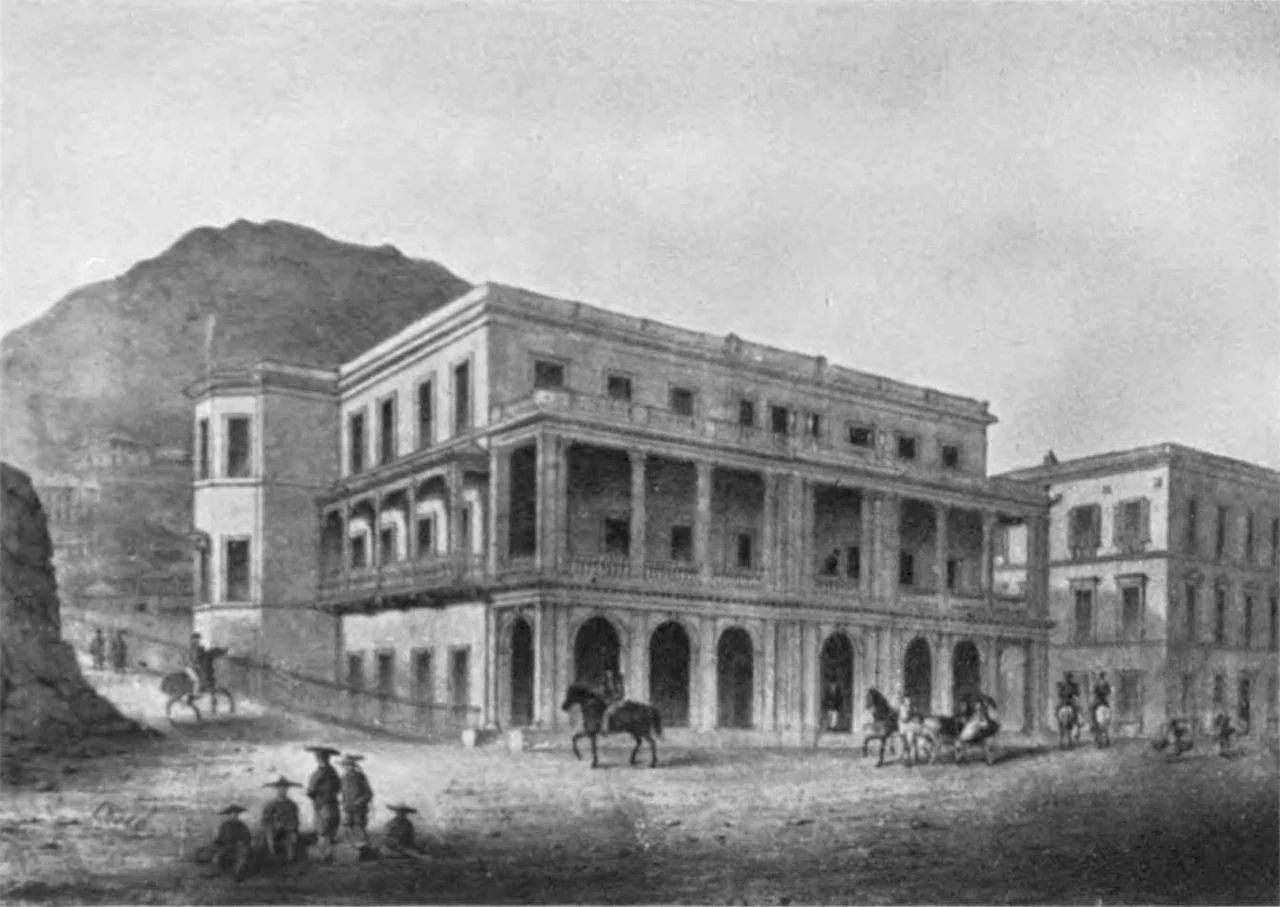

Hong Kong Club Building
In 1974, the members of the Hong Kong Club voted to keep their building. They lost anyway. The Victorian Renaissance structure that had stood at the corner of Chater Road and Connaught Road Central since 1897 — one of the last buildings of its kind in Hong Kong — came down in June 1981. The cost to save it would have been HK$500 million in public funds, the Executive Council decided, and that cost was unjustified. "If even the Government appears to value nothing but money," said the chairman of the Hong Kong Conservancy Association at the time, "Hong Kong's youth cannot be expected to have higher standards." The wrecking ball came anyway.
Founded in the Colony's Infancy
The Hong Kong Club was founded in 1846, just five years after the colony itself was established. Its first premises occupied a three-storey building along Queen's Road Central, running from the corner of Wyndham Street to D'Aguilar Street. An 1847 chronicle described it admiringly: a handsome building covering nearly a third of an acre, with a grand staircase supported on fluted columns in the Corinthian order. Construction and furnishings cost £15,000, raised through shares. It was an institution from the start — a place where the colony's merchants, administrators, and professionals came to be among themselves. The plot that first generation building occupied is now home to the Entertainment Building.
A Victorian Landmark on a 999-Year Lease
On 16 February 1895, the Club received a 999-year lease on a new site — the kind of lease that was meant to feel permanent. The new building, designed by Palmer & Turner and completed in July 1897, was built in a Renaissance Revival style that made it one of the most recognizable structures on the Central waterfront. Annual rent to the colonial government was $324. For nearly a century it stood as a landmark, accumulating the weight of institutional memory that comes only from decades of the same conversations in the same rooms. By the 1970s, that weight had turned into a conservation argument: the building was, its defenders argued, irreplaceable.
The Battle to Save It
The Club's finances were strained by the 1970s, and the site — prime Central real estate — was worth far more as a tower than as a Victorian clubhouse. In 1977, a reported offer of HK$200 million arrived from Wardley. The executive committee signed a heads of agreement with developers before members had a chance to vote. An emergency general meeting was called for 20 October 1980. Members contested the decision; the chairman was forced to concede that ratification was required. The Antiquities Advisory Board recommended preservation. The Hong Kong Conservancy Association appealed to Governor Murray MacLehose. In September 1980, the Executive Council overruled the preservation recommendation, citing the HK$500 million cost to taxpayers. Hongkong Land became the developer. The building came down in June 1981.
The Tower That Replaced It
The current building — the third generation Hong Kong Club Building — is a 25-storey tower designed by Harry Seidler, an Austrian-born Australian architect known for his modernist work. The design was unveiled to Club members in December 1980, while the preservation fight was still unresolved. The Club occupies the lower eight levels: four podium floors of dining rooms and bars for members. The upper seventeen floors are leased as offices, making the arrangement commercially viable in the way the Victorian building never could have been. The address at the corner of Jackson Road, between Chater Road and Connaught Road Central, remains the same. The institution continues. The building it replaced does not.
What the Demolition Left Behind
The Hong Kong Club's story is partly a story about what cities keep and what they discard when the math changes. Hong Kong demolished much of its colonial-era built environment in the decades after World War II — not always carelessly, but rarely with the tools to stop it when money pointed the other direction. The loss of the second-generation Club Building accelerated heritage conversations in Hong Kong, contributing eventually to the frameworks for historic building assessment that exist today. The current building is not without architectural interest — Seidler's work commands attention — but no photograph of the Victorian original has stopped being elegiac. It was, as its defenders said, the last of its kind.
From the Air
The Hong Kong Club Building sits at approximately 22.281°N, 114.161°E in Central, Hong Kong Island, at the junction of Chater Road, Connaught Road Central, and Jackson Road. From the air, Central's dense cluster of towers is immediately recognizable; the Club Building stands adjacent to Chater Garden and the Court of Final Appeal. Hong Kong International Airport (VHHH) is roughly 26 km to the northwest. Viewing is best on approach to or departure from VHHH tracking over Victoria Harbour, at altitudes between 1,000 and 4,000 feet.
Nearby Stories
- Lok Ma Chau Loop 2.3 km away
- Portas do Cerco 2.3 km away
- Kweilin Incident 17 km away
- Wanshan Archipelago Campaign 34 km away
- Nanxiong Formation 115 km away
- Battle of Nanpeng Island 148 km away
- Heyuan 169 km away
- Cape Maobitou 632 km away