.jpg)
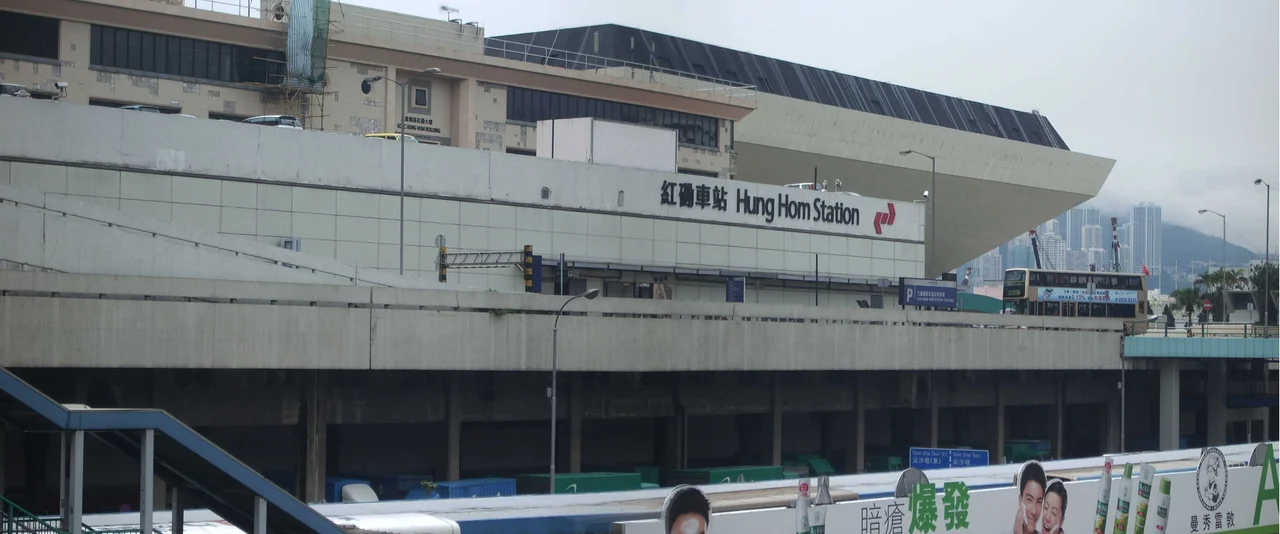
Hong Kong Coliseum
On December 8, 1983, David Bowie stood on the stage of the Hong Kong Coliseum and played John Lennon's 'Imagine.' The date was the third anniversary of Lennon's murder, and Bowie — closing out the final two nights of his Serious Moonlight Tour — chose the song deliberately, in a city still processing what it meant to be both Chinese and colonial, both traditional and modern. It was exactly the kind of moment the building was built for: large enough to hold the weight of it.
An Inverted Pyramid Above the Bay
The Coliseum was inaugurated on 27 April 1983, its opening timed to coincide with the 100th anniversary of the Urban Council that built it. The building's most distinctive feature is its form: an inverted pyramid, wide at the roof and narrowing toward the base, positioned near Hung Hom Bay in Kowloon. The arena seats 12,500, making it the second largest indoor venue in Hong Kong after the AsiaWorld-Arena, which opened in 2005. The highest rows of seats rise to 41 metres above the floor. Four-sided color television screens hang from the center of the ceiling, ensuring that even the farthest seats have a clear view of the stage. The floor can bear loads of up to 1,800 kilograms per square meter — more than most industrial buildings — allowing production teams to construct elaborate stage sets without structural concern.
A Venue That Refuses to Specialize
The Coliseum's Chinese name, 紅磡體育館, translates roughly as 'Sports Arena,' but sport has rarely been its primary purpose. Concerts dominate the calendar. Universities use it annually for graduation ceremonies. Ice-skating productions have taken over the floor. From 1991 to 2010, with a single exception, the Miss Hong Kong Pageant was staged here. The FIVB Volleyball Women's Nations League has used it as a competition venue. Whitney Houston performed here on three consecutive nights in November 1988. Stevie Wonder, Phil Collins, and Kylie Minogue all played the venue in the late 1980s and early 1990s. Westlife brought their Where Dreams Come True Tour on 3 June 2001. The building seems to resist category — it is as comfortable hosting a volleyball tournament as a concert by one of the biggest pop stars in the world.
The Heartbeat of Cantopop
More than any single artist or event, the Coliseum became the spiritual home of Cantopop — the Cantonese popular music that defined Hong Kong's cultural identity from the 1970s onward. For Hong Kong audiences, performing here was not simply a booking; it was validation. The biggest names in Cantonese music measured their careers by Coliseum shows, and fans measured their loyalty by how many nights they attended. The building's intimacy — despite its 12,500 seats, the inverted pyramid geometry brings the audience close to the stage — suited the genre's emotional directness. To see your favorite singer at the Coliseum was to participate in something Hong Kong-specific, something that could only happen here, in this building, in this language.
Renovation and Reinvention
When Hong Kong hosted the 5th East Asian Games in 2009, the Coliseum required upgrading. A HK$168.6 million renovation ran from July 2008 through January 2009, during which the venue was closed entirely. The project replaced all approximately 10,500 fixed seats, repainted them in four colors corresponding to four seating zones, upgraded lighting systems, replaced scoreboards, and refurbished front-of-house facilities. The venue reopened on 28 January 2009. The renovation preserved what mattered while updating what needed updating — the signature inverted pyramid silhouette unchanged, the scale unchanged, the relationship between performer and audience unchanged.
A Night the Building Cannot Forget
On 28 July 2022, during a concert by the local boy band Mirror, a large LED screen suspended above the stage fell when one of its supporting cables snapped, crashing onto two dancers. One dancer suffered severe spinal injuries causing paralysis and was admitted to intensive care in serious condition; the other was also injured. All remaining performances in the series were cancelled, and government investigations followed. The accident did not define the Coliseum, but it marked it. Safety assessments and regulatory scrutiny followed across Hong Kong's entertainment industry — the engineering firm responsible for the rigging later pleaded guilty to occupational safety violations and was fined. The building that had hosted decades of spectacle without incident suddenly had an incident that would not be forgotten — a night when the machinery behind the magic failed the people it was meant to serve.
From the Air
The Hong Kong Coliseum sits at approximately 22.302°N, 114.182°E on the Kowloon side of Victoria Harbour, adjacent to the former Hung Hom KCR station near Hung Hom Bay. The inverted-pyramid form is visually distinctive from the air — a wide, low structure tapering toward its base, contrasting with the vertical towers surrounding it. Hong Kong International Airport (VHHH) is roughly 25 km to the northwest. On departure from VHHH heading east, the Kowloon peninsula is visible off the right side; the Coliseum can be identified near the water's edge at Hung Hom. Recommended viewing altitude 1,500–3,500 feet.
Nearby Stories
- Lok Ma Chau Loop 2.3 km away
- Portas do Cerco 2.3 km away
- Kweilin Incident 17 km away
- Wanshan Archipelago Campaign 34 km away
- Nanxiong Formation 115 km away
- Battle of Nanpeng Island 148 km away
- Heyuan 169 km away
- Cape Maobitou 632 km away