
Hong Kong Correctional Services Museum
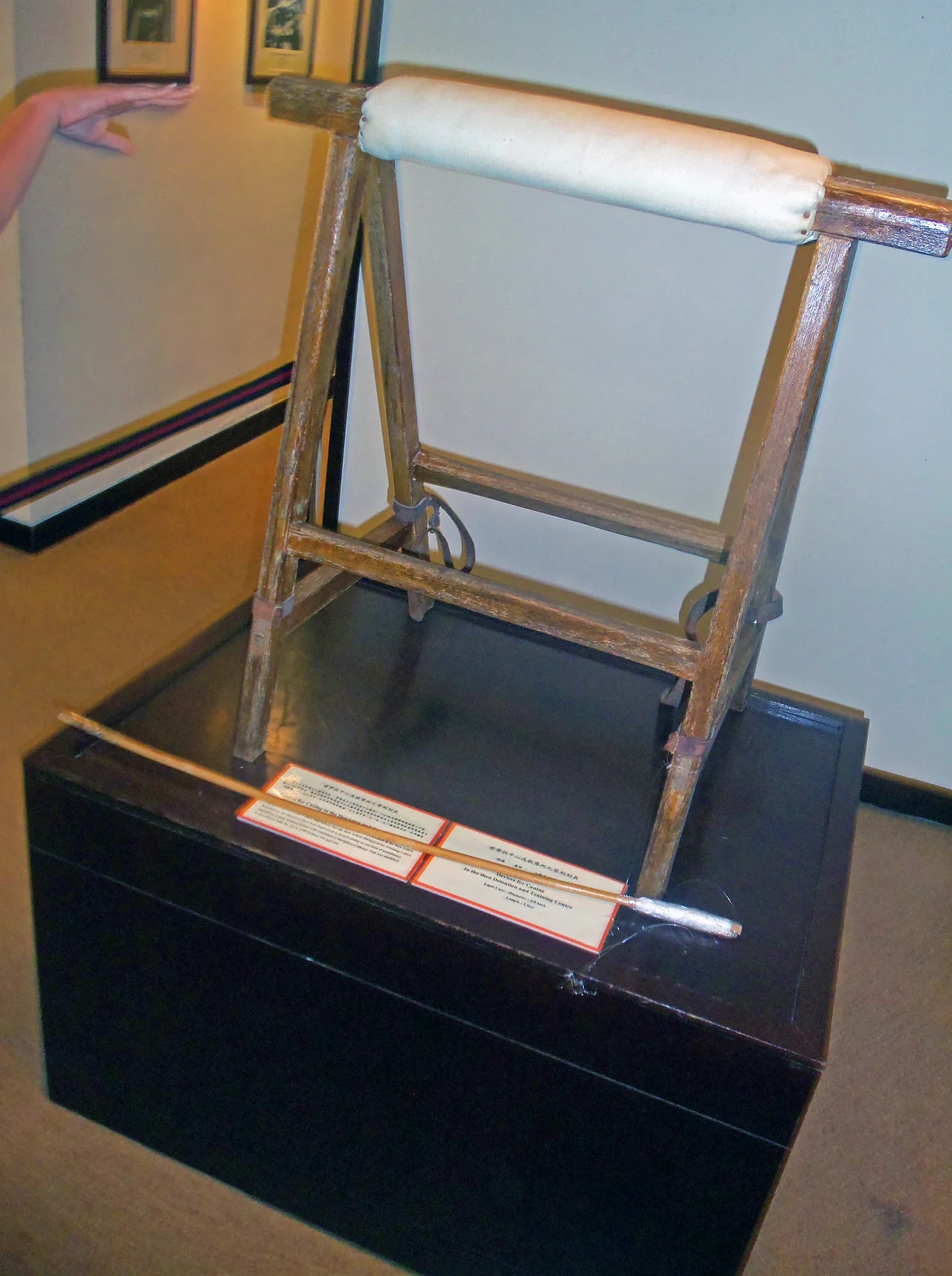
Stanley is known for its market, its beach, its colonial-era prison that held Allied civilians during the Japanese occupation. Less known is the small museum tucked beside the Staff Training Institute of the Correctional Services Department on Tung Tau Wan Road, where a mock gallows stands in one of the galleries and the view from the lookout point takes in the blue water of Tai Tam Bay. The museum is easy to miss. It rewards the visitor who doesn't.
One Hundred and Seventy Years in Ten Galleries
The Hong Kong Correctional Services Museum opened to the public after being relocated to its current two-storey building next to the parade ground of the Staff Training Institute. Its 480 square meters contain over 600 artifacts tracing Hong Kong's criminal and rehabilitative history from the Qing dynasty — which began in 1644 — through the colonial period and into modern times. Ten galleries organize the story: punishment and imprisonment, prison history and development across two galleries, life inside prisons, staff uniforms and insignia, Vietnamese boat people, homemade weapons and unauthorized articles, staff events, industries and vocational training, and overseas cooperation. That progression — from punishment to rehabilitation to international connection — reflects a genuine institutional evolution, not just a curatorial choice.
When Piracy Was a Capital Crime
The colonial period gallery carries particular weight. In the nineteenth and early twentieth centuries, Hong Kong's position at the mouth of the Pearl River Delta made it a hub of maritime commerce — and a hub of piracy. The colonial courts treated piracy as a capital offense, and the gallows was the instrument. The mock gallows in the museum is a replica of the kind used during the colonial period, when executions were carried out within prison walls. Standing beside it, even in replica form, in a small gallery with informational placards around you, has a different quality than reading about the practice in a book. The museum makes the mechanism visible and specific, which is exactly what a museum of punishment should do.
Gallery Six: Boat People
Among the ten galleries, the sixth — devoted to Vietnamese boat people — documents one of Hong Kong's most complex humanitarian chapters. Between the late 1970s and the 1990s, Hong Kong received hundreds of thousands of Vietnamese refugees fleeing the aftermath of the Vietnam War. Many were held in detention centers managed in part by the Correctional Services Department. The gallery addresses this period directly, including the conditions of detention and the policies that governed it. The boat people arrived as refugees; Hong Kong's response was often to detain them indefinitely while their status was determined. Gallery Six does not resolve that tension — it documents it.
Homemade, Unauthorized, and Ingenious
Gallery Seven, devoted to homemade weapons and unauthorized articles confiscated from prisoners, has the quality of an accidental design exhibition. The creativity with which people deprived of tools make tools is remarkable — and the museum presents these objects without sensationalizing them. Alongside the weapons are the products of vocational training: Gallery Nine covers the industries and crafts programs through which inmates have been trained and employed. The annex adds another dimension, displaying handicrafts produced by people in custody. It is a deliberately complex portrait: the same institution that confiscated improvised weapons also taught skills and displayed the work of the people it supervised.
Tai Tam Bay from the Lookout
Outside the annex, a 200-square-meter lookout point faces Tai Tam Bay. Stanley sits on the southern shore of Hong Kong Island, away from the dense development of the harbor side, and the view south across the water is a reminder of the territory's geography: this is a place of bays, headlands, and open sea, as well as towers and traffic. The museum is open Tuesday through Sunday, 10am to 5pm, closed Mondays and public holidays. Buses from Central, North Point, Sai Wan Ho, and several other districts reach Stanley with reasonable frequency. The museum is free. The gallows is real — or was, once — and the view of the bay is genuinely good.
From the Air
The Hong Kong Correctional Services Museum is located at approximately 22.216°N, 114.218°E in Stanley on the southern shore of Hong Kong Island, near Tung Tau Wan Road. From the air, Stanley is identifiable as the peninsula projecting southward from the island's southern coast, with Tai Tam Bay to the east. Hong Kong International Airport (VHHH) is roughly 30 km to the northwest. The museum grounds adjoin the Staff Training Institute and overlook the bay; the site is best viewed on a coastal approach or during a turn over the southern waters of Hong Kong at altitudes between 1,000 and 3,000 feet.
Nearby Stories
- Lok Ma Chau Loop 2.3 km away
- Portas do Cerco 2.3 km away
- Kweilin Incident 17 km away
- Wanshan Archipelago Campaign 34 km away
- Nanxiong Formation 115 km away
- Battle of Nanpeng Island 148 km away
- Heyuan 169 km away
- Cape Maobitou 632 km away