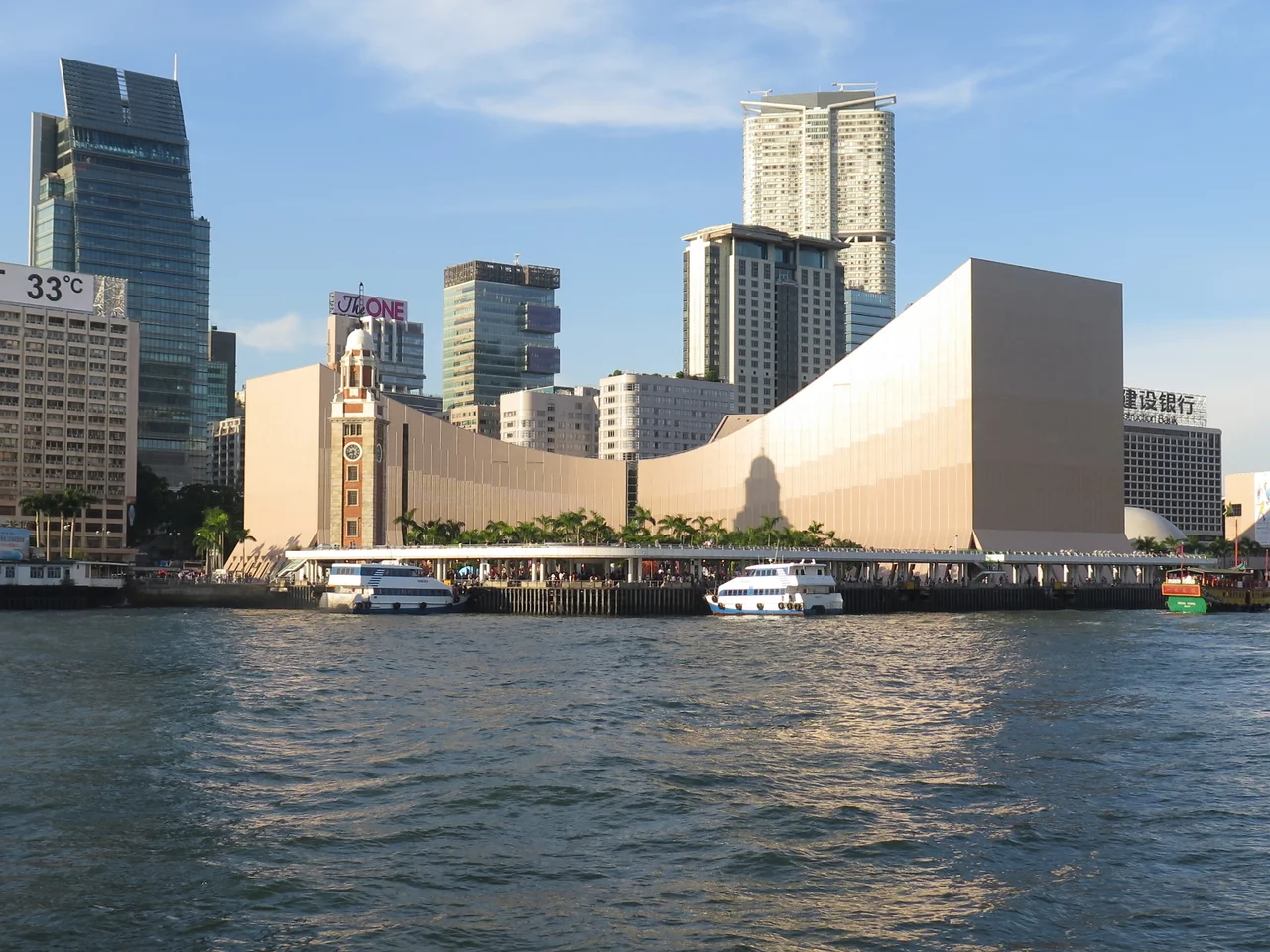

Hong Kong Cultural Centre
When Charles, Prince of Wales, and Princess Diana unveiled the commemorative plaque on 8 November 1989, they were standing on ground that had once carried locomotive steam. The Hong Kong Cultural Centre was built on the site of the old Kowloon station of the Kowloon–Canton Railway — a decision that proved deeply controversial, as the historic station was demolished to make way for it. That contentious beginning is worth keeping in mind now, as you stand before one of Asia's premier performing arts venues, looking out across Victoria Harbour at the glittering skyline of Hong Kong Island.
A Vision Two Decades in the Making
The idea of a cultural centre for Kowloon had been circulating since 1970, when the Urban Council began pressing for a venue to match the standard of City Hall in Central. The project was formally announced in 1974, with construction expected to begin the following year. It didn't. Financial constraints pushed the schedule back, then back again. By 1978, the Urban Council had declared the project a top priority — only for cost estimates to leap from $190 million to $474 million, sending planners back to the drawing board once more.
When construction finally did begin, the controversy shifted from money to memory. The Kowloon railway station that had occupied the site since the early twentieth century was demolished, and many Hong Kongers felt that an irreplaceable piece of the city's history had been sacrificed. What remained was the Clock Tower, standing between the centre and the Star Ferry pier, a lone witness to what had been there before.
The Architect and the Organ
The building was designed by José Lei, then chief architect of the Public Works Department. His design — a sloping, windowless roof that slopes dramatically toward the harbour — drew its own share of critics. Some found it cold and imposing. Others admired its bold geometry against the waterfront sky. Whatever your view of the exterior, the interior tells a different story.
The Concert Hall, with 2,019 seats arranged in an oval two-tiered auditorium, is finished in high-quality oak and fitted with an adjustable acoustic canopy. At its heart is the instrument that makes this room exceptional: an 8,000-pipe organ built by the Austrian firm Rieger Orgelbau, one of the largest pipe organs in Asia. Installation alone took four months, from August to November 1989, requiring the careful placement of thousands of individual pipes. The Hong Kong Philharmonic Orchestra has made this hall its home, and the acoustics justify why.
Three Stages, One Skyline
Beyond the Concert Hall, the centre operates two other major performance spaces. The Grand Theatre seats 1,734 across three tiers and was designed specifically for large-scale opera, ballet, and musicals — its stage dimensions and technical infrastructure built to accommodate full productions. Since 1991, it has hosted the annual Hong Kong Film Awards presentation ceremony, adding a layer of cinematic history to its operatic one.
The Studio Theatre, smaller and more flexible, accommodates between 300 and 496 seats depending on the configuration of any given production. Experimental theatre, intimate recitals, and contemporary dance have all found a home on its stage. Supporting all three venues are eleven rehearsal and practice rooms and four foyer exhibition areas, making the centre as much a place of daily work as of public performance.
Step outside and the cultural geography becomes clear: the Space Museum stands to the east, the Museum of Art just beyond it, and the Star Ferry pier immediately to the west. The Clock Tower stands between them all — a reminder that this particular piece of Kowloon's waterfront has always been a place where the city gathers.
A Waterfront Stage
From Victoria Harbour, the Cultural Centre reads as a bold angular form against the Tsim Sha Tsui skyline, its sloping roof unlike anything else along the waterfront. Concerts here often end with audiences spilling out onto Salisbury Road to find the harbour still glittering before them — a combination of experience that is distinctly Hong Kong, where high art and spectacular urban geography are rarely far apart.
Since 2000, the venue has been administered by the Leisure and Cultural Services Department. The programmes it presents span Western classical music, Cantonese opera, ballet, jazz, and international touring productions. For a city that built it all on a demolished railway station after nearly two decades of delay, the Cultural Centre has become something its critics could not have predicted: genuinely indispensable.
From the Air
The Hong Kong Cultural Centre sits at 22.2939°N, 114.170°E on the Tsim Sha Tsui waterfront in Kowloon. From the air at 2,000–4,000 feet, look for the distinctive sloping roofline along Salisbury Road, immediately west of the Space Museum dome and east of the Star Ferry clock tower. The venue is directly across Victoria Harbour from the Hong Kong Island skyline. The primary nearby airport is Hong Kong International Airport (VHHH) on Lantau Island, approximately 30 km to the west. At lower altitudes, the Cultural Centre's angular form is clearly distinguishable from surrounding buildings; approach from over the harbour for the most dramatic view of the entire Tsim Sha Tsui cultural district.
Nearby Stories
- Lok Ma Chau Loop 2.3 km away
- Portas do Cerco 2.3 km away
- Kweilin Incident 17 km away
- Wanshan Archipelago Campaign 34 km away
- Nanxiong Formation 115 km away
- Battle of Nanpeng Island 148 km away
- Heyuan 169 km away
- Cape Maobitou 632 km away