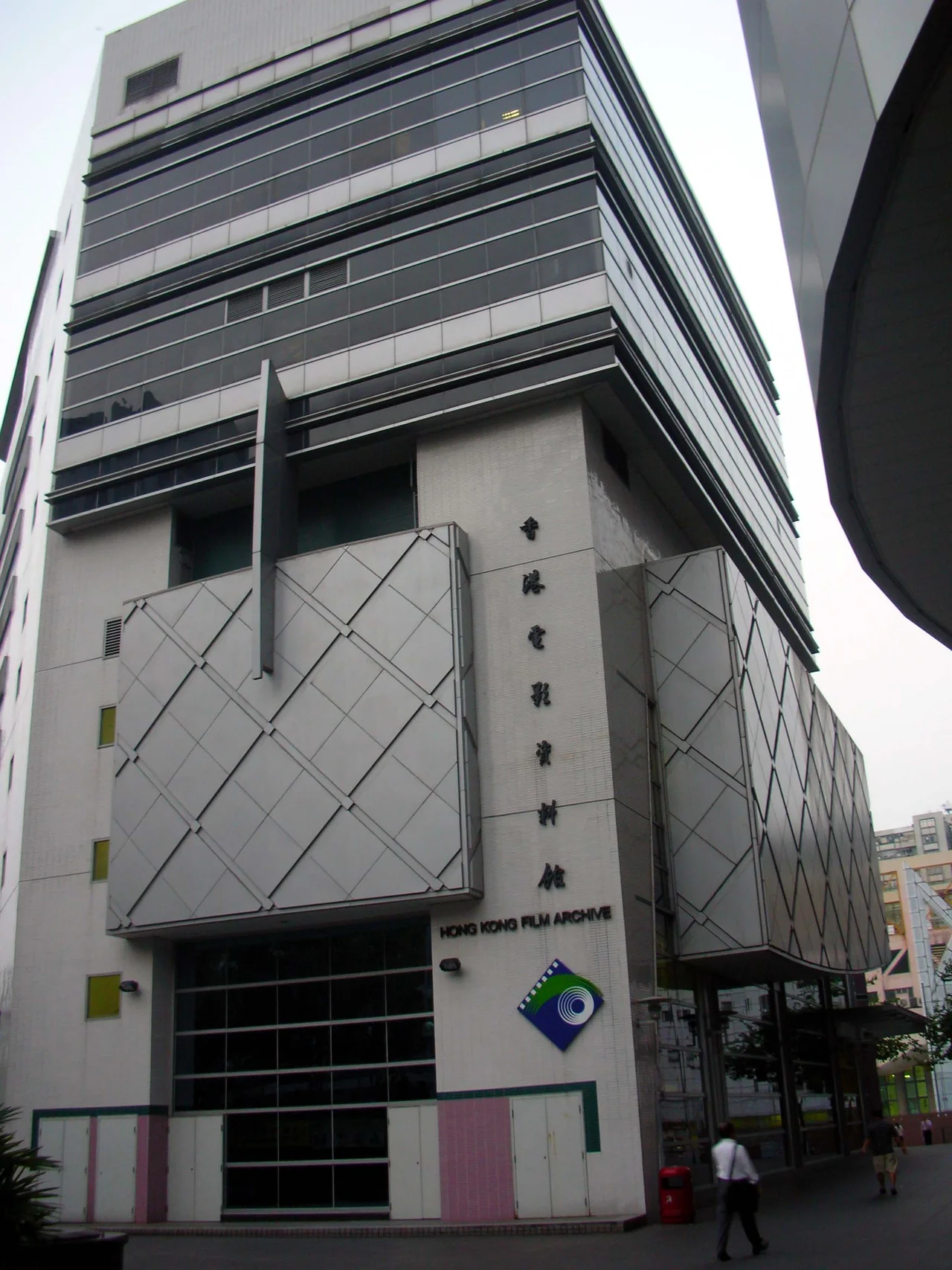

Hong Kong Film Archive
In November 2011, a lorry pulled up to a quiet building at 50 Lei King Road and unloaded a hundred decades of Hong Kong cinema. TVB was handing over roughly 1,000 film titles — reels spanning the 1930s to the 1990s — to permanent care. Among them was a 1939 picture called Little Heroine, the earliest Chinese film in the broadcaster's library, and a 1947 spy melodrama called Female Spy 76, shot when the territory was still exhaling the smoke of Japanese occupation. It was the kind of donation that feels less like a transaction and more like a rescue.
The Archive That Almost Wasn't
Hong Kong cinema had been exploding onto international screens for decades before anyone paused to ask who was preserving it. The kung fu films, the Cantonese melodramas, the new-wave experiments of the 1980s — most existed on fragile nitrate or acetate stock, susceptible to decay, fire, and neglect. It was the Urban Council that finally moved, opening the Planning Office of what would become the Hong Kong Film Archive in 1993. Three years later the archive joined the International Federation of Film Archives, signalling its ambition to operate at the same standard as the great film libraries of London, Paris, and New York. The Leisure and Cultural Services Department took over management in 2000, and on 3 January 2001 the purpose-built building in Sai Wan Ho opened its doors. The timing was pointed: Hong Kong had returned to China in 1997, and the question of what counted as Hong Kong culture — distinct, particular, irreplaceable — had taken on a new urgency.
Reels, Rooms, and a 125-Seat Cinema
The building is five storeys of climate-controlled pragmatism, with most of its life happening well out of public view. Film stores occupy the first, second, and third floors. A projection room sits on the second. The Resource Centre on the third floor is where researchers and enthusiasts can dig into the archive's holdings — catalogues, posters, production records, the documentary residue of a century's worth of filmmaking. Downstairs, the ground floor holds a box office and an exhibition hall. What brings ordinary visitors in is the 125-seat cinema tucked within, where the archive runs regular public screenings of its holdings at an accessible ticket price of $40, with concessions for students, seniors, and people with disabilities. The cinema makes the archive something rarer than a repository: a living venue where films meet audiences they were always meant to find.
A Hundred Must-See Reasons
The archive doesn't just store films — it makes arguments about which ones matter. Its list of 100 Must-See Hong Kong Movies functions as a kind of collective memory project, identifying the works that define the tradition. Eight of the films transferred by TVB appear on that list: Wong Fei-hung's Whip that Smacks the Candle (1949), its companion piece Wong Fei-hung Burns the Tyrants' Lair (1949), Blood-stained Azaleas (1951), Mysterious Murderer (1951, both parts), Butterfly and Red Pear Blossom (1959), Father Is Back (1961), and The Pregnant Maiden (1968). Reading the titles alone is to hear the cadence of mid-century Cantonese popular culture — heroic folklore, domestic tension, social comedy, barely-coded melodrama. The fact that many of these had been sitting in a broadcaster's warehouse rather than a properly temperature-controlled vault makes the transfer feel all the more fortunate.
Writing the History It Holds
The archive is also a publisher. Its Hong Kong Filmography series is the closest thing to a comprehensive official record of the territory's cinematic output, cataloguing productions year by year with credits, synopses, and contextual notes. The Monographs of Hong Kong Film Veterans does something harder: it records the oral histories and working memories of the directors, cinematographers, actors, and producers who made the films, capturing what no reel can preserve. A quarterly newsletter keeps the wider community informed of new acquisitions, upcoming screenings, and developments in film culture. It is a modest publication, but it performs the essential institutional work of staying in conversation with the audience whose interest ultimately justifies the archive's existence.
Getting There, Getting In
For a building dedicated to preserving the past, the archive is remarkably easy to reach. It sits about five minutes' walk from Exit A of Sai Wan Ho MTR station, in a part of Hong Kong Island that retains more of the old neighbourhood texture than the glassy districts further west. The public areas — box office, exhibition hall, Resource Centre — occupy a small portion of the building's footprint, which is fitting: most of what the archive does happens behind closed doors, in the dark, at controlled temperatures, at the slow pace of preservation. Visiting is a reminder that the work of keeping cultural memory alive is not glamorous. It is continuous, technical, and expensive. But when the lights go down in that 125-seat cinema and a 1940s Hong Kong opens on the screen, the payoff becomes obvious.
From the Air
The Hong Kong Film Archive sits at approximately 22.285°N, 114.222°E on the northeastern shore of Hong Kong Island, in the Sai Wan Ho district. From the air at 3,000–5,000 feet, the distinctive waterfront of Hong Kong Island's north shore is clearly visible. The nearest major airport is Hong Kong International Airport (VHHH) on Lantau Island, roughly 35 km to the west-southwest. Shek Kong Airfield (VHSK), the PLA garrison airbase, lies about 25 km to the northwest in the New Territories. The archive's neighbourhood is identifiable from above by the MTR depot at Sai Wan Ho and the broad sweep of Victoria Harbour beyond.
Nearby Stories
- Lok Ma Chau Loop 2.3 km away
- Portas do Cerco 2.3 km away
- Kweilin Incident 17 km away
- Wanshan Archipelago Campaign 34 km away
- Nanxiong Formation 115 km away
- Battle of Nanpeng Island 148 km away
- Heyuan 169 km away
- Cape Maobitou 632 km away