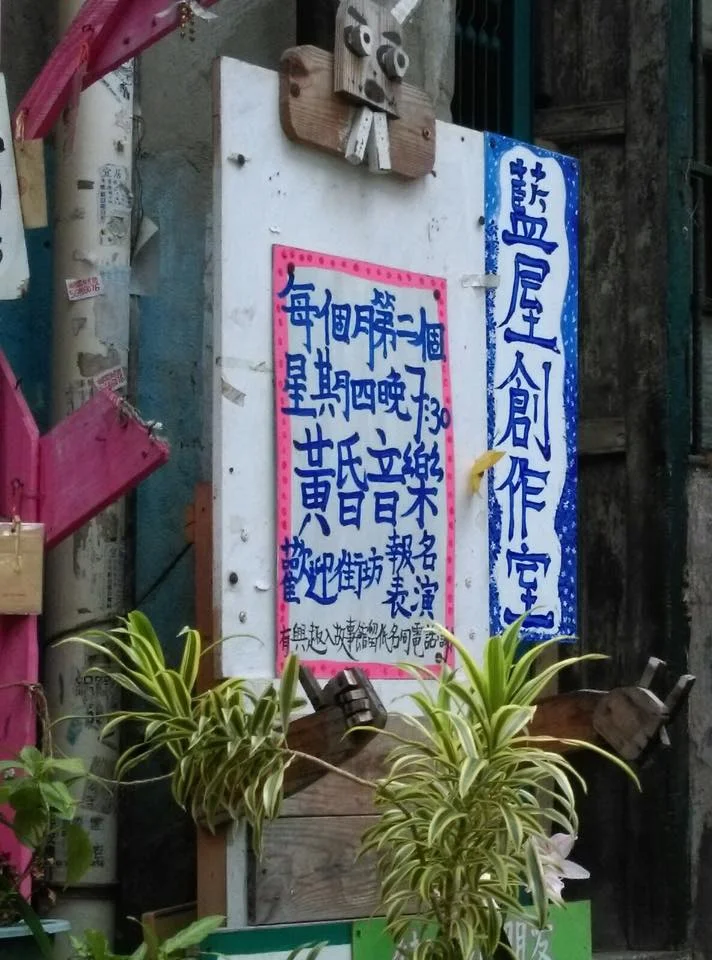

Hong Kong House of Stories
The building is painted a shade of blue that has no official name but is immediately recognisable to anyone who has walked down Stone Nullah Lane in Wan Chai. The Blue House — a four-storey tenement block built in the 1920s, one of the last surviving examples in Hong Kong of its type — wears its colour like a declaration. Inside it, the Hong Kong House of Stories operates not as a museum in the conventional sense but as something harder to categorise: part neighbourhood archive, part community living room, part workshop space where the elderly teach the young how things used to be made.
The Building That Became a Blue House
The Blue House cluster in Wan Chai is a row of pre-war tenement buildings that survived the waves of demolition that swept through Hong Kong's older districts from the 1970s onward. Their survival was not accidental — it required sustained advocacy from heritage groups and local residents who argued that the social fabric of a neighbourhood could not be separated from its physical fabric. The buildings were eventually declared Grade I historic buildings, the highest heritage classification in Hong Kong. What the Blue House holds is not just old architecture; it is the logic of an older way of urban life, where shops occupied ground floors, families occupied upper floors, and community was an unavoidable daily condition rather than something organised and scheduled.
From Livelihood Place to House of Stories
The museum opened in 2007 under the name Wan Chai Livelihood Place, a name that located it firmly in the practical and the everyday. In March 2012 it was renamed Hong Kong House of Stories — a shift that tells you something about how its founders understood what they were doing. A livelihood place suggests economy and survival. A house of stories suggests memory and identity. Both are accurate. The museum collects and presents the personal and neighbourhood histories of Wan Chai and Hong Kong more broadly, using exhibitions, guided tours, film screenings, and night concerts. Some of its past exhibitions read like an inventory of a vanishing world: 'Stall on Street,' 'Hong Kong's Retirement Plan,' 'Memories of Hong Kong's Film,' 'Naamyam Exhibition' — that last one exploring a form of traditional Cantonese storytelling that few young people today have heard performed.
Elders at the Centre
One of the House of Stories' most deliberate choices is who staffs it. Most of the volunteers are elderly residents of the neighbourhood — people who carry in their own memories the history the museum is trying to preserve. This is not simply a staffing strategy; it is an argument about where knowledge lives. The elderly volunteers are not performing nostalgia for visitors. They are the primary holders of the lived understanding of what Wan Chai was before the hotels and the nightclubs and the glass towers arrived. Community Guided Tours — of Wan Chai and of Central — draw on this knowledge, taking participants through streets that still contain evidence of older patterns of life, if you know where to look and who to ask.
Making Things, Keeping Things
The handicraft area of the museum is where the knowledge held by the elderly volunteers becomes transferable. Traditional Industry Workshops and Local Crafts Workshops run alongside Community Arts and Traditional Food sessions, organised under the 'Community Classroom' programme. The point is not the object produced — a stamp, a notebook, a handmade souvenir — but the transmission of the skill and the conversation it generates. The museum's operating costs are partly funded by donations collected through this craft activity. There is something fitting about that: the House of Stories sustaining itself through the same logic of small transactions and neighbourhood exchange that the tenements around it were built to support.
Regular Rhythms
Unlike many institutions that rely on temporary exhibitions to draw audiences, the House of Stories builds its programme around recurring events: monthly film screenings, night concerts, art studios, neighbourhood sharing discussions. The Wan Chai Community Cultural Tour runs in an English-language version for visitors who arrive without existing connections to the area. The Wan Chai Cuisine Tour and Wan Chai Hiking Tour offer less conventional ways into the neighbourhood's character. Together these events create something that functions less like a museum schedule and more like a neighbourhood calendar — the kind that used to exist organically in places like this before urban renewal emptied them out and filled them again with different people who didn't know each other yet.
From the Air
The Hong Kong House of Stories sits at approximately 22.274°N, 114.174°E in the Wan Chai district of Hong Kong Island. The Blue House cluster is located on Stone Nullah Lane, a short street in the older residential fabric south of the Wan Chai commercial strip. From the air at 3,000–5,000 feet, Wan Chai is identifiable by the curving shoreline south of Causeway Bay and the high-rises of the Convention and Exhibition Centre area. Hong Kong International Airport (VHHH) lies approximately 33 km to the west. The Peak, rising steeply behind the Central-Wan Chai corridor, serves as a landmark for orientation.
Nearby Stories
- Lok Ma Chau Loop 2.3 km away
- Portas do Cerco 2.3 km away
- Kweilin Incident 17 km away
- Wanshan Archipelago Campaign 34 km away
- Nanxiong Formation 115 km away
- Battle of Nanpeng Island 148 km away
- Heyuan 169 km away
- Cape Maobitou 632 km away