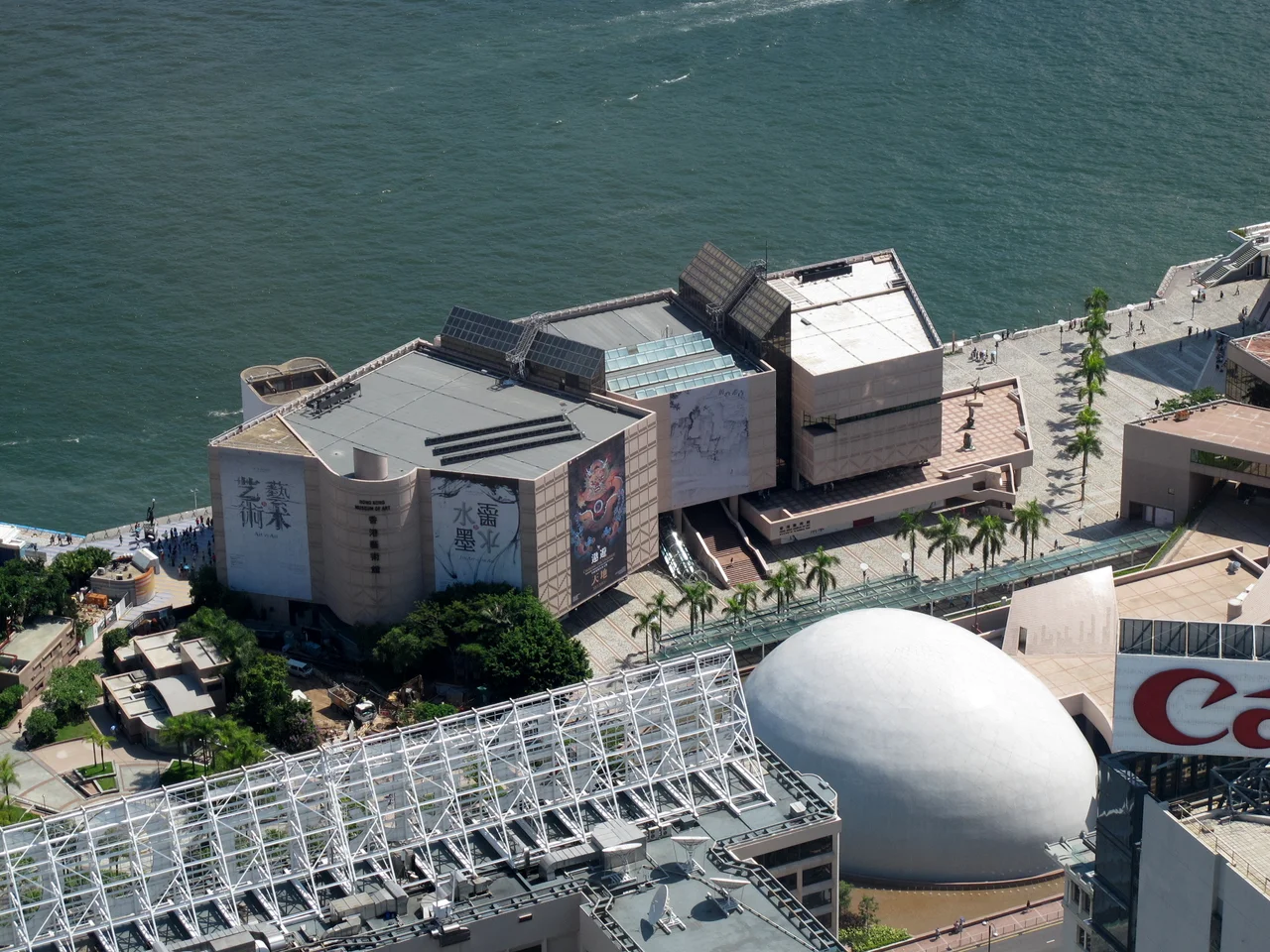

Hong Kong Museum of Art
In 1962, a new exhibition in the Hong Kong City Hall opened under the title Hong Kong Art Today. It was the first major show with Hong Kong art as its explicit subject — and the curators were already arguing about what it meant. Naturalism was passé, the exhibition declared; abstract art was the future. It was an unusually bold claim for an institution less than a year old. That institution — renamed and relocated several times, expanded at a cost of HK$934 million, closed for four years, reopened — is now the Hong Kong Museum of Art, on the Kowloon waterfront in Tsim Sha Tsui, free to enter for permanent exhibitions.
From City Hall to the Harbourfront
The museum began in 1962 as the City Hall Museum and Art Gallery, occupying space in the City Hall in Central. Within thirteen years it had grown enough to split: the Hong Kong Museum of History went one way, the Hong Kong Museum of Art another. The art museum moved to Kowloon Park in 1983, then to its current address at 10 Salisbury Road, Tsim Sha Tsui, in 1991. Governor Chris Patten formally inaugurated the new building on 11 September 1992. The location — next to the Hong Kong Cultural Centre and the Hong Kong Space Museum, facing Victoria Harbour — is part of the cultural district that Hong Kong built on reclaimed land along the Kowloon waterfront. The setting matters: the museum's back is to the city, and its front faces the water.
The Collection
More than 17,000 items make up the permanent collection. Paintings, calligraphy, and sculpture from Hong Kong, China, and elsewhere in the world form the core. The collection spans antiquity and the present, Chinese classical art and contemporary Hong Kong practice. Admission to the permanent galleries is free. The museum rotates its displays regularly and cooperates with institutions abroad for travelling exhibitions. Since 1975 it has hosted the Hong Kong Art Biennial Exhibition, featuring contemporary Hong Kong artists; the biennial was renamed the Hong Kong Contemporary Art Biennial Awards in 2009. These two programmes — the permanent collection and the biennial — define the institution's dual role as archive and incubator.
Four Years Dark
The museum closed on 3 August 2015 for what became a HK$934 million expansion and renovation. It did not reopen until 30 November 2019 — four years and four months later, a long pause in the life of a public institution. The closure was long enough that visitors who remembered the old building found the new one substantially different. The expansion added space, updated the galleries, and positioned the museum to make a stronger claim on regional relevance in a city that has seen significant private art infrastructure develop around it. Its rival, the Hong Kong Arts Centre, is a non-government institution; together, the two are considered the leading art museums in the city.
The View from the Waterfront
The museum's location on Salisbury Road places it within walking distance of both the Tsim Sha Tsui MTR station and East Tsim Sha Tsui station, and even closer to the Tsim Sha Tsui Ferry Pier, with services to Wan Chai and Central. A few hundred metres to the east, the Avenue of Stars runs along the promenade. The Clock Tower stands nearby — the last remnant of the old Kowloon–Canton Railway terminal. At night, the skyline of Hong Kong Island is fully visible across the water from the museum's neighbourhood. It is a setting that keeps reminding you that this is a harbour city, that the wealth and the culture and the argument about what Hong Kong art means all grew up alongside that water.
From the Air
The Hong Kong Museum of Art sits at approximately 22.2935°N, 114.172°E on the Kowloon waterfront in Tsim Sha Tsui, facing Victoria Harbour. From the air, the Cultural Centre complex — distinctive with its tiled curved roof — is visible near the tip of the Kowloon Peninsula alongside the Clock Tower and the Star Ferry terminals. Hong Kong International Airport (VHHH) is approximately 30 kilometres to the west. At 2,000–3,000 feet, the Kowloon waterfront promenade is clearly readable as a linear strip along the southern edge of the peninsula, with the dense grid of Tsim Sha Tsui behind it.
Nearby Stories
- Lok Ma Chau Loop 2.3 km away
- Portas do Cerco 2.3 km away
- Kweilin Incident 17 km away
- Wanshan Archipelago Campaign 34 km away
- Nanxiong Formation 115 km away
- Battle of Nanpeng Island 148 km away
- Heyuan 169 km away
- Cape Maobitou 632 km away