
Hong Kong Museum of History
The exhibition opened with a trilobite and closed with a handshake. That arc — from the Devonian period, 400 million years ago, to the transfer of sovereignty in 1997 — defined The Hong Kong Story, the permanent exhibition that drew over 10 million visitors before closing for renovation in 2020. Few cities can claim that kind of temporal sweep in a single building. The Hong Kong Museum of History, anchored in Tsim Sha Tsui East on the Kowloon side of the harbour, has been collecting and interpreting the territory's layered past since 1975, moving through three different homes before settling into its current premises on Chatham Road South.
A Museum That Kept Moving
The institution's own story involves a fair amount of relocation. It was born in July 1975 when the Urban Council split the City Museum and Art Gallery — which had operated from Hong Kong City Hall since 1962 — into two separate institutions, one for art and one for history. For its first eight years, the Museum of History operated from rented space in Star House, a commercial building near the Star Ferry. In 1983 it moved to temporary premises in Kowloon Park, in a building that today serves as the Hong Kong Heritage Discovery Centre. Only in 1998 did it settle into its current permanent home near the Hong Kong Science Museum. Three addresses in 23 years suggest an institution that took a while to find its footing — or perhaps a city that kept outgrowing its own cultural infrastructure.
Four Hundred Million Years in Eight Galleries
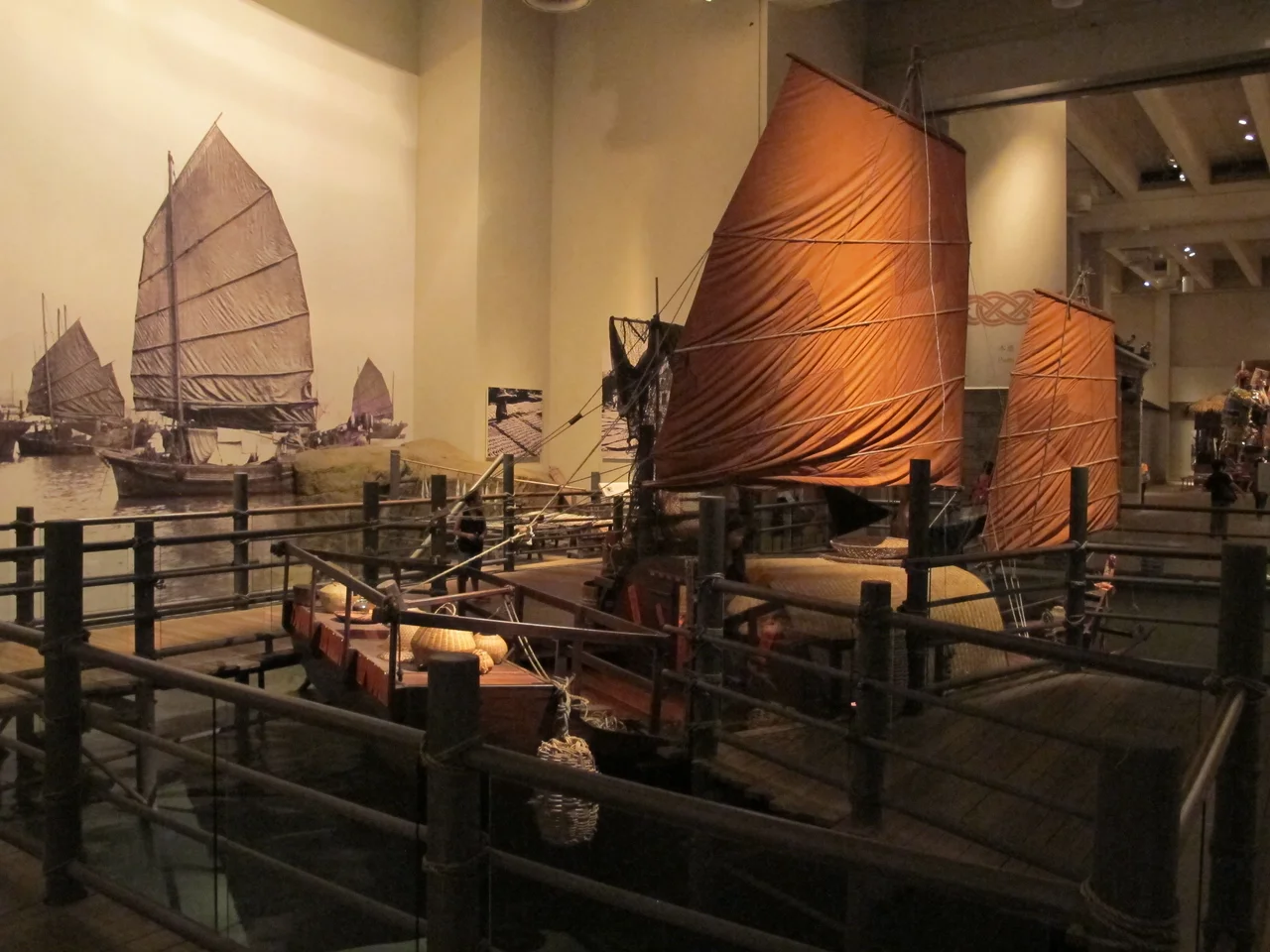
The Hong Kong Story, which opened on 30 August 2001, became the museum's signature achievement. Spread across two floors and eight galleries, it deployed more than 4,000 exhibits alongside 750 graphic panels, dioramas, and multimedia programmes to trace the territory from prehistoric formations through the colonial period to the 1997 Handover. Prehistoric fossils sat alongside 19th-century colonial documents and ancient Chinese pottery. The ambition was encyclopedic: natural environment, folk culture, historical development — all of it gathered into a single coherent narrative. After attracting more than 10 million visitors, the exhibition closed in late 2020 for a major renovation. The fully revamped Hong Kong Story reopened on 1 April 2026, expanded to 10 sections across the ground floor and now organised around four themes: Roots of Culture, East Meets West, Coalition against Japanese Aggression, and Hong Kong as a Global Metropolis.
A Network Across the Territory
The main museum in Tsim Sha Tsui is only part of the picture. The institution runs five branch museums scattered across Hong Kong, each focused on a distinct thread of the territory's history. The Hong Kong Museum of the War of Resistance and Coastal Defence occupies a Victorian-era fort in Shau Kei Wan. The Lei Cheng Uk Han Tomb Museum in Sham Shui Po protects a Han dynasty burial complex discovered during construction in 1955. The Law Uk Folk Museum in Chai Wan preserves a 200-year-old Hakka village house. The Fireboat Alexander Grantham Exhibition Gallery sits inside Quarry Bay Park. And the Dr. Sun Yat-sen Museum at Mid-Levels in Central traces the life of the revolutionary who studied medicine in Hong Kong and went on to found the Republic of China. Together, they form a distributed archive of Hong Kong's many pasts.
History Under Revision
Museums are never neutral institutions, and Hong Kong's political changes since 2019 have made that point unavoidable at this one. In 2024, the museum opened a separate National Security Exhibition Gallery focusing on the Chinese Communist Party and the Hong Kong national security law. The gallery frames the 2019 protests as the result of subversion by foreign powers, a characterisation that diverges sharply from how many participants and observers remember those events. High school students are now brought to visit. The permanent exhibition itself reopened in April 2026, reframed around themes of Chinese cultural roots — a new interpretive lens replacing the one that had guided the exhibition since 2001. What a museum chooses to display — and how it chooses to display it — is itself a kind of history in the making.
Crossing to Kowloon
The museum sits on the Kowloon side of Victoria Harbour, a short walk west from Hung Hom station or north from East Tsim Sha Tsui station on the MTR. Standing outside on Chatham Road South, the density of Hong Kong surrounds you: the harbour glittering to the south, the mass of Kowloon's commercial towers pressing in from every direction. It is an unlikely location for an institution devoted to deep time and layered history, but that contrast feels appropriate. Hong Kong has always done its remembering in the middle of its rushing forward.
From the Air
The Hong Kong Museum of History is located at 22.302°N, 114.177°E in Tsim Sha Tsui East, Kowloon. Approaching Hong Kong International Airport (VHHH) from the east, the Kowloon peninsula is visible to the north of Victoria Harbour. The museum area lies roughly 2.5 km northeast of the Tsim Sha Tsui Star Ferry terminal. Recommended viewing altitude: 3,000–5,000 ft for a clear look at the Kowloon grid and the harbour. The distinctive skyline of Hong Kong Island — including the ICC Tower at 484 m — provides orientation to the south.
Nearby Stories
- Lok Ma Chau Loop 2.3 km away
- Portas do Cerco 2.3 km away
- Kweilin Incident 17 km away
- Wanshan Archipelago Campaign 34 km away
- Nanxiong Formation 115 km away
- Battle of Nanpeng Island 148 km away
- Heyuan 169 km away
- Cape Maobitou 632 km away