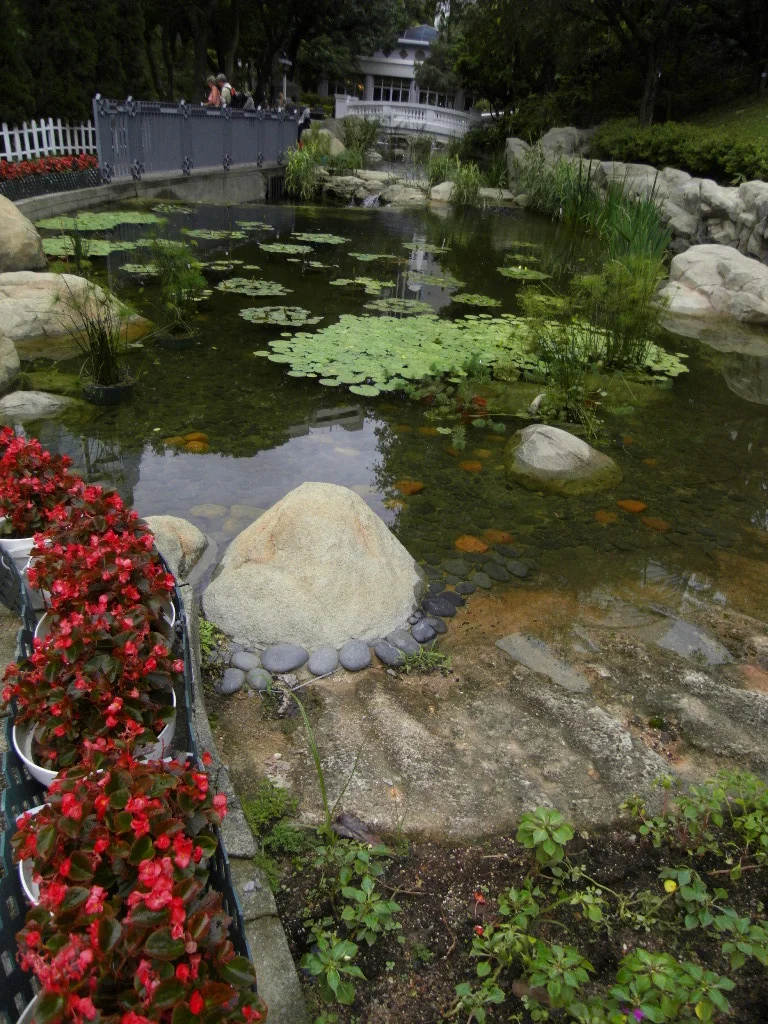

Hong Kong Park
The barracks came first. For over a century, the land in the middle of what is now Hong Kong's central business district belonged to Victoria Barracks, a sprawling British military installation built between 1867 and 1910. Soldiers drilled and slept where joggers now run and children watch birds. When the barracks were handed to the Hong Kong government in 1979, the question became what to do with one of the most valuable pieces of ground in Asia. The answer, eventually, was to do something unusual: to make it a park.
A Green Island in a Glass Sea
Hong Kong Park opened on 23 May 1991, inaugurated by Governor Sir David Wilson. Cost HK$398 million to build across 8 hectares, it sits in a canyon of towers — Pacific Place, the skyscrapers of Admiralty, the gleaming facades of Central pressing in from every side. Walking in from Cotton Tree Drive, the noise shifts. The city doesn't disappear — you can always see it, always hear it at the edges — but it recedes. Artificial streams thread between planted slopes. The geometry of the surrounding streets gives way to something softer. The park won the Honour Award for Urban Design from the American Institute of Architects' Hong Kong Chapter in 1998, and was named one of the top ten buildings of the 1990s by a Hong Kong building journal.
The Aviary at Its Centre
The Edward Youde Aviary is the park's signature feature and Hong Kong's largest. Named for a former Governor of Hong Kong, it encloses a section of forested hillside under a tensioned wire mesh canopy, creating a walk-through habitat where birds move freely through trees at eye level and above. Sunbirds, kingfishers, and Bali starlings move through the dense plantings. The Vantage Point provides an elevated view into the canopy. Nearby, the Forsgate Conservatory houses seasonal plant exhibitions — orchid shows, tropical species — in a greenhouse that catches light on both sides of the hill.
What the Barracks Left Behind
Not everything from the Victoria Barracks era was torn down. Several historic buildings were retained and repurposed, all now graded as Grade II Historic Buildings. Flagstaff House, built in 1846 as the residence of the Commander of British Forces, is the oldest surviving Western-style building in Hong Kong. Since 1984 it has housed the Flagstaff House Museum of Teaware, its colonial proportions now given over to the art of the Chinese tea ceremony. Cassels Block, former quarters for married British officers, became the Hong Kong Visual Arts Centre in 1992. Rawlinson House became the Cotton Tree Drive Marriage Registry — couples now exchange vows in what was once the British Deputy General's residence.
A Memorial in the Garden
Among the park's quieter corners stands a statue of an anonymous World War I soldier, drawn from the statuary collection of Eu Tong Sen, a prominent Straits Chinese merchant who donated it to the city. Alongside it, a bronze plaque commemorates the defenders of Hong Kong during December 1941, when Japanese forces attacked and the British garrison made its final stand. The plaque honors all who fought, with particular mention of John Robert Osborn, a Canadian warrant officer who threw himself on a grenade to save his comrades and was posthumously awarded the Victoria Cross. The park holds this memory quietly among its gardens.
From the Air
Hong Kong Park is located at 22.2772°N, 114.1615°E in the Central district of Hong Kong Island, nestled between the towers of Admiralty and Pacific Place. At 1,500 feet, the green canopy of the park is visible as a distinct patch of vegetation within the dense urban fabric below — the only sizable green space between the harbour and the Mid-Levels. Victoria Peak rises to the south, and Victoria Harbour lies to the north. The nearest airport is Hong Kong International (VHHH), approximately 22 nautical miles to the west-northwest.
Nearby Stories
- Lok Ma Chau Loop 2.3 km away
- Portas do Cerco 2.3 km away
- Kweilin Incident 17 km away
- Wanshan Archipelago Campaign 34 km away
- Nanxiong Formation 115 km away
- Battle of Nanpeng Island 148 km away
- Heyuan 169 km away
- Cape Maobitou 632 km away