
Hong Kong Police Museum
The tiger came down from the hills north of Sheung Shui in 1915 and killed two police officers — Indian Constable Ruttan Singh died at the scene; Constable Goucher died from his wounds days later. After the animal was shot, someone preserved its head. A century later, that head sits in a glass case at the Hong Kong Police Museum, staring out at visitors from the Orientation Gallery. It is not the most historically significant object in the building — that honor might go to the Plague Medal from 1894, awarded during one of Hong Kong's worst public health crises, or perhaps the original Green Coat uniform worn by Chinese constables in the colony's early years. But the tiger stops people cold. It makes the past feel immediate in a way that a photograph cannot.
A Station on the Hill
The museum occupies the former Wan Chai Gap Police Station at 27 Coombe Road, a building perched near the Peak on the southern face of Hong Kong Island. Police stations at altitude made sense in the colonial period — the Mid-Levels and the Peak were where the British administration lived, and a station at the Gap could monitor movement between the harbor-facing slopes and the southern reaches of the island. The station itself was decommissioned; the museum moved in during 1988, having previously occupied Police Headquarters and then a commercial building in Wan Chai. A revitalisation project that began in mid-2020 returned the museum to the public in September 2022 with a renewed presentation.
What the Galleries Hold
Following its 2022 revitalisation, the museum is organized around four galleries. The Orientation Gallery covers the general history of the Hong Kong Police Force — uniforms, equipment, firearms, photographs, archives. Among its most unusual holdings is memorabilia donated by the widow of former Commissioner of Police Duncan Macintosh, and a collection of counterfeit banknotes. The Serious Crime Gallery details Hong Kong's long struggle with drug trafficking and major criminal investigations, displaying paraphernalia alongside reconstructions of criminal operations. The Triad Society Gallery examines the history, structure, and rituals of Hong Kong's triad organizations — the secret societies that shaped the colony's criminal underworld for generations. A fourth Thematic Gallery rotates focused exhibitions on specific periods and topics in police history.
The Field Gun at the Door
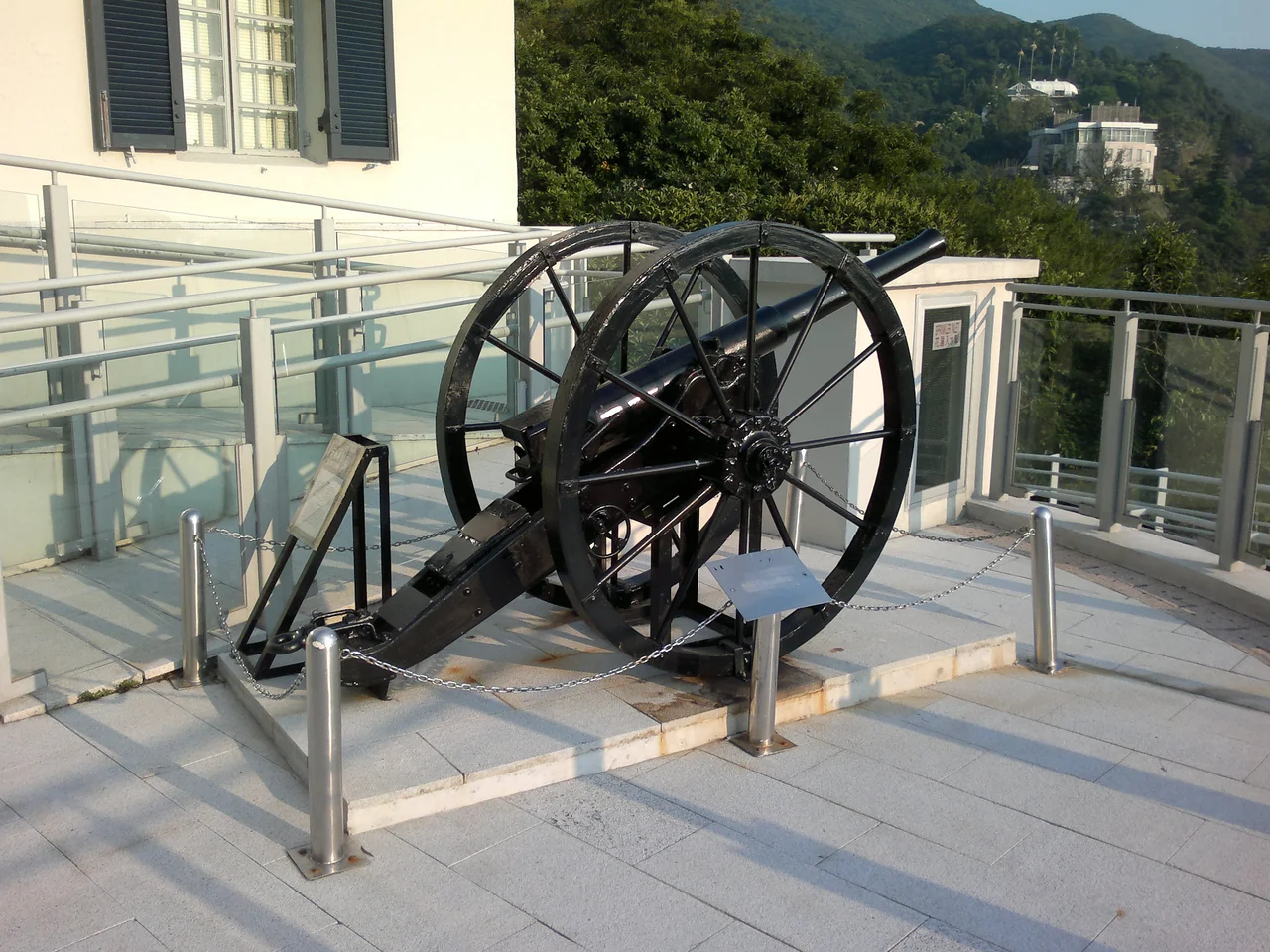
Before entering, visitors pass a field gun displayed at the museum's entrance. The gun guarded the Old Tai Po Police Station for 45 years. It is a 7.7 cm FK 96, a German field piece from the late 19th century, and there are only two surviving examples of this type in the world. How it came to guard a Hong Kong police station in the New Territories, and then to stand at the entrance to a museum on a hillside near the Peak, is itself a story that crosses continents and centuries. The museum does not explain every thread — but the object stands as proof that Hong Kong's history runs deeper and stranger than its colonial surface suggests.
The Committee That Started It
The museum traces its origins not to any government initiative but to a committee. In 1964 the Police Historical Records Committee was formed within the force itself, tasked with collecting artifacts relating to Hong Kong police history. Over the following years the committee assembled a significant collection. The proposal to create a museum came from the committee — a recognition that the objects deserved display, not just storage. The museum opened in limited form in 1976, housed initially within Police Headquarters. The move to the former Wan Chai Gap Station in 1988 gave it space and atmosphere: the building's own history added another layer to what the exhibits were already telling.
From the Air
The Hong Kong Police Museum is located at 22.2677°N, 114.1692°E near Wan Chai Gap on the southern slopes of Hong Kong Island, at approximately 250 metres elevation. Victoria Peak rises to the west-southwest, and the museum's hilltop position makes it visible from aircraft approaching from the south. Flying over Hong Kong Island at 3,000 feet, the area around the Gap is easily identified between the densely built northern slopes and the quieter residential areas on the island's southern side. Hong Kong International Airport (VHHH) lies approximately 22 nautical miles to the west on Lantau Island.
Nearby Stories
- Lok Ma Chau Loop 2.3 km away
- Portas do Cerco 2.3 km away
- Kweilin Incident 17 km away
- Wanshan Archipelago Campaign 34 km away
- Nanxiong Formation 115 km away
- Battle of Nanpeng Island 148 km away
- Heyuan 169 km away
- Cape Maobitou 632 km away